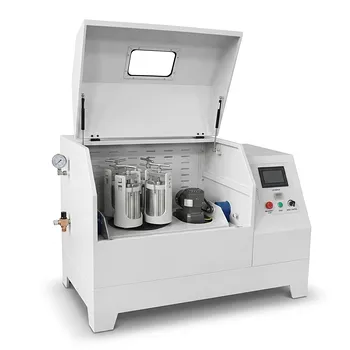
What role do high-energy ball mills play in the preparation of reinforcements for hybrid metal matrix composites?
Updated 4 months ago
High-energy ball mills are the primary catalyst for achieving microstructural homogeneity and particle refinement in hybrid metal matrix composites. They utilize intense mechanical forces—specifically impact, shear, and friction—to reduce coarse reinforcements like silicon carbide or coconut shell charcoal into micron or nanometer scales. This process ensures that disparate reinforcement phases are uniformly distributed and deeply embedded into the metal matrix, establishing the foundation for superior mechanical properties.
High-energy ball milling transforms bulk materials into refined, high-reactivity powders through a cycle of repeated fracturing and cold welding. This mechanical alloying process is essential for overcoming particle agglomeration and creating the strong interfacial bonding necessary for high-strength hybrid composites.
Mechanisms of Reinforcement Refinement
Particle Size Reduction to the Nano-Scale
High-energy ball mills utilize prolonged mechanical collisions, often lasting 50 to 60 hours, to crush coarse particles. This intensive processing can refine materials such as silicon carbide (SiC) and charcoal from bulk forms down to micron or even nanometer scales.
Increasing Specific Surface Area
As particles are fractured into smaller dimensions, their specific surface area increases exponentially. This expanded surface area provides more contact points for the aluminum or iron-based matrix, which fosters stronger interfacial bonding during the final stages of production.
Precise Control of Reinforcement Geometry
The mill's grinding media apply consistent impact forces that allow for precise particle size control. This predictability is vital for optimizing the final composite's tensile strength and hardness, as it prevents the stress concentrations associated with oversized particles.
Achieving Homogeneous Distribution in Hybrid Systems
De-agglomeration of Nano-Phases
Reinforcements like graphene nanosheets or boron nitride (BNNP) naturally tend to clump or agglomerate. High-energy milling uses high-frequency shearing actions to break these clusters apart, ensuring every particle is isolated and functional within the mix.
Uniform Embedding through Cold Welding
In a planetary ball mill, the counter-rotation of the jar and sun disk creates violent collisions that induce continuous fracturing and cold welding. This process physically anchors reinforcements, such as nano-boron carbide (nB4C), into the matrix powder particles rather than leaving them as loose surface contaminants.
Microstructural Foundation for Sintering
By achieving a uniform distribution of components at the powder stage, the mill establishes a high-quality microstructural foundation. This uniformity carries over into the subsequent compaction and sintering phases, resulting in a final bulk material with low porosity and consistent performance.
Facilitating Mechanical Alloying (MA)
Solid-State Alloying and Atomic Mixing
High-energy processing induces strong plastic deformation, which can lead to atomic-level mixing of the matrix metal and the reinforcements. This solid-state alloying creates a composite powder where the reinforcement is no longer just a separate phase but is integrated into the chemical structure of the matrix.
Enhancing Chemical Reactivity
The mechanical energy transferred during milling increases the reaction activity of the powder particles. This heightened state of energy makes the powders more responsive during thermal processing, which can improve the efficiency of the diffusion bonding process.
Understanding the Trade-offs and Limitations
Processing Time and Energy Consumption
Refining particles to the nanometer scale often requires extended milling times, sometimes exceeding 60 hours. This high energy demand can increase production costs and may lead to equipment wear if not managed correctly.
Risk of Powder Contamination
The intense friction between the grinding balls, the jar walls, and the powder can introduce impurities from the milling media. To maintain high purity, engineers must carefully select media materials—such as tungsten carbide or hardened steel—that match the composite's requirements.
Excessive Cold Welding
If the milling parameters are not optimized, the powders may undergo excessive cold welding, leading to the formation of large, unmanageable flakes. This typically requires the addition of a Process Control Agent (PCA), like stearic acid, to balance the fracturing and welding cycles.
How to Apply This to Your Project
Recommendations for Implementation
- If your primary focus is maximum tensile strength: Utilize extended milling times (50+ hours) to ensure reinforcements reach the nanometer scale for optimal interfacial bonding.
- If your primary focus is graphene-reinforced composites: Focus on high-frequency shearing actions to ensure the atomic-level mixing and de-agglomeration of the nanosheets.
- If your primary focus is reducing porosity: Use a planetary ball mill at high speeds (e.g., 600 rpm) to achieve a highly refined and uniform powder feedstock prior to hot pressing.
- If your primary focus is cold spray applications: Prioritize mechanical alloying to embed reinforcements directly into the matrix powder to create a robust composite feedstock.
By mastering the mechanical forces within a high-energy ball mill, you can engineer hybrid composites with a level of structural integrity that traditional mixing methods cannot achieve.
Summary Table:
| Key Role | Mechanism | Impact on Composite |
|---|---|---|
| Particle Refinement | Intensive impact & friction | Reduces reinforcements to micron/nano scales |
| Homogeneous Mixing | High-frequency shearing | Eliminates agglomeration of nano-phases (e.g. Graphene) |
| Mechanical Alloying | Repeated cold welding & fracturing | Enables atomic-level mixing and solid-state alloying |
| Interfacial Bonding | Increased specific surface area | Enhances chemical reactivity and matrix attachment |
| Structural Integrity | Uniform embedding | Minimizes porosity and prevents stress concentrations |
Elevate Your Material Research with Precision Engineering
At [Company Name], we provide complete laboratory sample preparation solutions tailored for advanced material science. Whether you are developing high-strength hybrid metal matrix composites or exploring novel powder metallurgy, our equipment is designed to ensure maximum microstructural integrity.
Our extensive product line includes:
- Advanced Milling: Planetary ball mills, jet mills, and cryogenic grinders for nano-scale refinement.
- Crushing & Sizing: Jaw/roll crushers and vibratory/air-jet sieve shakers for precise feedstock control.
- Compaction & Sintering: A full spectrum of hydraulic presses, including Cold/Warm Isostatic Presses (CIP/WIP), vacuum hot presses, and XRF pellet presses.
- Mixing Solutions: High-efficiency powder mixers and defoaming mixers for perfect homogeneity.
Ready to optimize your powder processing workflow? Contact our technical experts today to find the perfect solution for your lab’s specific needs.
References
- Nwigbo M.N., Ukaru Y.N.. Comparative Study of Tensile Properties of Hybrid AA6061/SIC/Carbonized Coconut Shell Micro and Nano Composites. DOI: 10.52589/ijmce-yemppwep
Mentioned Products
- High Energy Planetary Ball Mill for Nano Scale Grinding and Mechanical Alloying
- High Energy Hybrid Vibratory Ball Mill for Grinding Mixing and Cell Disruption
- High Energy Laboratory Planetary Ball Mill for Nano Grinding and Material Science Sample Preparation
- High Energy Planetary Ball Mill for Nano Scale Grinding and Colloidal Mixing in Material Science Research
- High Energy Omnidirectional Planetary Ball Mill 16L
People Also Ask
- Why is a high-energy planetary ball mill used for nano-milling As4Se3? Achieve Expert Structural Transformation
- What role do high-energy planetary ball mills play in FDM composite filament preparation? Optimize Material Performance
- What is the role of a high-energy planetary ball mill in the exfoliation of modified WSe2? Achieve Nano-Precision
- What is the function of a planetary ball mill in glass-ceramic sintering? Optimize Reactivity and Uniformity
- What is the role of a high-energy planetary ball mill in the preparation of high-performance nano-ceramics? Key Guide

Tech Team · PowderPreparation
Last updated on Jun 03, 2026
Related Products

High Energy Planetary Ball Mill for Nano Scale Grinding and Mechanical Alloying

High Energy Hybrid Vibratory Ball Mill for Grinding Mixing and Cell Disruption

High Energy Laboratory Planetary Ball Mill for Nano Grinding and Material Science Sample Preparation
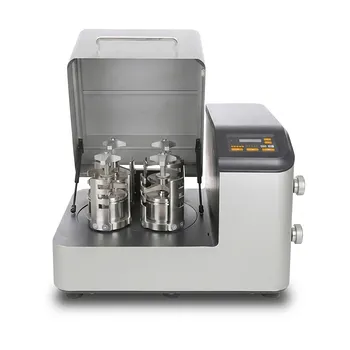
High Energy Planetary Ball Mill for Nano Scale Grinding and Colloidal Mixing in Material Science Research
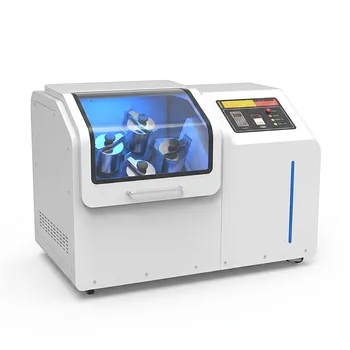
High Energy Omnidirectional Planetary Ball Mill 16L

Laboratory Nano High Energy Ball Mill Ultrafine Grinding Mechanical Alloying

Nano High Energy Vibratory Ball Mill with Heating and Temperature Control

Ultra-Low Temperature Cryogenic High-Energy Vibratory Ball Mill
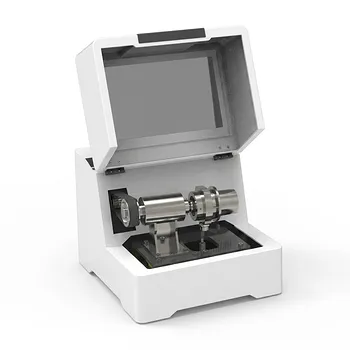
Single Tank High Energy Vibratory Ball Mill for Laboratory Grinding and Mixing

High Energy Omnidirectional Planetary Ball Mill 20L

High Energy Laboratory Planetary Ball Mill for Nano Grinding and Colloidal Mixing of Hard and Brittle Materials

Dual Jar High Energy Vibratory Ball Mill

Nanoscale High-Energy Vibratory Ball Mill for Laboratory Sample Preparation, Mechanochemistry, and Mechanical Alloying

Multi-Platform Nanoscale High-Energy Vibratory Ball Mill

Nano High Energy Vibratory Ball Mill for Laboratory Sample Preparation

Heating Temperature Controlled High Energy Vibratory Ball Mill

Vertical Square Planetary Ball Mill for Laboratory Sample Preparation and Nanoscale Grinding

8L Planetary Ball Mill for Laboratory Grinding and Sample Preparation
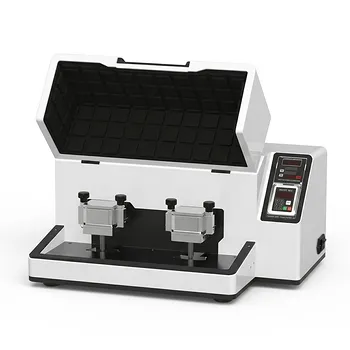
Nanoscale High Energy Vibratory Ball Mill Low Temperature