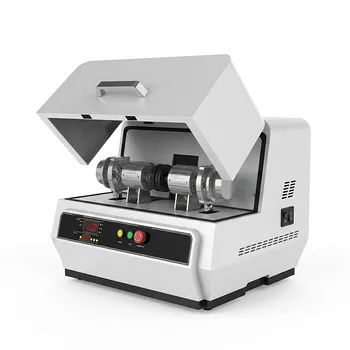
What role does a high-energy planetary ball mill play in magnesium-based hydrogen storage alloy preparation?
Updated 5 months ago
A high-energy planetary ball mill serves as the primary engine for mechanical alloying and microstructural activation in magnesium-based systems. By utilizing high-speed rotation to generate intense impact and shear forces, the mill facilitates the atomic-level mixing of magnesium with elements like nickel, aluminum, vanadium, and iron. This process is essential for transforming raw powders into specialized alloys that can effectively capture and release hydrogen.
High-energy ball milling overcomes the kinetic limitations of magnesium by inducing extreme plastic deformation and grain refinement. This creates a high-surface-area, nanostructured material with dense lattice defects that act as rapid transport channels for hydrogen atoms.
The Mechanism of Mechanical Alloying
Atomic-Level Synthesis
The planetary ball mill enables the synthesis of multi-component alloys without the need for high-temperature melting. Through continuous cycles of fracturing and cold welding, different metal powders are pressed together until they achieve a homogenous, atomic-level distribution.
Integrating Catalysts and Additives
The mill ensures the uniform loading of catalysts, such as iron seeds or Ni/MnOx, onto the magnesium matrix. This mechanical dispersion is critical for creating a highly active precursor environment, which is necessary for the subsequent formation of complex hydrides like Mg2FeH6.
Microstructural Transformation and Refinement
Nanoscale Grain Reduction
High-frequency impacts and shearing forces significantly refine alloy grains to the nanometer scale, often reaching sizes between 25 and 45 nm. This reduction in grain size creates a vast network of grain boundaries, which serve as high-speed "highways" for hydrogen diffusion.
Inducing Lattice Defects and Strains
The intense plastic deformation introduces high densities of dislocations, lattice defects, and internal strains. These structural irregularities lower the energy barrier for hydrogen nucleation, effectively reducing the temperature required for the alloy to release stored hydrogen.
Surface Activation and Kinetic Enhancement
Destruction of the Oxide Layer
Magnesium naturally forms a stable oxide layer that blocks hydrogen absorption. The high-energy friction and impact within the mill destroy this oxide layer, exposing fresh metallic surfaces that are highly reactive.
Increasing Specific Surface Area
By breaking down bulk particles into fine powders, the mill increases the specific surface area of the material. This provides more active sites for hydrogen dissociation and significantly shortens the diffusion distance that hydrogen atoms must travel to reach the interior of the particle.
Understanding the Trade-offs
Heat Management and Phase Changes
The high energy levels required for alloying generate significant heat within the milling vial. If not carefully managed through cooling cycles, this heat can lead to unwanted phase transformations or the sintering of powders, which reverses the benefits of grain refinement.
Potential for Contamination
The aggressive nature of high-energy milling can cause wear and tear on the milling media (balls and vials). Small amounts of material from the stainless steel or tungsten carbide components can contaminate the alloy, potentially altering its hydrogen storage capacity or cycle life.
How to Apply This to Your Project
Optimizing Your Milling Strategy
- If your primary focus is reducing dehydrogenation temperature: Prioritize longer milling times or higher speeds to maximize the density of lattice defects and grain boundaries.
- If your primary focus is achieving high purity: Use vials and balls made of the same material as your primary alloy component or high-hardness ceramics to minimize contamination.
- If your primary focus is catalyst efficiency: Ensure the catalyst is added during a secondary, shorter milling stage to prevent it from being buried too deeply within the magnesium matrix.
High-energy planetary ball milling is the definitive tool for engineering the complex microstructures required to make magnesium a viable medium for hydrogen storage.
Summary Table:
| Mechanism | Impact on Microstructure | Benefit to Hydrogen Storage |
|---|---|---|
| Mechanical Alloying | Atomic-level mixing of Mg, Ni, Fe, etc. | Synthesis of complex multi-component alloys |
| Grain Refinement | Reduction to nanoscale (25–45 nm) | Creates rapid diffusion channels for H2 atoms |
| Lattice Defects | High density of dislocations and strains | Lowers energy barriers for hydrogen release |
| Surface Activation | Removal of stable oxide layers | Increases reactive sites and absorption speed |
Elevate Your Material Research with Precision Powder Processing
Are you looking to optimize the kinetics and capacity of your hydrogen storage alloys? At [Company Name], we provide complete laboratory sample preparation solutions for material science, specializing in advanced powder processing and compaction equipment.
From achieving nanoscale grain refinement with our High-Energy Planetary Ball Mills to final pelletizing with our Hydraulic Presses (CIP/WIP/Hot Presses), we offer the tools you need for groundbreaking synthesis. Our extensive line also includes:
- Advanced Milling: Jet mills, sand/bead mills, and cryogenic grinders.
- Sieving & Mixing: Vibratory sieve shakers and high-efficiency defoaming mixers.
- Sample Compaction: Standard lab presses, XRF pellet presses, and vacuum hot presses.
Ready to refine your alloying process? Contact our technical experts today to find the perfect equipment configuration for your lab’s specific needs.
References
- E. Grigorova, П. В. Марков. Electrochemical and Gas-Solid Hydrogen Storage Properties of a Multi-Metal Magnesium-Based Alloy Obtained by Ball Milling. DOI: 10.3390/inorganics13090299
Mentioned Products
- High Energy Planetary Ball Mill for Nano Scale Grinding and Mechanical Alloying
- High Energy Omnidirectional Planetary Ball Mill 16L
- High Energy Laboratory Planetary Ball Mill for Nano Grinding and Colloidal Mixing of Hard and Brittle Materials
- High Energy Planetary Ball Mill for Nano Scale Grinding and Colloidal Mixing in Material Science Research
- High Energy Omnidirectional Planetary Ball Mill 20L
People Also Ask
- Why is a high-energy planetary ball mill used for nano-milling As4Se3? Achieve Expert Structural Transformation
- What role do high-energy planetary ball mills play in FDM composite filament preparation? Optimize Material Performance
- What is the role of a high-energy planetary ball mill in the exfoliation of modified WSe2? Achieve Nano-Precision
- What is the function of a planetary ball mill in glass-ceramic sintering? Optimize Reactivity and Uniformity
- What is the role of a high-energy planetary ball mill in the preparation of high-performance nano-ceramics? Key Guide

Tech Team · PowderPreparation
Last updated on May 14, 2026
Related Products

High Energy Planetary Ball Mill for Nano Scale Grinding and Mechanical Alloying
High Energy Omnidirectional Planetary Ball Mill 16L

High Energy Laboratory Planetary Ball Mill for Nano Grinding and Colloidal Mixing of Hard and Brittle Materials
High Energy Planetary Ball Mill for Nano Scale Grinding and Colloidal Mixing in Material Science Research
High Energy Omnidirectional Planetary Ball Mill 20L

High Energy Laboratory Planetary Ball Mill for Nano Grinding and Material Science Sample Preparation

8L Planetary Ball Mill for Laboratory Grinding and Sample Preparation

Vertical Square Planetary Ball Mill for Laboratory Sample Preparation and Nanoscale Grinding

Miniature Planetary Ball Mill with Vacuum Grinding and High Efficiency for Laboratory Sample Preparation
Planetary Ball Mill 12L
Vertical Production Planetary Ball Mill for High Throughput Powder Processing

Dual Station Planetary Ball Mill 24L

Multi-Platform Nanoscale High-Energy Vibratory Ball Mill

High Energy Hybrid Vibratory Ball Mill for Grinding Mixing and Cell Disruption
Laboratory Nano High Energy Ball Mill Ultrafine Grinding Mechanical Alloying

Nano High Energy Vibratory Ball Mill with Heating and Temperature Control
Heavy Duty Horizontal Planetary Ball Mill for Efficient Industrial Grinding and Sample Preparation

Nanoscale High-Energy Vibratory Ball Mill for Laboratory Sample Preparation, Mechanochemistry, and Mechanical Alloying

Nano High Energy Vibratory Ball Mill for Laboratory Sample Preparation