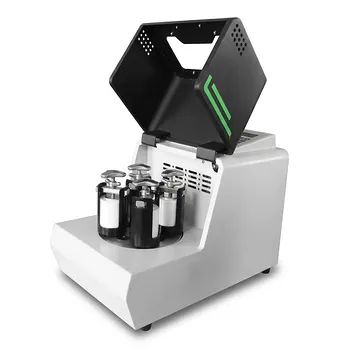
What is the primary role of high-energy ball milling in Li2-xZr1-xNbxCl6 synthesis? Achieve High Ionic Conductivity
Updated 3 months ago
In the synthesis of $Li_{2-x}Zr_{1-x}Nb_xCl_6$ halide electrolytes, the primary role of high-energy ball milling is to act as a mechanochemical driver that converts mechanical energy into chemical reactivity. This process utilizes high-speed rotation to generate intense impact and shear forces, which trigger a solid-phase reaction between precursors (LiCl, $ZrCl_4$, and $NbCl_5$) at the atomic level. By facilitating the integration of $Nb^{5+}$ into the crystal lattice, ball milling induces critical structural changes that significantly enhance the material's ionic conductivity.
Core Takeaway: High-energy ball milling is the essential mechanism for achieving atomic-scale homogeneity and effective niobium doping, which optimizes the electrolyte’s lattice structure and ion migration pathways for superior performance.
Driving the Mechanochemical Reaction
Conversion of Kinetic Energy to Chemical Work
High-energy ball milling utilizes the powerful impact and shear forces generated by high rotational speeds to break down the crystal structures of raw materials. This mechanical energy input promotes ion diffusion and reorganization at the atomic scale, often allowing reactions to occur that would otherwise require high-temperature thermal treatment.
Achieving Atomic-Level Homogeneity
Unlike standard mixing, high-energy milling ensures that lithium, zirconium, and niobium species are distributed uniformly at the atomic level. This deep mixing is critical for halide electrolytes, as it prevents the formation of localized secondary phases that could impede lithium-ion transport.
Lowering Activation Energy
By repeatedly fracturing and re-welding particles, the process increases the surface energy and reactive activity of the powder. This reduces the activation energy required for the solid-phase reaction, facilitating the formation of the target $Li_{2-x}Zr_{1-x}Nb_xCl_6$ compound.
Structural Optimization through Doping
Facilitating Effective $Nb^{5+}$ Doping
The milling process is the primary vehicle for effective niobium ($Nb^{5+}$) doping into the zirconium lattice sites. The intense mechanical forces drive the substitution of $Zr^{4+}$ with $Nb^{5+}$, a modification that is difficult to achieve through simple diffusion.
Inducing Lattice Contraction
A critical result of the mechanochemical synthesis is the lattice contraction induced by the doping process. This contraction alters the internal geometry of the crystal, creating more favorable environments for ion movement.
Optimizing Ion Migration Paths
By restructuring the lattice, the milling process optimizes ion migration paths, directly addressing the deep need for lower resistance to lithium-ion flow. This structural refinement is what transforms a standard precursor mix into a superionic conductor.
Understanding the Trade-offs and Pitfalls
Amorphization vs. Crystallinity
Extended milling can lead to excessive amorphization, where the long-range crystalline order is lost. While amorphous phases can sometimes enhance conductivity in sulfides, in certain halides, maintaining a specific crystalline framework is necessary for peak performance.
Contamination Risks
The high-energy nature of the process subjects the milling media and jars to significant wear. This can introduce impurities (such as alumina or zirconia) into the electrolyte, which may degrade electrochemical stability or decrease the purity of the final product.
Scalability and Heat Generation
High rotational speeds (e.g., 600 rpm) generate significant frictional heat, which can lead to unintended side reactions or phase transformations. Scaling this process from laboratory planetary mills to industrial volumes requires careful management of thermal loads and energy consumption.
Applying This to Your Synthesis Goals
Recommendations for Material Development
- If your primary focus is maximizing ionic conductivity: Prioritize optimizing the milling duration and speed to ensure complete $Nb^{5+}$ doping and lattice optimization without inducing excessive structural disorder.
- If your primary focus is phase purity: Carefully select milling media (e.g., zirconia) and monitor the mill’s temperature to prevent the introduction of contaminants and secondary phase formation.
- If your primary focus is rapid synthesis: Utilize higher rotational speeds to accelerate the mechanochemical bond breaking and recombination, potentially enabling the direct synthesis of the superionic phase at room temperature.
By mastering the mechanochemical forces of high-energy ball milling, researchers can precisely tune the atomic architecture of $Li_{2-x}Zr_{1-x}Nb_xCl_6$ to meet the demanding requirements of next-generation solid-state batteries.
Summary Table:
| Key Role | Mechanical Mechanism | Impact on Material Performance |
|---|---|---|
| Mechanochemical Driver | Kinetic energy to chemical work | Triggers solid-phase reactions between precursors |
| Atomic Homogenization | Intense impact and shear forces | Ensures uniform Li, Zr, and Nb distribution |
| Structural Doping | Nb5+ lattice substitution | Induces lattice contraction for better ion flow |
| Surface Activation | Particle fracturing/re-welding | Lowers activation energy for rapid synthesis |
| Phase Optimization | Energy-controlled synthesis | Creates superionic conduction pathways |
Elevate Your Battery Material Synthesis with Precision Equipment
To achieve the atomic-scale homogeneity required for high-performance $Li_{2-x}Zr_{1-x}Nb_xCl_6$ electrolytes, you need equipment that delivers consistent, high-energy mechanochemical forces. We provide complete laboratory sample preparation solutions for material science, specializing in the powder processing and compaction tools essential for solid-state battery research.
Our value to your laboratory includes:
- Advanced Milling Solutions: Optimize your mechanochemical reactions with our planetary ball mills, jet mills, and liquid nitrogen cryogenic grinders designed for contamination-free processing.
- Superior Powder Processing: Achieve perfect consistency with our vibratory sieve shakers and high-performance powder mixers.
- High-Density Compaction: Ensure optimal electrolyte-electrode contact using our full spectrum of hydraulic presses, including Cold/Warm Isostatic Presses (CIP/WIP), vacuum hot presses, and standard lab presses.
Ready to maximize your material's ionic conductivity and structural purity?
Contact our technical experts today to find your solution!
References
- Wanqing Ren, Li‐Zhen Fan. Promoting Ion Conduction and Li Metal Compatibility Through Nb <sup>5+</sup> ‐Substituted Zirconium‐Based Chlorides for All‐Solid‐State Batteries. DOI: 10.1002/idm2.70022
Mentioned Products
- High Energy Planetary Ball Mill for Nano Scale Grinding and Mechanical Alloying
- High Energy Hybrid Vibratory Ball Mill for Grinding Mixing and Cell Disruption
- High Energy Laboratory Planetary Ball Mill for Nano Grinding and Material Science Sample Preparation
- High Energy Omnidirectional Planetary Ball Mill 16L
- Ultra-Low Temperature Cryogenic High-Energy Vibratory Ball Mill
People Also Ask
- Why is a high-energy planetary ball mill used for nano-milling As4Se3? Achieve Expert Structural Transformation
- What role do high-energy planetary ball mills play in FDM composite filament preparation? Optimize Material Performance
- What is the role of a high-energy planetary ball mill in the exfoliation of modified WSe2? Achieve Nano-Precision
- What is the function of a planetary ball mill in glass-ceramic sintering? Optimize Reactivity and Uniformity
- What is the role of a high-energy planetary ball mill in the preparation of high-performance nano-ceramics? Key Guide

Tech Team · PowderPreparation
Last updated on Jun 03, 2026
Related Products
High Energy Planetary Ball Mill for Nano Scale Grinding and Mechanical Alloying

High Energy Hybrid Vibratory Ball Mill for Grinding Mixing and Cell Disruption

High Energy Laboratory Planetary Ball Mill for Nano Grinding and Material Science Sample Preparation
High Energy Omnidirectional Planetary Ball Mill 16L
Ultra-Low Temperature Cryogenic High-Energy Vibratory Ball Mill
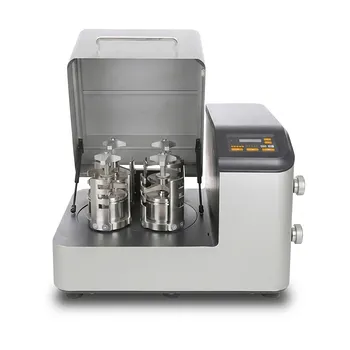
High Energy Planetary Ball Mill for Nano Scale Grinding and Colloidal Mixing in Material Science Research

Nano High Energy Vibratory Ball Mill with Heating and Temperature Control
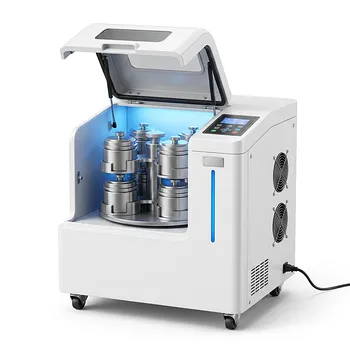
High Energy Omnidirectional Planetary Ball Mill 20L
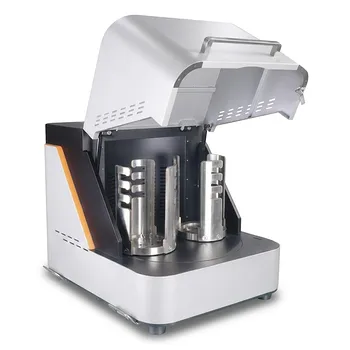
High Energy Laboratory Planetary Ball Mill for Nano Grinding and Colloidal Mixing of Hard and Brittle Materials
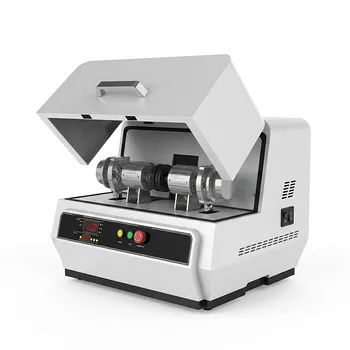
Dual Jar High Energy Vibratory Ball Mill

Multi-Platform Nanoscale High-Energy Vibratory Ball Mill
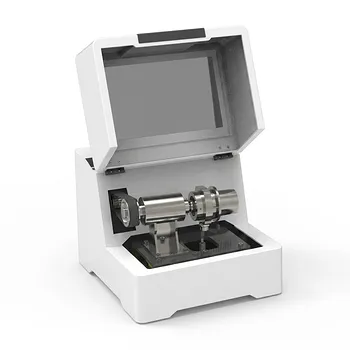
Single Tank High Energy Vibratory Ball Mill for Laboratory Grinding and Mixing
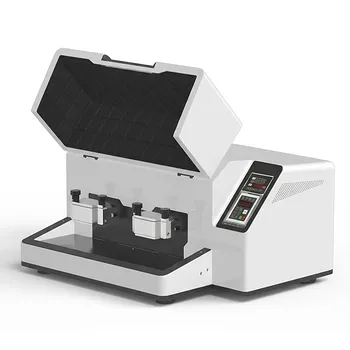
Nanoscale High-Energy Vibratory Ball Mill for Laboratory Sample Preparation, Mechanochemistry, and Mechanical Alloying
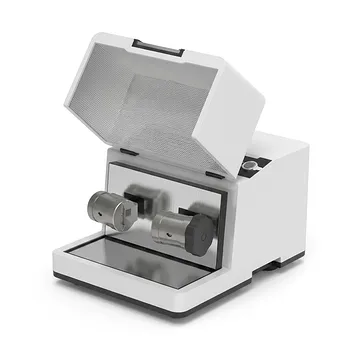
Heating Temperature Controlled High Energy Vibratory Ball Mill

Nano High Energy Vibratory Ball Mill for Laboratory Sample Preparation
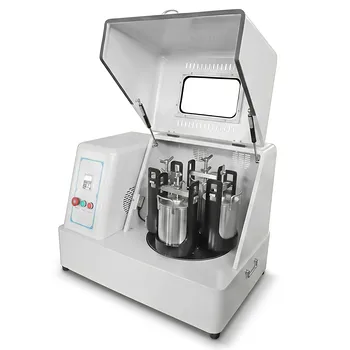
Vertical Square Planetary Ball Mill for Laboratory Sample Preparation and Nanoscale Grinding
Nanoscale High Energy Vibratory Ball Mill Low Temperature

8L Planetary Ball Mill for Laboratory Grinding and Sample Preparation
Dual Station Planetary Ball Mill 24L