Why is a high-energy planetary ball mill used for nano-milling As4Se3? Achieve Expert Structural Transformation
Updated 3 months ago
High-energy planetary ball milling is the preferred method for the nano-milling of arsenic selenide ($\text{As}_4\text{Se}_3$) because it provides the intense mechanical energy required to trigger mechanochemical transformations. Unlike traditional grinding, this process goes beyond simple size reduction; it utilizes high-speed impact and shear forces to break down the material’s internal cage-like molecular structures and redistribute them into a continuous, nanostructured polymeric network. This enables the synthesis of specific amorphous phases and nanostructures that are often impossible to achieve through conventional thermal melt-quenching methods.
Core Takeaway: The high-energy planetary ball mill acts as a mechanochemical reactor that uses intense physical force to drive the structural evolution of $\text{As}_4\text{Se}_3$ from a molecular glass to a re-amorphized, nanostructured polymeric network.
The Mechanics of High-Energy Transfer
Impact and Shear Force Generation
A planetary ball mill operates through the simultaneous rotation and revolution of grinding jars, creating powerful centrifugal forces. These forces accelerate the grinding media (balls) to high speeds, resulting in high-frequency, high-intensity impacts against the material. These collisions provide the localized energy necessary to overcome the chemical bond energies within the $\text{As}_4\text{Se}_3$ crystals.
Centrifugal Dynamics
The "planetary" motion ensures that the grinding balls move in complex trajectories, maximizing attrition and shear. This constant mechanical action is the core driver for solid-state amorphization, ensuring the powder is refined uniformly. This high-energy input is essential for shifting the material’s state without requiring the high temperatures that might lead to unwanted phase changes or degradation.
Driving Structural Transformation
From Molecular Cages to Polymeric Networks
Initial arsenic selenide glass often consists of discrete, cage-like $\text{As}_4\text{Se}_3$ molecules. The high-energy milling process facilitates mechanical activation, which breaks these cages apart at the molecular level. Once the cages are disrupted, the arsenic and selenium atoms are encouraged to repolymerize into a three-dimensional, continuous chain-like network.
Nanostructuring and Re-amorphization
The process induces nanostructuring, where the material is refined into particles typically smaller than 100 nanometers. This transition to a "network-like" structure results in re-amorphization, creating a material with high reactivity and a large specific surface area. This structural shift is critical for the development of high-performance chalcogenide glasses and composites.
Advantages of the Planetary System
Achieving Molecular Uniformity
High-energy milling ensures that different chemical components are mixed at a molecular level. This degree of uniformity is vital when preparing arsenic selenide for use in advanced ceramics or composites, where even minor inconsistencies can compromise the material's properties. It establishes a foundation for high-density sintering and tightly bonded composite structures.
Contamination Control with Specialized Media
To maintain the purity of the $\text{As}_4\text{Se}_3$ glass alloys, high-density materials like tungsten carbide are often used for the grinding media. Tungsten carbide provides exceptional hardness and wear resistance, which minimizes contamination from the balls themselves during the high-energy process. This ensures that the resulting nanopowders maintain their intended chemical integrity.
Understanding the Trade-offs
Thermal Management Challenges
The primary trade-off in high-energy milling is the generation of heat. The same friction and impact forces that drive mechanochemistry can cause a significant temperature rise within the grinding jar. If not managed—often through an argon protective atmosphere or intermittent milling cycles—this heat can lead to unwanted crystallization or oxidation of the selenium components.
Energy Consumption and Wear
High-energy planetary mills require significant power to maintain high-speed rotation over long durations. Furthermore, the intense forces place extreme mechanical stress on the equipment, leading to higher maintenance requirements compared to low-energy alternatives. Users must balance the need for rapid nanostructuring with the operational costs and potential for equipment fatigue.
How to Apply This to Your Project
When utilizing a high-energy planetary ball mill for arsenic selenide treatment, your approach should vary based on the desired end-state of the material.
- If your primary focus is nanostructure refinement: Optimize for high rotation speeds and use high-density media like tungsten carbide to achieve particle sizes below 100 nm quickly.
- If your primary focus is phase transformation (Re-amorphization): Focus on the duration of milling and energy dose to ensure sufficient mechanical activation for the cage-to-network transition.
- If your primary focus is material purity: Utilize an inert gas environment (such as Argon) and prioritize media with high wear resistance to prevent the introduction of impurities.
By leveraging the unique mechanochemical capabilities of the high-energy planetary ball mill, researchers can unlock new structural phases in arsenic selenide that define the next generation of nanostructured materials.
Summary Table:
| Key Feature | Impact on Arsenic Selenide (As4Se3) |
|---|---|
| Energy Transfer | High-intensity impact/shear breaks molecular cage structures |
| Structural Shift | Converts molecular glass into a nanostructured polymeric network |
| Particle Size | Achieves uniform refinement to sub-100nm dimensions |
| Amorphization | Enables solid-state amorphization impossible via thermal methods |
| Purity Control | High-density media (Tungsten Carbide) prevents contamination |
Elevate Your Material Research with Precision Engineering
At [Our Brand], we provide complete laboratory sample preparation solutions for material science, specializing in the equipment needed to master challenging materials like arsenic selenide. Our high-energy planetary ball mills, jet mills, and cryogenic grinders are designed to deliver the intense mechanochemical energy required for superior nanostructuring and molecular uniformity.
Beyond milling, we offer a comprehensive suite of powder processing tools, including:
- Crushing & Sizing: Jaw/roll crushers and vibratory/air-jet sieve shakers.
- Mixing: High-efficiency powder and defoaming mixers.
- Compaction: A full spectrum of hydraulic presses, including Cold/Warm Isostatic Presses (CIP/WIP), standard lab presses, XRF pellet presses, and vacuum hot presses.
Whether you are focusing on phase transformation, high-density sintering, or nanostructure refinement, our equipment ensures reliable and repeatable results. Contact us today to find your solution and take the next step in advanced material development!
References
- O. Shpotyuk, A. Kovalskiy. Molecular-Network Transformations in Tetra-Arsenic Triselenide Glassy Alloys Tuned within Nanomilling Platform. DOI: 10.3390/molecules29143245
Mentioned Products
- High Energy Planetary Ball Mill for Nano Scale Grinding and Mechanical Alloying
- High Energy Planetary Ball Mill for Nano Scale Grinding and Colloidal Mixing in Material Science Research
- High Energy Omnidirectional Planetary Ball Mill 16L
- High Energy Laboratory Planetary Ball Mill for Nano Grinding and Material Science Sample Preparation
- High Energy Laboratory Planetary Ball Mill for Nano Grinding and Colloidal Mixing of Hard and Brittle Materials
People Also Ask
- What role do high-energy planetary ball mills play in FDM composite filament preparation? Optimize Material Performance
- What is the role of a high-energy planetary ball mill in the exfoliation of modified WSe2? Achieve Nano-Precision
- What is the function of a planetary ball mill in glass-ceramic sintering? Optimize Reactivity and Uniformity
- What is the role of a high-energy planetary ball mill in the preparation of high-performance nano-ceramics? Key Guide
- What is the role of the high-energy planetary ball mill in HfB2-SiC prep? Achieve Homogeneity & Mechanical Activation

Tech Team · PowderPreparation
Last updated on Jun 03, 2026
Related Products

High Energy Planetary Ball Mill for Nano Scale Grinding and Mechanical Alloying
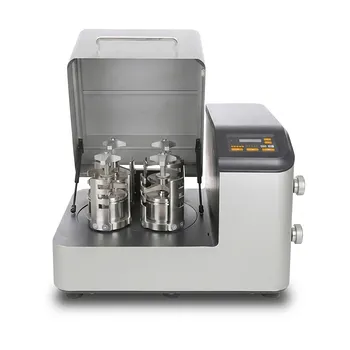
High Energy Planetary Ball Mill for Nano Scale Grinding and Colloidal Mixing in Material Science Research
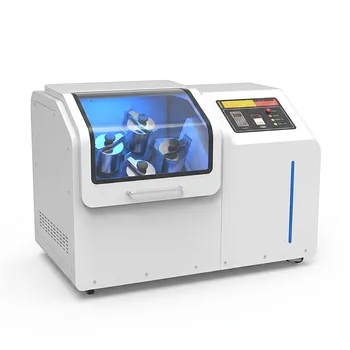
High Energy Omnidirectional Planetary Ball Mill 16L

High Energy Laboratory Planetary Ball Mill for Nano Grinding and Material Science Sample Preparation

High Energy Laboratory Planetary Ball Mill for Nano Grinding and Colloidal Mixing of Hard and Brittle Materials

High Energy Omnidirectional Planetary Ball Mill 20L

8L Planetary Ball Mill for Laboratory Grinding and Sample Preparation

Vertical Square Planetary Ball Mill for Laboratory Sample Preparation and Nanoscale Grinding
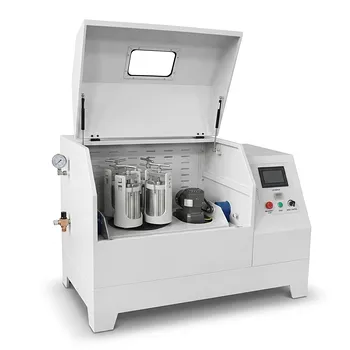
Vertical Production Planetary Ball Mill for High Throughput Powder Processing

Miniature Planetary Ball Mill with Vacuum Grinding and High Efficiency for Laboratory Sample Preparation
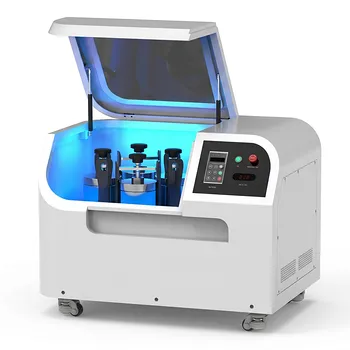
Planetary Ball Mill 12L
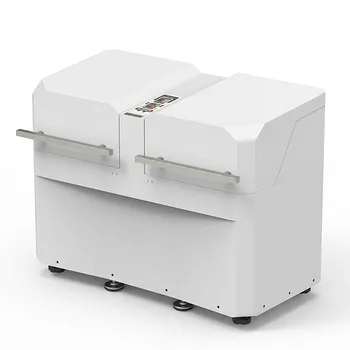
Dual Station Planetary Ball Mill 24L
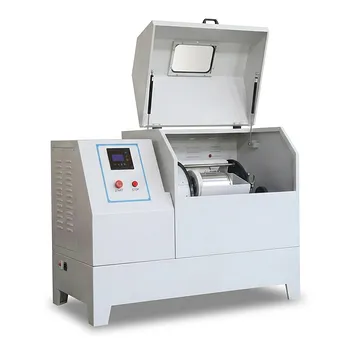
Heavy Duty Horizontal Planetary Ball Mill for Efficient Industrial Grinding and Sample Preparation
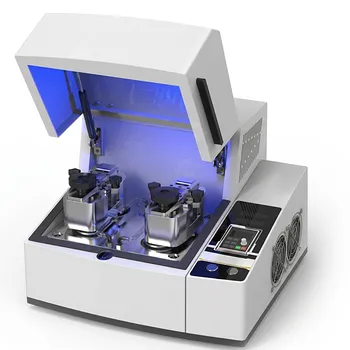
Laboratory Nano High Energy Ball Mill Ultrafine Grinding Mechanical Alloying

Multi-Platform Nanoscale High-Energy Vibratory Ball Mill

High Energy Hybrid Vibratory Ball Mill for Grinding Mixing and Cell Disruption

Nano High Energy Vibratory Ball Mill for Laboratory Sample Preparation
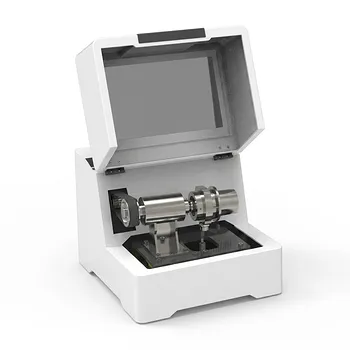
Single Tank High Energy Vibratory Ball Mill for Laboratory Grinding and Mixing

Nanoscale High-Energy Vibratory Ball Mill for Laboratory Sample Preparation, Mechanochemistry, and Mechanical Alloying