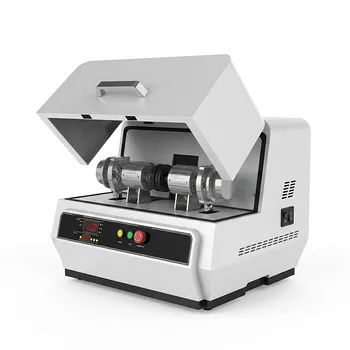
What role do high-energy planetary ball mills play in MgH2 modification? Enhance hydrogen storage via nanostructuring.
Updated 3 months ago
High-energy planetary ball mills function as the primary engine for mechanical activation and nanostructuring in the preparation of magnesium hydride ($MgH_2$) storage materials. By utilizing high-speed rotation to generate intense impact, shear, and friction forces, these mills refine $MgH_2$ powder to the nanoscale and introduce critical lattice defects. This process transforms the material's microstructure, directly overcoming the inherent kinetic limitations that typically hinder magnesium-based hydrogen storage.
Core Takeaway: High-energy planetary ball milling is essential for converting $MgH_2$ into a viable storage medium by simultaneously reducing particle size, introducing high-activity diffusion channels, and ensuring the atomic-level distribution of catalysts.
Nanostructuring and Grain Refinement
High-energy ball milling utilizes high-speed revolution and rotation to induce intense plastic deformation, fracturing, and cold welding of magnesium powder. This continuous cycle reduces the grain size to the nanometer scale, which is critical for material performance.
Shortening Hydrogen Diffusion Paths
By refining particles to the nanoscale, the mill significantly shortens the physical distance hydrogen atoms must travel within the material. This reduction in diffusion path length allows for much faster reaction rates during both the absorption and desorption phases.
Increasing Specific Surface Area
The mechanical fracturing of the $MgH_2$ matrix drastically increases the specific surface area. A higher surface-to-volume ratio provides more interface area for hydrogen-gas-to-solid-metal interactions, enhancing the overall reactivity of the powder.
Structural Defect Engineering
The "high-energy" aspect of the planetary mill does more than just break particles; it fundamentally alters the crystal lattice of the $MgH_2$. This structural modification is the key to lowering the temperature required for hydrogen release.
Creating Fast Diffusion Channels
Milling introduces a high density of dislocations, grain boundaries, and lattice defects. These irregularities act as "fast diffusion channels," allowing hydrogen atoms to move through the crystal structure with significantly less resistance than in a perfect lattice.
Lowering Activation Energy
The introduction of surface defects, such as micro-cracks and grooves, provides high-activity sites for hydrogen nucleation. This cumulative structural damage lowers the dehydrogenation activation energy, effectively reducing the temperature at which the material releases hydrogen.
Catalyst Integration and Mechanical Alloying
Beyond physical refinement, planetary ball mills are used for mechanical alloying, enabling the deep compounding of $MgH_2$ with various additives.
Atomic-Level Uniform Distribution
The mill ensures that catalysts—such as Ni/MnOx, $LaH_3$, or $NbH$—are uniformly loaded onto the $MgH_2$ particle surfaces. This atomic-level distribution maximizes the contact points between the catalyst and the hydride, ensuring the catalytic effect is felt throughout the entire batch.
Mechanical Activation and Oxide Removal
Magnesium particles often possess a stubborn surface oxide layer that inhibits hydrogen uptake. The high-energy friction and impact within the mill destroy this oxide layer, creating fresh, active surfaces that facilitate easier hydrogenation.
Understanding the Trade-offs
While high-energy milling is transformative, it is a process of "brute force" that carries specific technical risks.
- Contamination Risks: Extended milling times can lead to the introduction of impurities from the milling jars and balls (e.g., iron or chromium), which may inadvertently alter the material's properties.
- Thermal Management: The intense friction generates significant heat; if not managed, this can cause unwanted grain growth or even premature dehydrogenation of the $MgH_2$ during the process.
- Energy Consumption: High-intensity grinding for extended periods (often several hours) represents a significant energy cost in the production cycle.
Making the Right Choice for Your Goal
When utilizing high-energy planetary ball mills for $MgH_2$ modification, your specific objective should dictate your milling parameters.
- If your primary focus is improving reaction speed: Prioritize longer milling durations to maximize grain boundary density and minimize particle size.
- If your primary focus is lowering desorption temperature: Focus on the co-milling of specific transition metal catalysts to lower the activation energy via mechanical alloying.
- If your primary focus is material purity: Utilize shorter milling cycles or specialized jar linings (like tungsten carbide) to minimize contamination from the milling media.
By precisely controlling the mechanical energy delivered during the milling process, researchers can tune $MgH_2$ into a high-performance hydrogen storage solution.
Summary Table:
| Mechanism | Impact on MgH2 Structure | Primary Benefit |
|---|---|---|
| Grain Refinement | Reduces particles to nanoscale | Shortens hydrogen diffusion paths |
| Defect Engineering | Creates dislocations & micro-cracks | Lowers dehydrogenation activation energy |
| Mechanical Alloying | Atomic-level catalyst distribution | Enhances reaction kinetics and speed |
| Mechanical Activation | Strips away surface oxide layers | Increases surface reactivity and absorption |
Elevate Your Material Research with Precision Powder Solutions
Achieving the perfect nanostructure for MgH2 hydrogen storage requires more than just equipment—it requires precision. At our facility, we provide complete laboratory sample preparation solutions tailored for material science researchers and industrial manufacturers.
Our extensive product line is designed to handle every stage of your workflow:
- Advanced Milling: From the high-energy planetary ball mills and jet mills discussed above to cryogenic grinders and rotor mills.
- Powder Processing: High-efficiency powder mixers, defoaming mixers, and vibratory sieve shakers.
- Compaction Excellence: A full spectrum of hydraulic presses, including Cold/Warm Isostatic Presses (CIP/WIP), hot presses, and XRF pellet presses for high-density sample creation.
Whether you are refining catalysts or perfecting powder compaction, our equipment ensures the reliability and scalability your research demands. Contact our technical experts today to discuss your specific application and find the ideal solution for your laboratory.
References
- Ya‐Ke Wu, Liu‐Ting Zhang. Constructing a Favorable Microenvironment for Robust Hydrogen Storage in MgH <sub>2</sub> Through Synergistic Cooperation With Mn and Mg <sub>2</sub> Ni. DOI: 10.1002/rar2.70038
Mentioned Products
- High Energy Planetary Ball Mill for Nano Scale Grinding and Mechanical Alloying
- High Energy Omnidirectional Planetary Ball Mill 16L
- High Energy Laboratory Planetary Ball Mill for Nano Grinding and Colloidal Mixing of Hard and Brittle Materials
- High Energy Planetary Ball Mill for Nano Scale Grinding and Colloidal Mixing in Material Science Research
- High Energy Omnidirectional Planetary Ball Mill 20L
People Also Ask
- Why is a high-energy planetary ball mill used for nano-milling As4Se3? Achieve Expert Structural Transformation
- What role do high-energy planetary ball mills play in FDM composite filament preparation? Optimize Material Performance
- What is the role of a high-energy planetary ball mill in the exfoliation of modified WSe2? Achieve Nano-Precision
- What is the function of a planetary ball mill in glass-ceramic sintering? Optimize Reactivity and Uniformity
- What is the role of a high-energy planetary ball mill in the preparation of high-performance nano-ceramics? Key Guide

Tech Team · PowderPreparation
Last updated on Jun 03, 2026
Related Products

High Energy Planetary Ball Mill for Nano Scale Grinding and Mechanical Alloying

High Energy Omnidirectional Planetary Ball Mill 16L

High Energy Laboratory Planetary Ball Mill for Nano Grinding and Colloidal Mixing of Hard and Brittle Materials
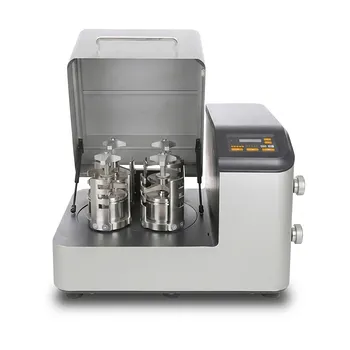
High Energy Planetary Ball Mill for Nano Scale Grinding and Colloidal Mixing in Material Science Research

High Energy Omnidirectional Planetary Ball Mill 20L

High Energy Laboratory Planetary Ball Mill for Nano Grinding and Material Science Sample Preparation

8L Planetary Ball Mill for Laboratory Grinding and Sample Preparation

Vertical Square Planetary Ball Mill for Laboratory Sample Preparation and Nanoscale Grinding
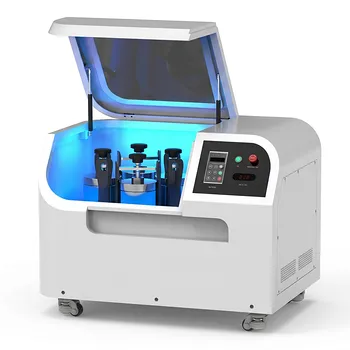
Planetary Ball Mill 12L

Miniature Planetary Ball Mill with Vacuum Grinding and High Efficiency for Laboratory Sample Preparation

Vertical Production Planetary Ball Mill for High Throughput Powder Processing
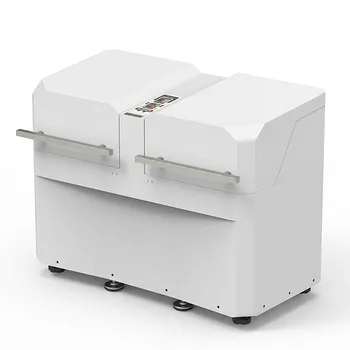
Dual Station Planetary Ball Mill 24L

Multi-Platform Nanoscale High-Energy Vibratory Ball Mill

High Energy Hybrid Vibratory Ball Mill for Grinding Mixing and Cell Disruption
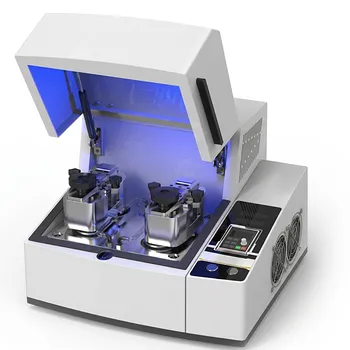
Laboratory Nano High Energy Ball Mill Ultrafine Grinding Mechanical Alloying

Nano High Energy Vibratory Ball Mill with Heating and Temperature Control

Heavy Duty Horizontal Planetary Ball Mill for Efficient Industrial Grinding and Sample Preparation

Nanoscale High-Energy Vibratory Ball Mill for Laboratory Sample Preparation, Mechanochemistry, and Mechanical Alloying

Nano High Energy Vibratory Ball Mill for Laboratory Sample Preparation