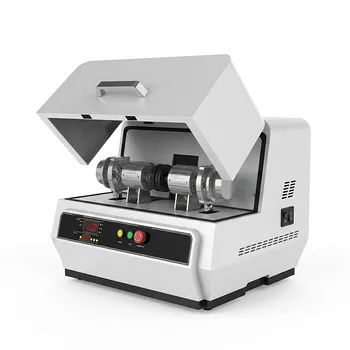
How do steel balls acting as grinding media within a ball mill jar facilitate material compounding? Optimize Kinetic Energy
Updated 4 months ago
Steel balls are the engine of kinetic energy transfer in mechanical alloying. These high-density grinding media facilitate material compounding by subjecting powder particles to high-frequency, high-energy impacts driven by the mill's rotation. This intense mechanical processing forces powder particles through repeated cycles of cold welding, fracturing, and re-welding, eventually producing a uniform mixture at the atomic scale.
The core of mechanical alloying lies in the ability of steel balls to convert mechanical motion into the intense physical force required to fuse dissimilar materials. By repeatedly deforming and breaking particles, these media enable the creation of ultra-fine-grained or nanocrystalline composites that are impossible to produce through traditional thermal melting.
The Mechanics of Material Transformation
The Cycle of Cold Welding and Fracturing
The primary function of steel balls is to subject the trapped powder to high-energy collisions. During these impacts, the powder particles are flattened and joined together through cold welding, then broken apart by fracturing as they become work-hardened. This continuous cycle ensures that the different components—typically a matrix and a reinforcement—are physically forced into contact.
Achieving Atomic-Scale Homogeneity
As the milling process continues, the layers of cold-welded materials become increasingly thin. This repeated deformation breaks up particle agglomerations and distributes reinforcement phases uniformly. Eventually, the particles reach a state where the mixture is homogeneous at the atomic scale, resulting in a stable solid solution or a nanocrystalline structure.
Solid-State Processing Advantages
Because this compounding happens in a solid state, it bypasses the limitations of liquid-phase processing, such as segregation or poor wettability. It allows for the production of Metal Matrix Composites (MMCs) with highly refined microstructures. This is particularly critical for materials that require high-performance thermal or mechanical properties.
Energy Transfer and Media Properties
The Role of Density and Mass
The effectiveness of the compounding depends heavily on the density and hardness of the steel balls. High-density media, such as high-strength stainless steel or high-chromium steel, provide the necessary kinetic energy to overcome the material's fracture toughness. This energy is essential to pulverize the powder and induce the plastic deformation required for compounding.
The Ball-to-Powder Ratio (BPR)
The collision energy within the mill jar is often controlled by the ball-to-powder weight ratio, such as a 10:1 ratio. This ratio determines the frequency and intensity of the impacts relative to the volume of material. A higher ratio generally increases the mechanochemical force applied to the particles, accelerating the refinement and alloying process.
Mechanochemical Force and Lattice Energy
In some applications, the kinetic energy from steel balls is used to generate sufficient mechanochemical force to overcome the lattice energy of stable compounds like silica. This allows for the effective pulverization of hard particles and their subsequent integration into a softer matrix. The media's high hardness ensures that the balls themselves do not deform, maintaining grinding efficiency.
Understanding the Trade-offs
Media Wear and Material Contamination
A significant challenge in mechanical alloying is the potential for media wear. As steel balls collide with each other and the jar walls, small amounts of the media material can wear off and enter the alloy. This can introduce unwanted impurities, which may negatively affect the performance of sensitive materials like thermoelectric alloys.
Balancing Impact Energy and Heat
High-energy milling generates significant localized heat during collisions. While some heat can facilitate diffusion, excessive temperatures may lead to unwanted phase changes or the recovery of work-hardened structures. Professionals must balance the rotation speed and milling time to prevent the material from deviating from its target nanocrystalline state.
Making the Right Choice for Your Goal
How to Apply This to Your Project
- If your primary focus is maximum grain refinement: Use high-density, high-hardness steel balls with a higher ball-to-powder ratio to maximize the fracturing frequency.
- If your primary focus is material purity: Select high-strength stainless steel media and monitor milling time closely to minimize the introduction of wear-related impurities.
- If your primary focus is scaling production: Utilize the Bond wear equation and abrasion indices to estimate media consumption and manage the costs of consumable steel balls.
- If your primary focus is dispersing brittle phases: Ensure the steel balls provide enough impact force to fracture oxide or ceramic reinforcements so they can be uniformly embedded in the ductile matrix.
By strategically managing the kinetic energy of steel balls, you can achieve a level of material homogeneity and structural refinement that traditional metallurgical techniques cannot match.
Summary Table:
| Process Phase | Mechanism of Action | Key Benefit for Materials |
|---|---|---|
| Cold Welding | High-energy impact joins powder particles | Facilitates initial phase bonding |
| Fracturing | Breaking of work-hardened particles | Ensures extreme grain refinement |
| Energy Transfer | High-density media collisions | Enables atomic-scale homogeneity |
| BPR Control | Optimizing ball-to-powder ratio | Accelerates the alloying process |
Elevate Your Material Research with Expert Sample Prep Solutions
Achieving atomic-scale homogeneity in mechanical alloying requires more than just high-quality media—it requires a complete, integrated approach to powder processing. At [Brand Name], we provide end-to-end laboratory solutions tailored for material science. From high-energy planetary ball mills, jet mills, and cryogenic grinders that ensure precise grain refinement, to our advanced Cold/Warm Isostatic Presses (CIP/WIP) and vacuum hot presses for superior compaction, we empower researchers to create next-generation composites.
Whether you need to disperse brittle phases or scale up production with reliable sieve shakers and powder mixers, our equipment is designed for durability and precision. Contact our technical team today to find the perfect configuration for your alloying and compaction needs!
References
- Km. Pooja, Pallavi Chaudhary. Metal matrix composites: revolutionary materials for shaping the future. DOI: 10.1007/s43939-025-00226-6
Mentioned Products
- Heavy Duty Horizontal Planetary Ball Mill for Efficient Industrial Grinding and Sample Preparation
- Vertical Semi Circular Planetary Ball Mill for Laboratory Precision Grinding
- Vertical Square Planetary Ball Mill for Laboratory Sample Preparation and Nanoscale Grinding
- High Energy Planetary Ball Mill for Nano Scale Grinding and Mechanical Alloying
- Vertical Production Planetary Ball Mill for High Throughput Powder Processing
People Also Ask
- Why grind lime-pozzolan specimens for TG/DTA for 3 mins? Master sample prep for high-precision thermal analysis.
- What is the role of a planetary ball mill in the mechanical activation of ZTA powder? Boost Sintering Performance
- What is the function of a planetary ball mill in wollastonite ceramic prep? Achieve Molecular Homogenization & Reactivity
- How does a planetary ball mill contribute to the homogenization of trace elements? Achieve Sub-Micron Uniformity
- What is the function of a high-performance planetary ball mill in AMZ laminates? Master Ceramic Homogenization.

Tech Team · PowderPreparation
Last updated on Jun 03, 2026
Related Products

Heavy Duty Horizontal Planetary Ball Mill for Efficient Industrial Grinding and Sample Preparation
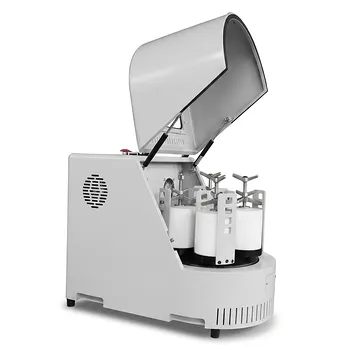
Vertical Semi Circular Planetary Ball Mill for Laboratory Precision Grinding

Vertical Square Planetary Ball Mill for Laboratory Sample Preparation and Nanoscale Grinding

High Energy Planetary Ball Mill for Nano Scale Grinding and Mechanical Alloying

Vertical Production Planetary Ball Mill for High Throughput Powder Processing
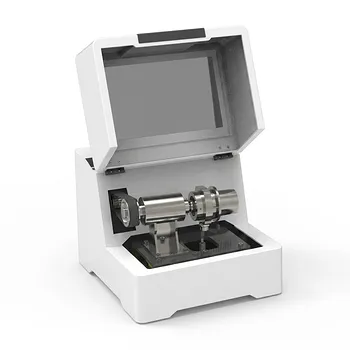
Single Tank High Energy Vibratory Ball Mill for Laboratory Grinding and Mixing
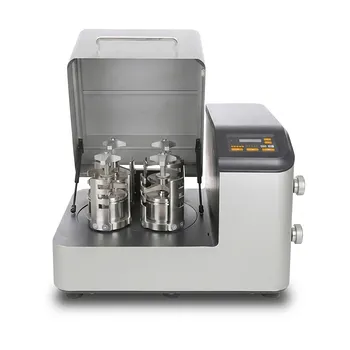
High Energy Planetary Ball Mill for Nano Scale Grinding and Colloidal Mixing in Material Science Research

High Energy Laboratory Planetary Ball Mill for Nano Grinding and Material Science Sample Preparation

Miniature Planetary Ball Mill with Vacuum Grinding and High Efficiency for Laboratory Sample Preparation

360° Rotating Omnidirectional Laboratory Planetary Ball Mill for Homogeneous Ultra-Fine Grinding and Mixing

High Energy Hybrid Vibratory Ball Mill for Grinding Mixing and Cell Disruption
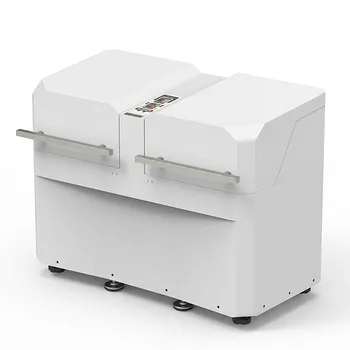
Dual Station Planetary Ball Mill 24L
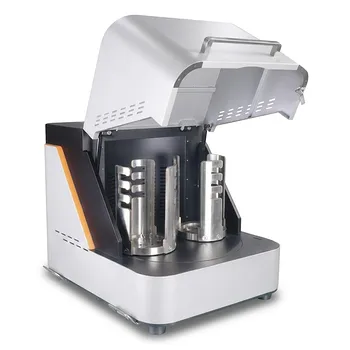
High Energy Laboratory Planetary Ball Mill for Nano Grinding and Colloidal Mixing of Hard and Brittle Materials

High Energy Omnidirectional Planetary Ball Mill 16L
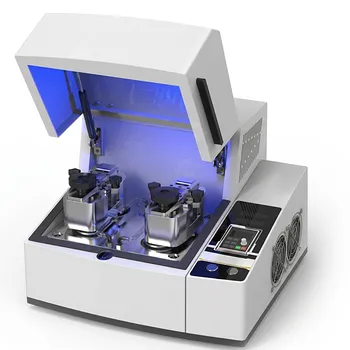
Laboratory Nano High Energy Ball Mill Ultrafine Grinding Mechanical Alloying
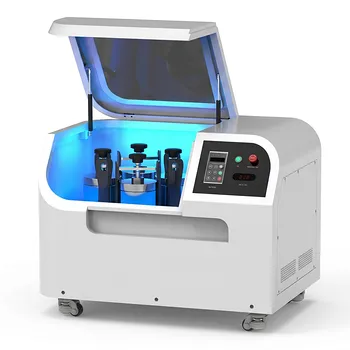
Planetary Ball Mill 12L

High Throughput Micro Ball Mill for Cryogenic Grinding and Laboratory Cell Disruption

Nanoscale High-Energy Vibratory Ball Mill for Laboratory Sample Preparation, Mechanochemistry, and Mechanical Alloying

8L Planetary Ball Mill for Laboratory Grinding and Sample Preparation