The Fracture Point: Why an Engineer’s Obsession with Control Turns Eggshells into High-Strength Polymers
Oct 04, 2026
The Beginning of Chaos
A chicken egg is a masterpiece of structural engineering. But once the egg is cracked and the yolk is gone, the shell becomes something else entirely: a brittle, irregular, annoying piece of waste. To the untrained eye, that is where the story ends.
A materials engineer sees a different narrative. They see a calcium carbonate reservoir—an inorganic, heat-resistant filler that could reinforce polymers if only it could be tamed. The problem is chaos. Eggshells fracture unpredictably. Their natural variability fights back against any attempt to create a uniform powder.
This is where the psychology of precision enters the room.
The Engineer’s Intolerance for Randomness
Engineers are not just people who solve problems. They are people who hate unplanned variance. Morgan Housel once observed that financial risk lives in the distributions we can’t see. For a materials scientist, that unseen distribution is the particle size spread in a filler powder.
If you grind eggshells in a generic blender, you get a lottery ticket. Some particles will be huge, some tiny. When mixed into a polymer matrix, the large chunks become stress concentrators—microscopic failure points that guarantee mechanical weakness. The composite’s performance becomes a gamble.
This is psychologically unacceptable for anyone building a repeatable manufacturing process. The engineer’s craving for control demands a system that doesn’t just cut, but classifies. It demands a machine that says “no” to a particle until it is proven to be the right size.
That machine is the high-energy centrifugal mill.
The Anatomy of Predictive Fracture
At its core, a high-energy centrifugal mill is a certainty generator. It doesn’t hope that particles come out right—it forces them to, using two brutal but elegant mechanisms:
The Rotor’s Relentless Impact
A rotor spins at extreme speed, grabbing brittle eggshells and accelerating them outward with brutal kinetic energy. Every collision against the stator pins generates a cascade of impact and shear forces. The shells don’t just break; they shatter along their natural fracture planes, instantly multiplying their surface area.
The Ring Sieve’s Real-Time Gatekeeping
This is where the psychology of control becomes hardware. A fixed ring sieve surrounds the rotor. The openings are precisely calibrated to the target micron size. No particle leaves the chamber until physical geometry permits it. The mill becomes a self-policing system—the sieve is a bouncer that rejects anything oversize until the rotor beats it into compliance.
The technical result is a powder trapped in a narrow particle size distribution. The psychological result is the engineer’s dream: a batch-to-batch guarantee of uniformity.
The Math of Interaction
Why does micron-level precision matter so much? Because the interface between filler and polymer is a contact sport.
- Surface Area: Smaller, uniform particles create a massive collective surface area. This is the playground where hydrogen bonds form between the eggshell’s calcium carbonate and the matrix’s polymer chains.
- No Clumping: Broad distributions allow small particles to fill the gaps between large ones, but uniform micron-sized particles repel agglomeration. They disperse like individual citizens rather than a mob.
- Thermal Anchoring: A perfectly scattered population of inorganic filler interrupts heat flow through the composite, raising its thermal stability and delaying degradation.
The Performance Ledger
| Milling Feature | Psychological Need Addressed | Composite Result |
|---|---|---|
| High-Speed Rotor | Eliminates large statistical outliers | Rapid drop to micron-level fineness |
| Fixed Ring Sieve | Eliminates manual screening guesswork | Guaranteed dispersion uniformity |
| Brittle Fracture Optimization | Predictable failure under stress | High-surface-area CaCO₃ ready for bonding |
Suddenly, the eggshell is no longer waste. It’s a predictable engineering input.
The Toolkit Beyond the Mill
A high-energy centrifugal mill is brilliant, but it doesn’t work in a vacuum. The eggshell that enters it must already be a clean, manageable precursor. And the powder that leaves it must become part of a finished sample—perhaps a pellet for XRF analysis or a compacted composite disc.
Real control over material science requires a complete ecosystem. That’s why a comprehensive sample preparation workflow matters just as much as the star player in the middle.
The Sample Preparation Workflow
- Primary Crushing: Jaw or roll crushers pre-fracture bulky eggshell inputs into a manageable grit.
- Conditioning (if needed): Liquid nitrogen cryogenic grinders embrittle materials that would otherwise flex or clog under heat, though eggshells naturally cooperate.
- Fine Milling: High-energy centrifugal mills, planetary ball mills, or jet mills execute the precise particle size reduction.
- Separation and Analysis: Vibratory or air-jet sieve shakers with certified test sieves confirm the particle distribution, closing the quality loop.
- Homogenization: Powder and defoaming mixers ensure perfect consistency before the filler meets the polymer.
- Consolidation: Hydraulic presses—whether cold isostatic presses (CIP) for complex shapes or hot presses for dense composite plates—lock the structure into a test-ready solid.
Every piece of this chain is a defense against randomness. Omit one step, and you reintroduce a variable you can’t see until the mechanical test fails.
Three Paths to Implementation
Before you select your mill settings, decide what the composite demands from its filler. Your psychological profile as an engineer will gravitate toward one of these priorities:
- If your need is Maximum Dispersion: Your enemy is clumping. Use the finest ring sieve available and accept a slightly longer process time. You’re optimizing for absolute particle isolation in the matrix.
- If your need is Mechanical Reinforcement: Your goal is bond density. Extend milling duration until the surface area maximizes, even if it approaches an hour. Strong hydrogen bonding demands ultra-refined edges.
- If your need is Production Throughput: You respect efficiency above all else. Maximize rotor speed to deliver impact force intensity that shortens the time to target size, balancing energy use against output.
The centrifugal mill adapts to all three philosophies. You just need to know which variable keeps you up at night.
The Certainty of a Complete System
The journey from eggshell chaos to composite perfection is not a single piece of equipment. It’s a system that mirrors the engineer’s own mind—a sequence of logical, gated operations that refuse to accept variance.
When you have a complete laboratory sample preparation solution—from crushers and mills to sieve shakers, mixers, and hydraulic presses—you are no longer adapting to your raw material. You are dictating its final form. The brittle, unpredictable eggshell becomes a high-performance filler because you refused to let it be anything else.
Ready to stop managing randomness and start controlling material destiny? Contact Our Experts
Quick Links
Suggested Products
Ultra Centrifugal Mill High Speed Laboratory Grinder for Fibrous and Brittle Sample Preparation High Efficiency Vacuum Planetary Centrifugal Mixer and Defoaming Machine for Industrial Material Research and Precise Laboratory Powder Dispersion Ultra Centrifugal Mill for Rapid Laboratory Sample Preparation and Fine Powder Grinding High Viscosity Planetary Centrifugal Mixing and Vacuum Defoaming Machine for Laboratory Material Preparation Nano High Energy Vibratory Ball Mill for Laboratory Sample PreparationFurther Reading
The Particle Paradox: Why the Secret to a Perfect Effervescent Tablet Lives in the Grinding Room The Hidden Lever in Ceramic Composites: Why High-Energy Grinding Separates Breakthroughs from Bench Failures The Brittle Truth: Why Your Catalyst's Potential Is Trapped in the Ribbon, and the One Violent Step to Set It Free The Invisible Architect of Failure: Why a Bubble in Your Resin-GelMA Mix Casts a Shadow on Your Entire Print The Hidden Disorder in Your Battery Slurry—and the Precision Tool That Destroys It
PowderPreparation
Last updated on May 14, 2026
Related Products

Ultra Centrifugal Mill High Speed Laboratory Grinder for Fibrous and Brittle Sample Preparation

High Efficiency Vacuum Planetary Centrifugal Mixer and Defoaming Machine for Industrial Material Research and Precise Laboratory Powder Dispersion
Ultra Centrifugal Mill for Rapid Laboratory Sample Preparation and Fine Powder Grinding

High Viscosity Planetary Centrifugal Mixing and Vacuum Defoaming Machine for Laboratory Material Preparation

Nano High Energy Vibratory Ball Mill for Laboratory Sample Preparation
High Energy Laboratory Planetary Ball Mill for Nano Grinding and Material Science Sample Preparation
Single Tank High Energy Vibratory Ball Mill for Laboratory Grinding and Mixing
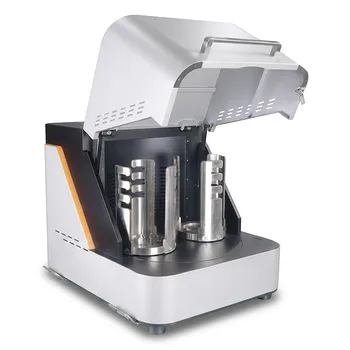
High Energy Laboratory Planetary Ball Mill for Nano Grinding and Colloidal Mixing of Hard and Brittle Materials

High Energy Planetary Ball Mill for Nano Scale Grinding and Mechanical Alloying

High Viscosity Planetary Centrifugal Vacuum Mixer for Material Defoaming and Uniform Mixing

Heating Temperature Controlled High Energy Vibratory Ball Mill

Industrial Planetary Centrifugal Vacuum Defoaming Mixer for High Viscosity Paste and Advanced Material Science
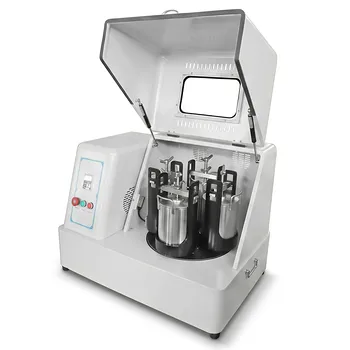
Vertical Square Planetary Ball Mill for Laboratory Sample Preparation and Nanoscale Grinding
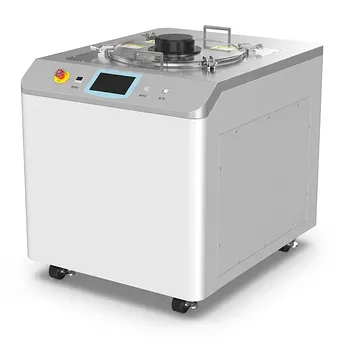
Industrial Planetary Centrifugal Vacuum Defoaming Mixer for High Viscosity Paste and Powder Homogenization
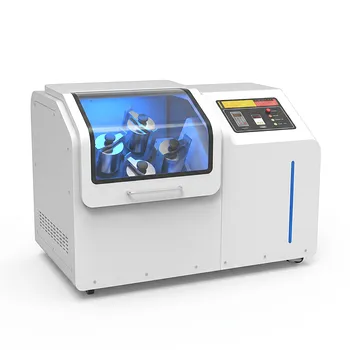
High Energy Omnidirectional Planetary Ball Mill 16L
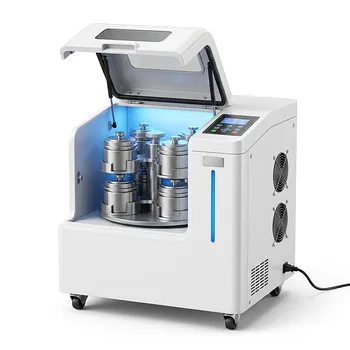
High Energy Omnidirectional Planetary Ball Mill 20L

Dual Jar High Energy Vibratory Ball Mill

Dual Cup Vacuum Centrifugal Mixer Planetary Paste Defoaming Machine Industrial Material Processor
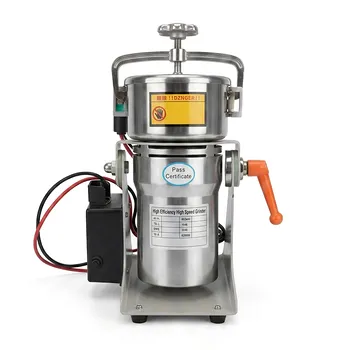
High Efficiency High Speed Grinder Laboratory Mill 1300W 25000rpm