Why is the ball-to-powder weight ratio critical in synthesizing Mg2FeH6? Master Energy Density & Phase Purity
Updated 4 months ago
Mechanical energy transfer is the primary reason the ball-to-powder weight ratio (BPR) is critical in synthesizing $Mg_2FeH_6$. This ratio dictates the collision frequency and the energy intensity delivered to the magnesium and iron precursors, which is essential for overcoming the kinetic barriers required to form complex hydrides.
The ball-to-powder weight ratio acts as the "throttle" for energy density in a ball mill. It determines whether the mechanical forces are sufficient to activate material interfaces and drive the chemical transition from elemental powders to the $Mg_2FeH_6$ phase.
The Mechanics of Energy Transfer
Defining Energy Density
The BPR directly determines the total mechanical energy transferred to the powder per unit of time. A higher ratio, such as 40:1, ensures that the energy density within the milling jar is high enough to cause significant plastic deformation and lattice distortion.
Collision Frequency and Intensity
Increasing the number of balls relative to the powder mass elevates the frequency of impacts. Each collision serves as a micro-event that provides the necessary kinetic energy to refine the powder particles and increase their interfacial surface area.
Driving the Chemical Synthesis of $Mg_2FeH_6$
Interfacial Activation
For $Mg_2FeH_6$ to form, magnesium and iron atoms must interact at a molecular level. A high BPR facilitates interfacial activation, breaking down oxide layers and ensuring that the two elements are in intimate contact, which is a prerequisite for the nucleation of complex hydrides.
Overcoming Kinetic Barriers
The synthesis of complex hydrides often requires substantial energy to initiate the reaction between solid components. The massive mechanical energy input provided by an optimized BPR provides the physical basis for overcoming these recovery kinetics, allowing the reaction to proceed at lower temperatures than conventional methods.
Particle Size Refinement
A critical BPR ensures that the powder reaches a nanometer scale (often around 20-30 nm). This drastic reduction in grain size creates more active sites and shorter diffusion paths, which significantly improves the overall synthesis efficiency and hydrogen storage properties.
Understanding the Trade-offs
Thermal Management and Frictional Heat
While a high BPR increases reaction speed, it also generates significant frictional heat. If the ratio is too high, the resulting temperature spike can lead to the thermal decomposition of the newly formed $Mg_2FeH_6$ or cause the powder to stick to the milling media.
Contamination and Media Wear
Using an excessive BPR increases the likelihood of media wear, where small fragments of the grinding balls (e.g., steel or zirconia) contaminate the powder. This can alter the chemical purity of the $Mg_2FeH_6$ and negatively impact its hydrogen absorption/desorption kinetics.
Powder Agglomeration
There is a point of diminishing returns where excessive energy causes particles to agglomerate rather than refine. When powders weld back together due to high-impact forces, the effective surface area decreases, potentially stalling the synthesis of the hydride phase.
How to Optimize BPR for Your Synthesis
Achieving the perfect balance requires aligning the BPR with your specific material goals and equipment capabilities.
- If your primary focus is rapid phase purity: Employ a higher BPR (e.g., 40:1) to maximize energy intensity and accelerate the nucleation of the $Mg_2FeH_6$ phase.
- If your primary focus is minimizing contamination: Utilize a moderate BPR (e.g., 10:1 or 20:1) combined with high-hardness grinding media to reduce wear and maintain chemical integrity.
- If your primary focus is nanostructure control: Select a ratio that balances impact and shear forces, ensuring sufficient energy for grain refinement without inducing excessive frictional heat.
By precisely controlling the ball-to-powder ratio, you transform a simple mechanical process into a sophisticated tool for chemical synthesis.
Summary Table:
| Key Parameter | Impact on Mg2FeH6 Synthesis | Primary Benefit |
|---|---|---|
| Energy Density | Dictates total mechanical energy per unit time | Overcomes kinetic reaction barriers |
| Collision Frequency | Increases micro-impact events between particles | Enhances interfacial activation |
| Grain Refinement | Reduces particles to nanometer scale (20-30 nm) | Shorter diffusion paths for hydrogen |
| Thermal Control | Manages frictional heat during milling | Prevents thermal decomposition of hydrides |
| BPR Optimization | Balances reaction speed vs. contamination | Ensures chemical purity and phase stability |
Elevate Your Material Synthesis with Precision Equipment
Achieving the perfect ball-to-powder ratio is only half the battle; high-performance hardware is the other. [Your Brand Name] provides complete laboratory sample preparation solutions tailored for advanced material science. We specialize in the high-energy powder processing and compaction equipment necessary for synthesizing complex hydrides like $Mg_2FeH_6$.
Our extensive product line is designed to give you total control over your synthesis parameters:
- Advanced Milling: Planetary ball mills, jet mills, and liquid nitrogen cryogenic grinders for superior grain refinement.
- Powder Processing: Sieve shakers, powder mixers, and defoaming mixers to ensure sample homogeneity.
- Compaction Solutions: A full spectrum of hydraulic presses, including Cold/Warm Isostatic Presses (CIP/WIP), vacuum hot presses, and XRF pellet presses for high-density finishing.
Whether you are aiming for nanostructure control or rapid phase purity, our team is ready to help you configure the ideal lab setup.
Contact our experts today to optimize your workflow!
References
- Alexandre Augusto Cesário Asselli, Jacques Huot. Investigation of Effect of Milling Atmosphere and Starting Composition on Mg2FeH6 Formation. DOI: 10.3390/met4030388
Mentioned Products
- Heavy Duty Horizontal Planetary Ball Mill for Efficient Industrial Grinding and Sample Preparation
- Vertical Semi Circular Planetary Ball Mill for Laboratory Precision Grinding
- Vertical Production Planetary Ball Mill for High Throughput Powder Processing
- Vertical Square Planetary Ball Mill for Laboratory Sample Preparation and Nanoscale Grinding
- High Energy Planetary Ball Mill for Nano Scale Grinding and Mechanical Alloying
People Also Ask
- Why grind lime-pozzolan specimens for TG/DTA for 3 mins? Master sample prep for high-precision thermal analysis.
- What is the role of a planetary ball mill in the mechanical activation of ZTA powder? Boost Sintering Performance
- What is the function of a planetary ball mill in wollastonite ceramic prep? Achieve Molecular Homogenization & Reactivity
- How does a planetary ball mill contribute to the homogenization of trace elements? Achieve Sub-Micron Uniformity
- What is the function of a high-performance planetary ball mill in AMZ laminates? Master Ceramic Homogenization.

Tech Team · PowderPreparation
Last updated on Jun 03, 2026
Related Products
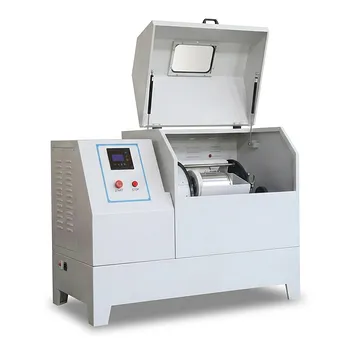
Heavy Duty Horizontal Planetary Ball Mill for Efficient Industrial Grinding and Sample Preparation
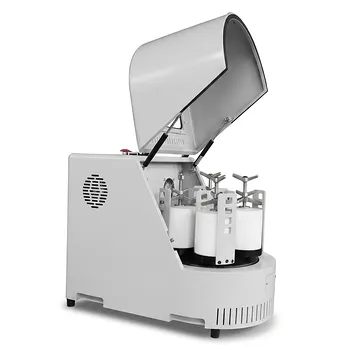
Vertical Semi Circular Planetary Ball Mill for Laboratory Precision Grinding
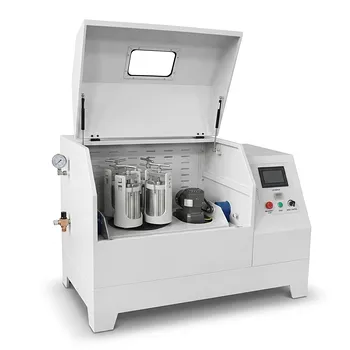
Vertical Production Planetary Ball Mill for High Throughput Powder Processing
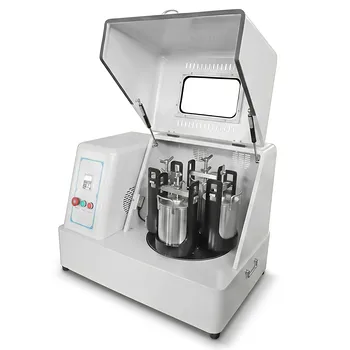
Vertical Square Planetary Ball Mill for Laboratory Sample Preparation and Nanoscale Grinding
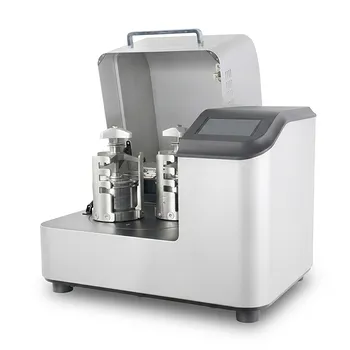
High Energy Planetary Ball Mill for Nano Scale Grinding and Mechanical Alloying
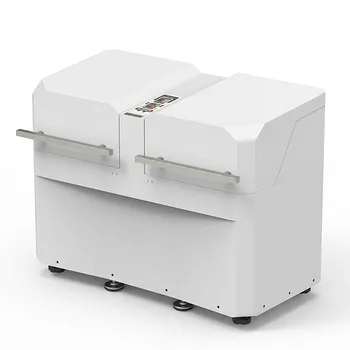
Dual Station Planetary Ball Mill 24L
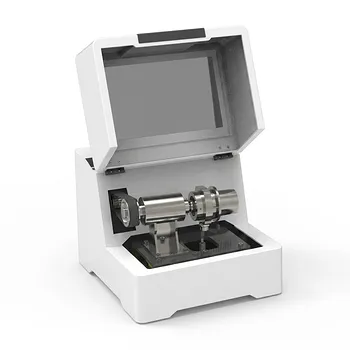
Single Tank High Energy Vibratory Ball Mill for Laboratory Grinding and Mixing
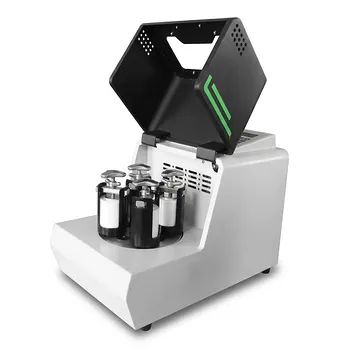
Miniature Planetary Ball Mill with Vacuum Grinding and High Efficiency for Laboratory Sample Preparation
High Energy Laboratory Planetary Ball Mill for Nano Grinding and Material Science Sample Preparation
High Energy Omnidirectional Planetary Ball Mill 16L
High Energy Planetary Ball Mill for Nano Scale Grinding and Colloidal Mixing in Material Science Research
360° Rotating Omnidirectional Laboratory Planetary Ball Mill for Homogeneous Ultra-Fine Grinding and Mixing
Planetary Ball Mill 12L
High Energy Laboratory Planetary Ball Mill for Nano Grinding and Colloidal Mixing of Hard and Brittle Materials
Dual Jar High Energy Vibratory Ball Mill
Multi-Platform Nanoscale High-Energy Vibratory Ball Mill

Nano High Energy Vibratory Ball Mill for Laboratory Sample Preparation
High Energy Omnidirectional Planetary Ball Mill 20L
8L Planetary Ball Mill for Laboratory Grinding and Sample Preparation