Why is repeated sieving necessary for ammonal explosive mixtures? Key to Homogenization & Detonation Stability
Updated 5 months ago
Repeated sieving is the mechanical foundation of explosive consistency. It ensures the complete breakdown of microscopic clumps (agglomerates) and forces a uniform spatial blend of oxidizer and fuel particles. This process is a physical prerequisite for achieving stable detonation and gathering accurate performance data.
The necessity of repeated sieving lies in its ability to achieve microscopic homogenization through mechanical forcing. By eliminating agglomerates and ensuring a uniform distribution of ammonium nitrate and aluminum, the mixture can sustain the consistent chemical reactions required for stable detonation.
Breaking Down Physical Barriers to Reaction
The Elimination of Agglomerates
Ammonium nitrate and aluminum powder naturally tend to form small agglomerates or clumps due to moisture or electrostatic forces. If these clumps remain, they create "pockets" of pure fuel or pure oxidizer rather than a reactive mixture.
Repeated sieving uses the mesh as a mechanical cutting tool to break these clumps apart. This ensures that every individual particle is available to participate in the chemical reaction.
Mechanical Forcing for Spatial Distribution
Simply stirring powders often fails to achieve a perfect mix because particles of different densities and shapes tend to segregate. Sieving acts as a mechanical forcing mechanism that pushes particles through the aperture in close proximity to one another.
This process ensures a uniform spatial distribution, meaning the fuel (aluminum) and oxidizer (ammonium nitrate) are perfectly interspersed. Without this, the energy release during detonation would be uneven.
The Impact on Detonation Performance
Ensuring Microscopic Homogeneity
Detonation is a chemical reaction that occurs at the microscopic level in nanoseconds. For the reaction to be continuous and stable, the oxidizer and fuel must be in direct contact throughout the entire mass.
High-level homogenization provides the physical environment needed for these consistent chemical reactions. This prevents "dead zones" in the explosive that could lead to a failed or incomplete detonation.
Reliability of Detonation Velocity Data
In experimental settings, researchers must collect reliable detonation velocity data to understand an explosive's power. If a mixture is poorly homogenized, its detonation velocity will fluctuate wildly, making the data useless.
Controlled sieving through specific apertures ensures that the particle size distribution is strictly maintained. This consistency allows researchers to attribute performance results to the chemical composition rather than physical flaws in the mix.
Understanding the Trade-offs
The Risk of Mechanical Sensitivity
While repeated sieving is necessary for performance, it introduces mechanical friction and static electricity. This can increase the risk of accidental ignition, especially with sensitive aluminum powders.
Safety protocols must balance the need for homogenization with the dangers of over-processing. Proper grounding and non-sparking sieve materials are essential to mitigate these risks.
Sieve Wear and Contamination
Frequent use of specific aperture sieves can lead to mesh deformation or wear over time. If the apertures expand, the particle size distribution becomes inconsistent, defeating the purpose of the process.
Additionally, the physical friction of the explosive against the sieve can lead to trace material contamination. Regular calibration and inspection of test sieves are mandatory for maintaining experimental integrity.
How to Apply This to Your Project
To achieve the highest standards of mixture stability and data accuracy, homogenization processes must be standardized.
- If your primary focus is detonation stability: Prioritize repeated sieving cycles to ensure no agglomerates remain that could interrupt the reaction wave.
- If your primary focus is data collection accuracy: Use certified test sieves with specific apertures to strictly control particle size distribution and minimize experimental variables.
- If your primary focus is safety during mixing: Implement humidity controls and grounding wire systems to reduce static build-up during the mechanical forcing process.
Precision in the physical preparation of an explosive is the only way to ensure predictability in its chemical performance.
Summary Table:
| Key Aspect | Role in Homogenization | Impact on Performance |
|---|---|---|
| Agglomerate Removal | Breaks down fuel/oxidizer clumps via mechanical forcing | Ensures every particle is available for reaction |
| Spatial Distribution | Intersperses particles to prevent density segregation | Leads to uniform energy release and stable detonation |
| Data Reliability | Maintains strict particle size distribution | Provides consistent and accurate detonation velocity data |
| Safety & Integrity | Requires non-sparking materials and grounding | Mitigates risks of mechanical friction and contamination |
Optimize Your Material Preparation with KinTek
Achieve unparalleled precision in your powder homogenization and material research with KinTek. We provide complete laboratory sample preparation solutions for material science, specializing in high-performance powder processing and compaction equipment tailored for sensitive and advanced applications.
Our extensive product lines include:
- Sieving & Milling: Vibratory and air-jet sieve shakers with various test sieves, planetary ball mills, jet mills, and rotor mills for perfect particle size control.
- Processing: Jaw/roll crushers, liquid nitrogen cryogenic grinders, and high-efficiency powder/defoaming mixers.
- Compaction: A full spectrum of hydraulic presses, including Cold/Warm Isostatic Presses (CIP/WIP), standard lab presses, and vacuum hot presses.
Whether you are refining explosive mixtures or developing advanced ceramics, KinTek ensures your samples meet the highest standards of consistency and safety.
Enhance your lab's efficiency and data accuracy — Contact our experts today!
References
- Józef Paszula, Sebastian Kazubek. Influence of ammonium nitrate(V) grain size on the detonation parameters of ammonals. DOI: 10.22211/matwys/0206
Mentioned Products
- Laboratory Vibratory Test Sieve Shaker for Precision Particle Size Analysis and Powder Grading
- 三维电磁微量振动筛分仪
- High Frequency Wet Three-Dimensional Vibrating Sieve Shaker for Dry and Wet Particle Size Analysis
- Laboratory Air Jet Sieving Machine for Fine Powder Particle Size Analysis and Deagglomeration
- Tapping Oscillating Sieve Shaker for Dry and Wet Particle Size Analysis
People Also Ask
- What role does a laboratory sieve shaker play in determining PDI? Achieve Precision in Biomass Quality Testing
- What are the functions of sieve shakers for coconut shell powder? Achieve Precise Particle Size & Quality Control.
- What function does a laboratory sieve shaker perform in the PSD analysis of residual soil? Ensure Precise Grading
- What is the role of a laboratory sieve shaker in the preparation of plantain peel adsorbents? Standardize Particle Size
- What is the function of a laboratory vibratory sieve shaker? Enhance Coal Particle Size Distribution (PSD) Analysis

Tech Team · PowderPreparation
Last updated on May 14, 2026
Related Products

Laboratory Vibratory Test Sieve Shaker for Precision Particle Size Analysis and Powder Grading

三维电磁微量振动筛分仪

High Frequency Wet Three-Dimensional Vibrating Sieve Shaker for Dry and Wet Particle Size Analysis
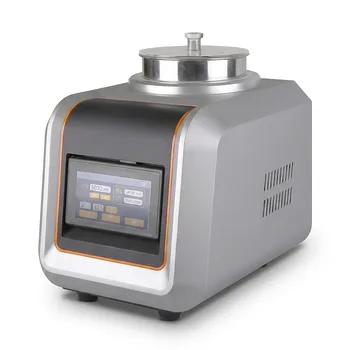
Laboratory Air Jet Sieving Machine for Fine Powder Particle Size Analysis and Deagglomeration

Tapping Oscillating Sieve Shaker for Dry and Wet Particle Size Analysis

Dry Three Dimensional Vibratory Sieve Shaker

Heavy Duty Dry Three Dimensional Vibratory Sieve Shaker for Particle Separation

Three Dimensional Rotary Vibrating Sieve

Stainless Steel Rotary Vibrating Sieve High Precision Circular Vibratory Separator Industrial Powder Grading Machine Multi Layer Sifting Equipment