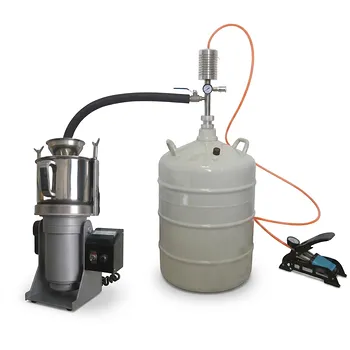
Why is liquid nitrogen used for iron ore pellet analysis? Preserve Integrity for Accurate Particle Size Distribution
Updated 4 months ago
The use of liquid nitrogen for cryogenic treatment is essential for "freezing" the instantaneous physical state of iron ore green pellets. This rapid quenching process solidifies the moisture within the pellets, preventing them from adhering to one another or crumbling during sampling and sieving. By creating this stable, brittle state, researchers can accurately measure the true particle size distribution (PSD) without the interference of mechanical deformation or surface stickiness.
To obtain an accurate particle size distribution of wet iron ore green pellets, one must neutralize their inherent stickiness and fragility. Cryogenic treatment using liquid nitrogen provides an ultra-low temperature environment that locks the pellet structure in place, ensuring that the data reflects the actual condition of the sintering bed rather than artifacts of the sampling process.
Preserving the Structural Integrity of Green Pellets
Instantaneous Quenching via Ultra-Low Temperatures
Liquid nitrogen has a boiling point of -196°C, which allows for a nearly instantaneous transition from a wet, plastic state to a solid, frozen state.
This rapid deep-freeze "locks" the pellet's internal and external geometry at the exact moment of sampling.
Without this speed, the moisture within the pellet could migrate or slowly crystallize, potentially altering the very dimensions you are trying to measure.
Eliminating Surface Stickiness and Adhesion
Wet green pellets are naturally viscous and prone to agglomeration due to their high liquid content and the presence of binders.
The cryogenic treatment drastically increases the brittleness of the material and eliminates surface stickiness.
By removing the "tacky" nature of the pellets, researchers can ensure they remain as individual entities during sieving rather than clumping together into false larger particles.
Enhancing Measurement Accuracy
Protecting Fragile Adhesion Layers
The outermost layer of a green pellet is often a fragile adhesion layer composed of fine particles that have not yet been fully integrated into the core.
Standard mechanical handling or room-temperature sieving would likely strip these layers away, leading to an underestimation of particle size.
Liquid nitrogen treatment reinforces these delicate layers, allowing them to survive the mechanical stresses of the reduction and sieving processes.
Preventing Physical Deformation
Green pellets are susceptible to plastic deformation; they can flatten or change shape under their own weight or during handling.
Cryogenic cooling ensures the pellets reach their embrittlement point, making them rigid enough to resist deformation.
This rigidity is critical for capturing the actual particle size distribution as it exists in the sintering bed, where the arrangement of particles dictates airflow and heat transfer.
Understanding the Trade-offs
Thermal Shock and Cracking
While liquid nitrogen is excellent for stabilization, the extreme temperature gradient can occasionally cause thermal shock.
If the cooling is too violent, some pellets may develop micro-fractures, though this is generally considered a lesser evil than the alternative of adhesion and deformation.
Handling and Safety Requirements
The use of liquid nitrogen requires specialized cryogenic equipment and strict safety protocols to prevent asphyxiation and cold burns.
The process also adds operational complexity and cost compared to standard dry sieving, making it a technique reserved for high-precision analytical work rather than routine bulk testing.
How to Apply This to Your Analysis
Making the Right Choice for Your Goal
- If your primary focus is capturing the precise sintering bed structure: You must use liquid nitrogen to ensure the "quenched" state of the pellets reflects their real-world spatial distribution.
- If your primary focus is preventing sample degradation during milling: Liquid nitrogen should be used to maintain an inert, oxygen-deficient atmosphere that inhibits oxidation.
- If your primary focus is minimizing equipment clogging: Use cryogenic treatment to increase material brittleness, which allows for cleaner fractures and prevents the "smearing" of sticky materials on sieves or mills.
By leveraging the unique properties of liquid nitrogen, you transform a fragile, changing sample into a stable specimen ready for definitive analysis.
Summary Table:
| Feature | Benefit for Green Pellets | Impact on PSD Analysis |
|---|---|---|
| Rapid Quenching | Instantaneous deep-freeze at -196°C | Locks physical state and internal geometry |
| Embrittlement | Eliminates surface stickiness | Prevents clumping and false larger particles |
| Structural Rigidity | Resists plastic deformation | Captures actual size as it exists in the sintering bed |
| Layer Protection | Preserves fragile adhesion layers | Avoids underestimation of particle size during handling |
Optimize Your Material Analysis with Precision Sample Prep
To achieve reliable data in material science, your sample preparation must be flawless. Our brand provides complete laboratory sample preparation solutions, specializing in high-performance powder processing and compaction equipment.
We offer an extensive line of tools designed to handle even the most challenging materials like iron ore green pellets:
- Size Reduction: Liquid nitrogen cryogenic grinders, planetary ball mills, jet mills, and jaw/roll crushers.
- Particle Characterization: Vibratory and air-jet sieve shakers with a wide range of precision test sieves.
- Compaction & Forming: A full spectrum of hydraulic presses, including Cold/Warm Isostatic Presses (CIP/WIP), XRF pellet presses, and vacuum hot presses.
- Mixing: Advanced powder and defoaming mixers for uniform sample consistency.
Ensure your research reflects the true state of your materials. Contact us today to explore how our specialized equipment can enhance your laboratory's capabilities and accuracy.
References
- Robin Bergstrand, J. F. Garden. The Effect of Marra Mamba Ore Addition on the Granulation Characteristics of Pisolite Based and Hematite Based Sinter Blends. DOI: 10.2355/isijinternational.45.492
Mentioned Products
- Cryogenic Liquid Nitrogen Grinder for Ultrafine Heat-Sensitive Powder Processing
- Laboratory Cryogenic Grinder Liquid Nitrogen Low Temperature Ultrafine Grinding
- Laboratory Liquid Nitrogen Cryogenic Grinder for Polymer and Elastomer Materials
- Laboratory Liquid Nitrogen Cryogenic Grinder Polymer Sample Preparation Pulverizer
- Small Liquid Nitrogen Cryogenic Grinder for Ultrafine Grinding of Heat-Sensitive Materials in Laboratories
People Also Ask
- What role does liquid nitrogen cryogenic grinding play in the modification of CNTs? Optimize Nanomaterial Processing
- Why is a liquid nitrogen cryogenic grinder required before DSC? Ensure Accurate Thermal Analysis & Sample Integrity.
- Why is a liquid nitrogen cryogenic grinder necessary for plastic pre-processing? Achieve Precise Co-Pyrolysis Results
- What is the role of a liquid nitrogen cryogenic grinder in biomass pretreatment? Optimize Your Activated Carbon Quality
- What is the role of a liquid nitrogen cryogenic grinder in drug-polymer mixing? Achieve Superior Sample Homogeneity

Tech Team · PowderPreparation
Last updated on Jun 03, 2026
Related Products
Cryogenic Liquid Nitrogen Grinder for Ultrafine Heat-Sensitive Powder Processing
Laboratory Cryogenic Grinder Liquid Nitrogen Low Temperature Ultrafine Grinding
Laboratory Liquid Nitrogen Cryogenic Grinder for Polymer and Elastomer Materials
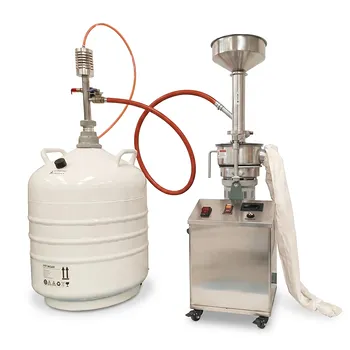
Laboratory Liquid Nitrogen Cryogenic Grinder Polymer Sample Preparation Pulverizer
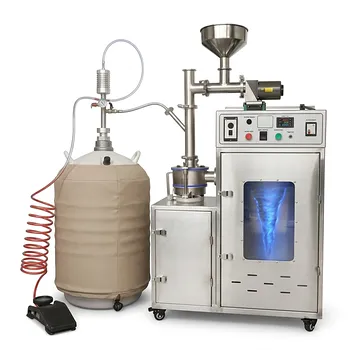
Small Liquid Nitrogen Cryogenic Grinder for Ultrafine Grinding of Heat-Sensitive Materials in Laboratories
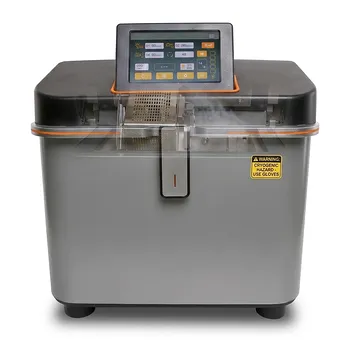
Cryogenic Liquid Nitrogen Grinder for DNA Analysis and Polymer Pulverization with Automatic Cooling and Electromagnetic Impact Technology
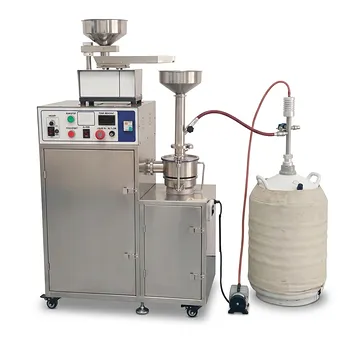
Small Liquid Nitrogen Cryogenic Grinder with Vibratory Feeder for Laboratory Sample Preparation
Small Liquid Nitrogen Cryogenic Grinder for Plastic and Heat-Sensitive Material Sample Preparation