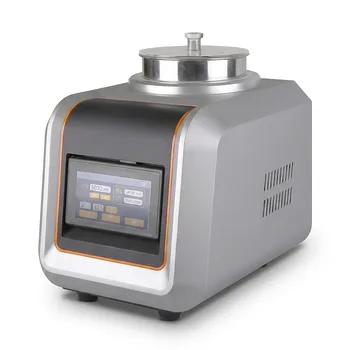
Why is an automated vibratory sieve shaker required for biomass pellet production? Optimize Quality & Strength
Updated 4 months ago
The use of an automated vibratory sieve shaker is a technical necessity to ensure particle size uniformity before the mixing and molding stages of pellet production. By performing precise particle size classification, the shaker removes oversized materials and isolates specific fractions, which is critical for achieving a uniform mixture. This consistency directly determines the mechanical strength of the final pellet and the efficiency of subsequent thermal or chemical reactions.
Core Takeaway: Automated sieving eliminates particle size variability, which is the primary cause of structural failure and uneven energy release in biomass pellets. Ensuring a uniform grain size allows for consistent pressure distribution during molding and optimized heat transfer during combustion.
Enhancing Structural Integrity and Density
Eliminating Pressure Imbalances
During the molding process, inconsistent particle sizes lead to uneven pressure distribution within the pellet die. If larger particles are mixed with fine powders without classification, the mechanical stress is not distributed equally, resulting in pellets with weak structural integrity.
Minimizing Internal Voids
Uniform particles pack more efficiently, significantly minimizing internal voids and pores within the molded briquette or pellet. Reducing these gaps increases the bulk density of the fuel and prevents the pellets from crumbling during transport or storage.
Controlling Mechanical Stability
The particle size distribution is a core parameter that determines the mechanical stability of pellet fuels. Using a sieve shaker to achieve an optimal particle ratio ensures that the Khaya senegalensis or other biomass pellets maintain their shape and density after formation.
Optimizing Thermal and Chemical Reactions
Standardizing Heat and Mass Transfer
Consistency in particle size is critical for maintaining efficient heat and mass transfer during processes like hydrothermal carbonization (HTC) or pyrolysis. When particles are uniform, thermal energy penetrates the material at a predictable rate, ensuring a homogenous reaction.
Preventing Incomplete Reactions
Oversized particles often suffer from diffusion limitations, where the core of the particle remains unreacted while the surface is over-processed. Automated sieving ensures that all biomass particles fall within a specific range (e.g., below 1.18 mm), preventing incomplete or excessive reactions.
Ensuring Stable Energy Release
Uniformity in the raw material leads to more stable energy release during combustion. By removing outliers in particle size, the resulting pellets burn more consistently, preventing fluctuations in heat output that occur with poorly graded fuels.
Precision in Characterization and Research
Accuracy of Physicochemical Analysis
Standardizing particle size to specific levels, such as 355 μm or 75–90 μm, is essential for the repeatability of laboratory results. It eliminates variables that could skew the analysis of cellulose and lignin content or the measurement of lignin yield.
Reducing Kinetic Data Errors
In thermochemical research, inconsistent grain sizes introduce significant errors in pyrolysis kinetic data. Using high-precision vibratory shakers ensures that heat transfer uniformity is maintained, allowing for the accurate calculation of reaction rates.
Understanding the Trade-offs
The Risk of Excessive Fines
While removing oversized particles is beneficial, an over-reliance on extremely small particles (fines) can increase production costs due to the energy required for intensive grinding. Furthermore, a total lack of size variation can sometimes reduce the interlocking "bridge" effect that certain fiber lengths provide for pellet durability.
Energy Consumption vs. Quality
Automated vibratory shakers require additional energy and maintenance within the production line. However, skipping this step often leads to a higher reject rate of finished pellets, which usually outweighs the operational costs of the sieving equipment.
Applying This to Your Production Process
How to Apply This to Your Project
- If your primary focus is mechanical durability: Utilize the sieve shaker to isolate a specific range, such as 300 to 800 µm, to ensure optimal interlocking and density.
- If your primary focus is chemical processing (HTC/Pyrolysis): Set the shaker to a tighter tolerance (e.g., <0.25 mm) to eliminate diffusion limitations and ensure 100% reaction completion.
- If your primary focus is experimental repeatability: Use standard test sieves with specific vibration frequencies to strictly control the grain size distribution across all batches.
By integrating automated vibratory sieving, you transform a raw, heterogeneous biomass into a standardized industrial feedstock capable of meeting rigorous mechanical and thermal standards.
Summary Table:
| Key Factor | Impact of Automated Sieving | Benefit to Final Pellet |
|---|---|---|
| Particle Uniformity | Eliminates oversized materials and pressure imbalances | High mechanical strength and density |
| Structural Integrity | Minimizes internal voids and pores during molding | Prevents crumbling during transport |
| Thermal Efficiency | Standardizes heat and mass transfer rates | Stable energy release and complete reaction |
| Research Accuracy | Controls grain size distribution (e.g., <1.18 mm) | High repeatability in physicochemical analysis |
Elevate Your Biomass Processing with Precision Solutions
Achieving the perfect biomass pellet starts with superior material preparation. At our core, we provide complete laboratory sample preparation solutions tailored for material science and powder processing.
Whether you need to reduce raw biomass with our high-efficiency crushers (jaw/roll) and mills (planetary ball, jet, or rotor), or ensure perfect particle classification with our vibratory and air-jet sieve shakers, we have the expertise to optimize your workflow. To finalize your production, we offer a full spectrum of hydraulic presses, including standard lab presses and Cold/Warm Isostatic Presses (CIP/WIP), ensuring maximum pellet density and durability.
Ready to optimize your production efficiency and pellet quality?
Contact our specialists today to find the right equipment for your lab!
References
- Ras Izzati Ismail, Norawanis Abdul Razak. The Effect of Different Waste Material Binders in Relation to Khaya Senegalensis Solid Fuel Pellet Quality. DOI: 10.37934/araset.32.3.151164
Mentioned Products
- Vibratory Sieve Shaker Electromagnetic 3D Motion Powder Particle Size Analyzer for Dry and Wet Sieving
- Small Laboratory Vibratory Sieve Shaker for Powder Gradation and Particle Size Analysis
- Laboratory Dry and Wet Three Dimensional Vibratory Sieve Shaker for Particle Analysis
- Heavy Duty Dry Three Dimensional Vibratory Sieve Shaker for Particle Separation
- Stainless Steel Laboratory Vibratory Test Sieve Shaker
People Also Ask
- How does a vibratory sieve shaker contribute to optimizing the performance of activated carbon? Enhance Adsorption Precision
- Why is a laboratory vibratory sieve shaker necessary for processing magnesium-based borate precursor powders? Boost Activity
- Why use a vibratory sieve shaker to verify coarse aggregate grading in rubberized concrete? Ensure Structural Integrity
- What function do vibratory sieve shakers and standard test sieves serve in the preparation of adsorbents? Key Guide
- What role does a vibratory sieve shaker play in the particle size analysis of ground corn products? Enhance QC Precision

Tech Team · PowderPreparation
Last updated on Jun 03, 2026
Related Products

Vibratory Sieve Shaker Electromagnetic 3D Motion Powder Particle Size Analyzer for Dry and Wet Sieving

Small Laboratory Vibratory Sieve Shaker for Powder Gradation and Particle Size Analysis

Laboratory Dry and Wet Three Dimensional Vibratory Sieve Shaker for Particle Analysis

Heavy Duty Dry Three Dimensional Vibratory Sieve Shaker for Particle Separation

Stainless Steel Laboratory Vibratory Test Sieve Shaker

High Frequency Cabinet Type Three-Dimensional Rotary Vibrating Sieve Shaker for Dry Sieving and Particle Classification

Dry Three Dimensional Vibratory Sieve Shaker

Laboratory Vibratory Test Sieve Shaker for Precision Particle Size Analysis and Powder Grading

Small Laboratory Vibrating Sieve Shaker for Precise Particle Size Analysis

High Frequency Wet Three-Dimensional Vibrating Sieve Shaker for Dry and Wet Particle Size Analysis

三维电磁微量振动筛分仪

Tapping Oscillating Sieve Shaker for Dry and Wet Particle Size Analysis

Automatic Vibrating Powder Feeder for Laboratory Material Processing Precision Vibratory Hopper Feeder for Granular and Powder Material Handling Industrial Grade Vibrating Tray Feeder for Consistent Material Sample Preparation

Stainless Steel Rotary Vibrating Sieve High Precision Circular Vibratory Separator Industrial Powder Grading Machine Multi Layer Sifting Equipment

Three Dimensional Rotary Vibrating Sieve
Small Vibrating Ultrafine Grinder for Traditional Chinese Medicine
Vibratory Superfine Grinder for Ultra Fine Laboratory Powder Milling
Vibratory Disc Mill for Rapid Fine Grinding and High Throughput Sample Preparation of Hard and Brittle Materials