Why are high-precision vibratory sieve shakers required for mudstone grading? Ensure engineering fidelity & accuracy.
Updated 3 months ago
High-precision vibratory sieve shakers are required for mudstone grading because they provide the mechanical accuracy necessary to replicate complex engineering filler curves. These devices utilize controlled vibration and standard test sieves to categorize crushed mudstone into precise mass ratios, ensuring that laboratory models behave identically to actual field conditions.
To achieve engineering reliability, mudstone particles must be sorted with extreme consistency. High-precision vibratory shakers eliminate the human error of manual sorting, providing the repeatable data necessary to match specific grading requirements and structural performance standards.
Ensuring Engineering Fidelity and Replication
Replicating Field Grading Curves
In geotechnical engineering, the performance of mudstone filler depends heavily on its particle size distribution. High-precision shakers allow researchers to reconstruct specific grading curves by isolating exact weight percentages of different particle sizes.
Controlling Mass Ratio Consistency
The primary goal of grading control is to maintain a strict mass ratio for each component within the mix. High-precision equipment ensures that the ratio of coarse to fine particles remains stable, which is critical for the predictive accuracy of laboratory models.
Bridging the Gap Between Lab and Field
Without precise grading, a laboratory sample may not reflect the mechanical properties of mudstone used in the field. Using a vibratory shaker ensures that the porosity and compaction characteristics of the test material match the large-scale engineering application.
The Mechanics of Precision Sorting
Standardizing the Sieving Process
Mechanical shakers provide a level of standardization and repeatability that manual methods cannot achieve. By fixing the vibration frequency and duration, the equipment ensures that every batch of mudstone is processed under identical physical conditions.
Mechanical Vibration vs. Manual Sorting
Manual sorting is prone to "operator fatigue" and inconsistent motion, leading to inaccurate grading. Controlled mechanical vibration drives particles through the mesh efficiently, ensuring that even the finest silt and clay components are properly separated from larger sand-grade particles.
Quantitative Mass Fraction Analysis
These devices are essential for determining the mass fraction composition of a sample. By using a series of nested sieves with decreasing apertures, the shaker generates the raw data needed to calculate cumulative weight percentages and determine material fineness.
Impact on Data and Material Performance
Generating Accurate PSD Curves
A high-precision shaker is the only reliable way to generate a Particle Size Distribution (PSD) curve. This curve is the "fingerprint" of the material, revealing the sorting degree and uniformity of the crushed mudstone.
Optimizing Filling Density
Precise classification allows for the recombination of mudstone into specific ratios to maximize filling density. This control over particle packing is essential for improving inter-particle bonding and the overall mechanical durability of the consolidated material.
Verifying Processing Efficiency
For projects involving grinding or crushing, the shaker acts as a diagnostic tool. It allows engineers to verify if the crushing process has reached the optimal particle size range (such as the P80 index) required for the specific engineering use case.
Understanding the Trade-offs
The Risk of Particle Degradation
Over-vibrating friable materials like mudstone can cause particle attrition, where particles break down during the test itself. This leads to an artificial increase in the "fines" content, skewing the results of the grading analysis.
Sieve Blinding and Maintenance
Fine mudstone particles can often clog or "blind" the mesh of high-precision sieves. Regular maintenance and the use of ultrasonic cleaners or sieve aids are often necessary to maintain the accuracy of the equipment over time.
Vibration Amplitude Limitations
Setting the vibration amplitude too high can cause particles to bounce off the mesh rather than passing through it. Conversely, too low an amplitude may not provide enough energy to clear the apertures, requiring a calibration phase for every unique material type.
How to Apply This to Your Project
Making the Right Choice for Your Goal
- If your primary focus is field replication: Prioritize equipment that allows for high-load capacities to process larger, more representative samples of engineering filler.
- If your primary focus is research and data accuracy: Invest in shakers with digital controls for amplitude and time to ensure maximum repeatability across multiple test batches.
- If your primary focus is process control: Use a standard stack of sieves that target the specific "cut points" or P80 indices required for your crushing or grinding machinery.
Precision grading is the foundation of predictable material behavior, turning raw crushed mudstone into a calibrated engineering component.
Summary Table:
| Feature | Role in Mudstone Grading | Engineering Impact |
|---|---|---|
| Field Replication | Matches lab models to actual site conditions | Ensures structural reliability & safety |
| Mass Ratio Control | Maintains exact coarse-to-fine percentages | Accurate prediction of compaction & porosity |
| Mechanical Precision | Standardized vibration vs. manual error | Consistent & repeatable PSD curve generation |
| Process Verification | Validates crushing and grinding efficiency | Optimizes particle packing & bonding density |
Precision Grading Solutions for Your Material Research
Achieving reliable geotechnical data starts with superior sample preparation. At [Brand Name], we provide complete laboratory sample preparation solutions tailored for material science and powder processing.
Whether you need to categorize mudstone with our high-precision vibratory or air-jet sieve shakers, reduce particles with our crushers and mills, or achieve perfect compaction using our Cold/Warm Isostatic Presses (CIP/WIP), our equipment is engineered for accuracy and durability. We specialize in helping researchers and engineers bridge the gap between laboratory testing and field performance.
Ready to enhance your lab's precision and efficiency?
Contact our technical team today for a custom solution!
References
- Yue Liang, Kui Wang. Influential Mechanisms of Roughness on the Cyclic Shearing Behavior of the Interfaces Between Crushed Mudstone and Steel-Cased Rock-Socketed Piles. DOI: 10.3390/buildings15010141
Mentioned Products
- Vibratory Sieve Shaker Electromagnetic 3D Motion Powder Particle Size Analyzer for Dry and Wet Sieving
- Laboratory Dry and Wet Three Dimensional Vibratory Sieve Shaker for Particle Analysis
- Dry Three Dimensional Vibratory Sieve Shaker
- Stainless Steel Laboratory Vibratory Test Sieve Shaker
- Heavy Duty Dry Three Dimensional Vibratory Sieve Shaker for Particle Separation
People Also Ask
- How does a vibratory sieve shaker contribute to optimizing the performance of activated carbon? Enhance Adsorption Precision
- Why is a laboratory vibratory sieve shaker necessary for processing magnesium-based borate precursor powders? Boost Activity
- Why use a vibratory sieve shaker to verify coarse aggregate grading in rubberized concrete? Ensure Structural Integrity
- What function do vibratory sieve shakers and standard test sieves serve in the preparation of adsorbents? Key Guide
- What role does a vibratory sieve shaker play in the particle size analysis of ground corn products? Enhance QC Precision

Tech Team · PowderPreparation
Last updated on Jun 03, 2026
Related Products

Vibratory Sieve Shaker Electromagnetic 3D Motion Powder Particle Size Analyzer for Dry and Wet Sieving
Laboratory Dry and Wet Three Dimensional Vibratory Sieve Shaker for Particle Analysis

Dry Three Dimensional Vibratory Sieve Shaker
Stainless Steel Laboratory Vibratory Test Sieve Shaker

Heavy Duty Dry Three Dimensional Vibratory Sieve Shaker for Particle Separation

Small Laboratory Vibratory Sieve Shaker for Powder Gradation and Particle Size Analysis

Small Laboratory Vibrating Sieve Shaker for Precise Particle Size Analysis
High Frequency Wet Three-Dimensional Vibrating Sieve Shaker for Dry and Wet Particle Size Analysis
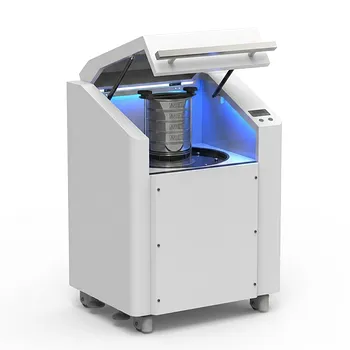
High Frequency Cabinet Type Three-Dimensional Rotary Vibrating Sieve Shaker for Dry Sieving and Particle Classification

Laboratory Vibratory Test Sieve Shaker for Precision Particle Size Analysis and Powder Grading

三维电磁微量振动筛分仪

Stainless Steel Rotary Vibrating Sieve High Precision Circular Vibratory Separator Industrial Powder Grading Machine Multi Layer Sifting Equipment

Tapping Oscillating Sieve Shaker for Dry and Wet Particle Size Analysis

Three Dimensional Rotary Vibrating Sieve
Vibratory Superfine Grinder for Ultra Fine Laboratory Powder Milling
Small Vibrating Ultrafine Grinder for Traditional Chinese Medicine
Automatic Vibrating Powder Feeder for Laboratory Material Processing Precision Vibratory Hopper Feeder for Granular and Powder Material Handling Industrial Grade Vibrating Tray Feeder for Consistent Material Sample Preparation