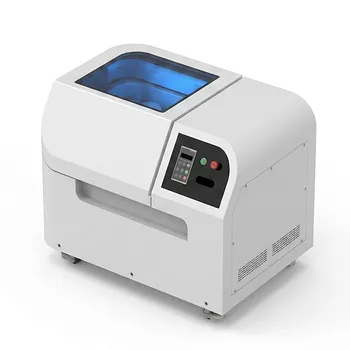
What role does a high-efficiency ball mill play in Li1.27Cr0.2Mn0.53O2 preparation? Enhancing Nanoscale Homogeneity
Updated 4 months ago
In the preparation of $Li_{1.27}Cr_{0.2}Mn_{0.53}O_{2}$ layered cathode materials, a high-efficiency ball mill acts as the critical mechanical processor that transforms raw precursors into a nanometer-scale suspension. By operating at high speeds, typically around 2000 rpm, the mill utilizes intense shear forces and impact energy to refine lithium, chromium, and manganese raw materials within an aqueous solution. This process reduces the slurry’s particle size to a range of 200–300 nm, creating a highly uniform mixture that serves as the essential physical foundation for the subsequent solid-state reaction.
High-efficiency ball milling ensures the atomic-level homogeneity of precursor components while significantly increasing their surface energy. This mechanical activation is vital for reducing the diffusion distance during calcination, ultimately enabling the formation of nano-sized primary particles in the final cathode material.
Mechanical Refinement and Particle Size Reduction
Achieving Nanometer-Scale Dimensions
The primary role of the ball mill is the drastic reduction of precursor particle size to 200–300 nm. This transition into the nanometer range is essential because it maximizes the specific surface area of the raw materials.
Smaller particles allow for a higher density of contact points between the lithium, chromium, and manganese components. This proximity is what enables the solid-state reaction to proceed efficiently at the targeted scale.
The Impact of High-Speed Shear Forces
Operating at high speeds, such as 2000 rpm, generates the powerful kinetic energy required to break down hard precursor aggregates. These shear and impact forces are much more intense than those found in standard planetary mills.
This high energy level is necessary to ensure that the aqueous slurry becomes a stable, well-dispersed suspension. Without this intensity, the precursors would remain too coarse, leading to inhomogeneous crystal growth during later stages.
Promoting Reaction Kinetics and Uniformity
Homogeneity at the Atomic Level
The high-efficiency mill facilitates molecular-level uniform mixing of the stoichiometric components. By eliminating spatial inhomogeneity, the mill ensures that every part of the precursor suspension has the correct ratio of elements.
This uniformity is a prerequisite for synthesizing pure-phase ceramic materials. It prevents the formation of unwanted secondary phases or localized impurities that can degrade battery performance.
Increasing Surface Energy and Reactivity
The intense mechanical action does more than just break particles; it introduces lattice defects and dislocations. These microscopic changes increase the reactivity of the precursor powders.
By raising the surface energy of the materials, the ball mill creates favorable kinetic conditions for ion diffusion. This allows the subsequent high-temperature calcination to occur more uniformly, resulting in the desired layered oxide structure.
Understanding the Trade-offs
Equipment Wear and Impurity Risks
While high speeds are necessary for refinement, they also increase the wear and tear on the grinding media and the mill container. This mechanical erosion can introduce small amounts of impurities from the grinding balls into the cathode precursor.
To mitigate this, users must carefully select grinding materials that are compatible with the cathode chemistry. Contamination control is a critical factor when aiming for high-purity $Li_{1.27}Cr_{0.2}Mn_{0.53}O_{2}$.
Energy Consumption vs. Refinement
High-efficiency milling at 2000 rpm is an energy-intensive process. There is often a point of diminishing returns where further milling time does not significantly reduce particle size but does increase heat generation.
Managing the thermal profile of the slurry during milling is vital. Excessive heat can cause unwanted premature chemical changes or evaporation of the aqueous solution, altering the suspension's consistency.
How to Apply This to Your Project
When utilizing high-efficiency ball milling for layered cathode synthesis, your specific goals should dictate your operational parameters.
- If your primary focus is maximizing discharge capacity: Prioritize achieving the 200-300 nm particle size range to ensure the formation of nano-sized primary particles during calcination.
- If your primary focus is material purity: Opt for high-quality, wear-resistant grinding media (such as zirconia) and monitor milling duration to minimize container erosion.
- If your primary focus is scalability and cost: Balance the milling speed and time to find the most energy-efficient window that still achieves a uniform atomic-level mixture.
Properly executed high-efficiency milling provides the foundational architecture necessary for the high-performance electrochemical behavior of lithium-rich layered oxides.
Summary Table:
| Key Parameter | Target Value / Action | Impact on Cathode Material |
|---|---|---|
| Milling Speed | ~2000 rpm | Generates high shear forces to break hard aggregates |
| Particle Size | 200–300 nm | Maximizes surface area for efficient solid-state reactions |
| Mixing Level | Atomic-level Homogeneity | Prevents secondary phases and ensures pure-phase ceramics |
| Surface Energy | Mechanical Activation | Introduces lattice defects to lower calcination temperature |
| Contamination | Material Selection | Zirconia media usage maintains high electrochemical purity |
Elevate Your Battery Material Research with Precision Engineering
Achieving the perfect 200-300nm precursor suspension for Li1.27Cr0.2Mn0.53O2 requires more than just high speed—it requires precision control and reliable equipment. We provide complete laboratory sample preparation solutions for material science, specializing in the high-performance powder processing and compaction equipment essential for advanced cathode development.
Our extensive product lines are designed to support every stage of your workflow:
- Advanced Milling: Achieve atomic-level homogeneity with our planetary ball mills, jet mills, and cryogenic grinders.
- Material Refinement: High-precision sieve shakers and mixers for consistent slurry preparation.
- Expert Compaction: A full spectrum of hydraulic presses, including Cold/Warm Isostatic Presses (CIP/WIP), vacuum hot presses, and XRF pellet presses for final sample characterization.
Whether you are focusing on maximizing discharge capacity or ensuring material purity, our equipment delivers the mechanical activation your research demands.
Ready to optimize your laboratory's efficiency? Contact us today to find the perfect solution for your powder processing needs!
References
- Chengkang Chang, Dongyun Zhang. Enhanced Electrochemical Performance of Li1.27Cr0.2Mn0.53O2 Layered Cathode Materials via a Nanomilling-Assisted Solid-state Process. DOI: 10.3390/ma12030468
Mentioned Products
- Miniature Planetary Ball Mill with Vacuum Grinding and High Efficiency for Laboratory Sample Preparation
- Heavy Duty Horizontal Planetary Ball Mill for Efficient Industrial Grinding and Sample Preparation
- High Energy Planetary Ball Mill for Nano Scale Grinding and Mechanical Alloying
- Vertical Production Planetary Ball Mill for High Throughput Powder Processing
- High Energy Omnidirectional Planetary Ball Mill 16L
People Also Ask
- Why is a planetary ball mill essential for SiBCN-rGO wet-spinning? Achieve Superior Dispersion and Spinnability
- What role does a planetary ball mill play in the preparation of forsterite (Mg2SiO4) ceramic raw materials? Key Insights
- How does a planetary ball mill contribute to the top-down size reduction of silica particles? Achieve Nano-Scale Precision
- Why is a benchtop planetary ball mill used for eggshell microparticles? Optimize Flame Retardant Grinding Efficiency
- Why grind lime-pozzolan specimens for TG/DTA for 3 mins? Master sample prep for high-precision thermal analysis.

Tech Team · PowderPreparation
Last updated on Jun 03, 2026
Related Products

Miniature Planetary Ball Mill with Vacuum Grinding and High Efficiency for Laboratory Sample Preparation
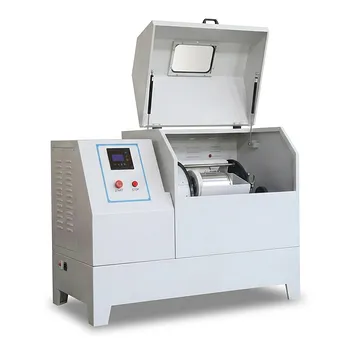
Heavy Duty Horizontal Planetary Ball Mill for Efficient Industrial Grinding and Sample Preparation

High Energy Planetary Ball Mill for Nano Scale Grinding and Mechanical Alloying

Vertical Production Planetary Ball Mill for High Throughput Powder Processing

High Energy Omnidirectional Planetary Ball Mill 16L
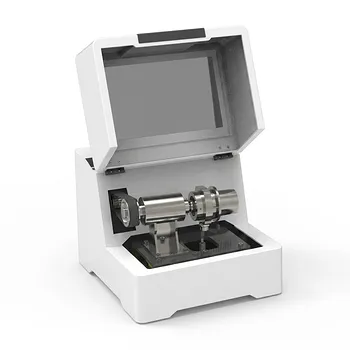
Single Tank High Energy Vibratory Ball Mill for Laboratory Grinding and Mixing

High Energy Omnidirectional Planetary Ball Mill 20L
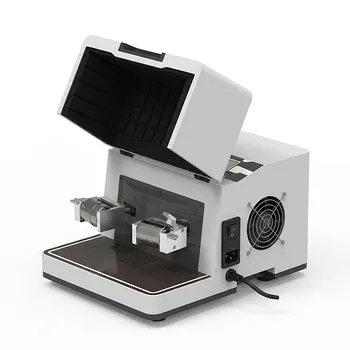
High Energy Hybrid Vibratory Ball Mill for Grinding Mixing and Cell Disruption
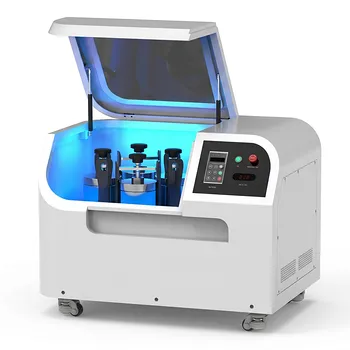
Planetary Ball Mill 12L

High Energy Laboratory Planetary Ball Mill for Nano Grinding and Material Science Sample Preparation
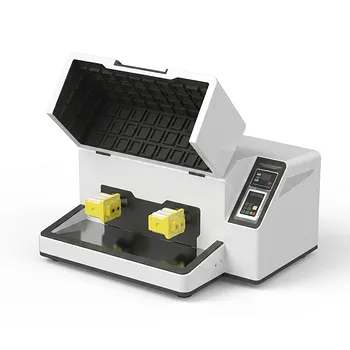
Multi-Platform Nanoscale High-Energy Vibratory Ball Mill

Nano High Energy Vibratory Ball Mill with Heating and Temperature Control

High Throughput Micro Ball Mill for Cryogenic Grinding and Laboratory Cell Disruption

Vertical Square Planetary Ball Mill for Laboratory Sample Preparation and Nanoscale Grinding
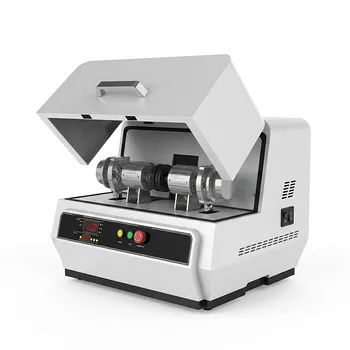
Dual Jar High Energy Vibratory Ball Mill
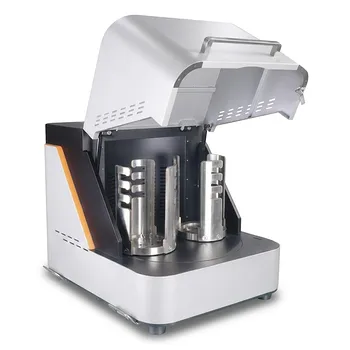
High Energy Laboratory Planetary Ball Mill for Nano Grinding and Colloidal Mixing of Hard and Brittle Materials
Dual Station Planetary Ball Mill 24L
Nanoscale High Energy Vibratory Ball Mill Low Temperature
Nano High Energy Vibratory Ball Mill for Laboratory Sample Preparation