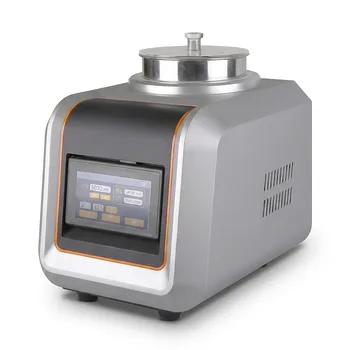
What role do mechanical sieve shakers play in microsphere quality assessment? Optimize Size for Precise Drug Release
Updated 4 months ago
Mechanical sieve shakers and standard test sieves provide the primary physical method for classifying drug-loaded microspheres by particle size. This process allows manufacturers to calculate the average particle size and distribution range by measuring the mass of material retained on each sieve (typically ranging from 10 to 120 mesh). These metrics are essential for validating the repeatability of manufacturing processes and predicting the specific drug release kinetics of the final therapeutic product.
Sieve analysis serves as a critical quality control checkpoint that links physical particle dimensions to biological performance. By defining the size distribution, developers ensure dose accuracy and consistent dissolution rates across different production batches.
Quantifying Physical Characteristics
The core function of sieve analysis is to transform a bulk powder into quantifiable data regarding its physical structure.
Calculating Average Particle Size
Mechanical shakers utilize vibration to pass dried microspheres through a series of graduated mesh sizes. By weighing the material retained on each individual sieve, technicians can determine the average particle size through mass-balance calculations.
Mapping the Distribution Range
A narrow distribution range indicates a highly controlled manufacturing process, whereas a wide range suggests inconsistency. This data is vital for assessing the repeatability of the melt dispersion process, ensuring that every batch meets the same physical specifications.
Eliminating Experimental Error
Standard test sieves allow researchers to isolate particles within a targeted range, such as 300 to 1000 micrometers. This isolation removes ultrafine powders or oversized particles that could otherwise skew data and lead to scientifically invalid conclusions during formulation testing.
Predicting Therapeutic Performance
The physical size of a microsphere is a direct determinant of how it behaves once administered to a patient.
Influencing Dissolution Kinetics
Particle size is inextricably linked to the surface area available for solvent interaction. Because smaller particles have a higher surface-area-to-volume ratio, they generally exhibit faster dissolution rates than larger spheres.
Ensuring Dose Accuracy
Consistent particle size distribution is vital for ensuring dose accuracy in pharmaceutical products. If the size distribution varies significantly between batches, the amount of active pharmaceutical ingredient (API) released over time may become unpredictable.
Optimizing Process Parameters
By analyzing the proportion of particles at specific sieve sizes, such as material passing through a 250-micrometer aperture, technicians can quantify how initial raw material sizes influence the final outcome. This allows for the fine-tuning of granulation and milling parameters to maximize yield.
Understanding the Trade-offs
While sieve analysis is a gold standard for particle sizing, it is not without limitations that can impact data integrity.
Mechanical Stress and Attrition
The mechanical vibration required for separation can sometimes cause friable microspheres to break or erode. This creates "fines" during the testing process itself, which can lead to an inaccurate representation of the original particle size distribution.
The Risk of Sieve Blinding
Smaller mesh sizes are prone to sieve blinding, where particles become wedged in the apertures and block the flow of material. This results in an overestimation of the mass of larger particles and requires careful maintenance and standardized vibration frequencies to prevent.
Static Electricity Challenges
Dry microspheres often carry a static charge that causes them to adhere to the stainless steel sieves or to each other. This can prevent particles from falling through the correct mesh size, necessitating the use of anti-static agents or specialized wet-sieving techniques in certain applications.
How to Apply This to Your Quality Assessment
To maximize the value of sieve analysis in your workflow, tailor your approach based on your specific quality goals.
- If your primary focus is predictable drug release: Prioritize a narrow sieve range to ensure a consistent surface-area-to-volume ratio across all batches.
- If your primary focus is manufacturing efficiency: Use the ratio of oversize particles to fines to evaluate the effectiveness of your melt dispersion or milling parameters.
- If your primary focus is regulatory compliance: Ensure all sieves are calibrated stainless steel standards and document the cumulative distribution percentage for every production lot.
By mastering the mechanical classification of microspheres, you ensure that the bridge between laboratory formulation and clinical efficacy remains technically sound and reproducible.
Summary Table:
| Key Metric | Role in Quality Assessment | Impact on Therapeutic Performance |
|---|---|---|
| Average Particle Size | Calculated via mass retained on graduated meshes | Directly influences dissolution rates and surface area |
| Distribution Range | Maps uniformity across 10 to 120 mesh sizes | Validates manufacturing repeatability and batch consistency |
| Sieve Isolation | Removes ultrafine powders and oversized particles | Ensures dose accuracy and eliminates experimental skew |
| Process Yield | Quantifies material passing specific apertures | Used to fine-tune milling and granulation parameters |
Elevate Your Pharmaceutical Material Processing
Precision in particle size distribution is the bridge between laboratory formulation and clinical efficacy. [Your Brand Name] provides complete laboratory sample preparation solutions for material science, specializing in advanced powder processing and compaction equipment tailored for the pharmaceutical and material industries.
Our extensive product line includes:
- Sizing & Classification: Vibratory and air-jet sieve shakers equipped with high-precision test sieves and various meshes.
- Size Reduction: High-efficiency crushers (jaw/roll), liquid nitrogen cryogenic grinders, and specialized mills (planetary ball, jet, sand/bead, disc, rotor).
- Mixing & Homogenization: Professional powder mixers and defoaming mixers for uniform API distribution.
- Advanced Compaction: A full spectrum of hydraulic presses, including Cold/Warm Isostatic Presses (CIP/WIP), standard lab presses, XRF pellet presses, and vacuum hot presses.
Ready to eliminate sieve blinding and optimize your microsphere yield? Contact our experts today to find the perfect solution for your lab!
References
- T. Rajasekaran. Synergistic Effect of Diclofenac Sodium and Sulfamethoxazole in Pure form, Microparticle Formulation and in Carbopol Incorporated Gel Containing Microparticle Formulation. DOI: 10.33263/lianbs124.111
Mentioned Products
- 三维电磁微量振动筛分仪
- Vibratory Sieve Shaker Electromagnetic 3D Motion Powder Particle Size Analyzer for Dry and Wet Sieving
- Laboratory Dry and Wet Three Dimensional Vibratory Sieve Shaker for Particle Analysis
- Small Laboratory Vibrating Sieve Shaker for Precise Particle Size Analysis
- Stainless Steel Laboratory Vibratory Test Sieve Shaker
People Also Ask
- Why is a standard sieve shaker essential for CBA powders in geopolymers? Enhance Reactivity & Material Strength
- Why are standard metal sieves and sieve shakers necessary for 5-aminotetrazole mixtures? Optimize Thermal & Kinetic Data
- Why Use Sieve Shakers for Gangue Slurry Experiments? Optimize Particle Grading for Superior Results
- What are the advantages of mechanical vs. manual sieving for road dust analysis? Achieve Superior Data Standardization.
- How do high-precision sieve shakers and powder mixers facilitate material circularity in metal PBF? Optimize AM Cycles

Tech Team · PowderPreparation
Last updated on Jun 03, 2026
Related Products

三维电磁微量振动筛分仪

Vibratory Sieve Shaker Electromagnetic 3D Motion Powder Particle Size Analyzer for Dry and Wet Sieving

Laboratory Dry and Wet Three Dimensional Vibratory Sieve Shaker for Particle Analysis

Small Laboratory Vibrating Sieve Shaker for Precise Particle Size Analysis

Stainless Steel Laboratory Vibratory Test Sieve Shaker

Heavy Duty Dry Three Dimensional Vibratory Sieve Shaker for Particle Separation

Dry Three Dimensional Vibratory Sieve Shaker

Small Laboratory Vibratory Sieve Shaker for Powder Gradation and Particle Size Analysis

Laboratory Vibratory Test Sieve Shaker for Precision Particle Size Analysis and Powder Grading

High Frequency Wet Three-Dimensional Vibrating Sieve Shaker for Dry and Wet Particle Size Analysis

Tapping Oscillating Sieve Shaker for Dry and Wet Particle Size Analysis

High Frequency Cabinet Type Three-Dimensional Rotary Vibrating Sieve Shaker for Dry Sieving and Particle Classification

Stainless Steel Rotary Vibrating Sieve High Precision Circular Vibratory Separator Industrial Powder Grading Machine Multi Layer Sifting Equipment

Three Dimensional Rotary Vibrating Sieve