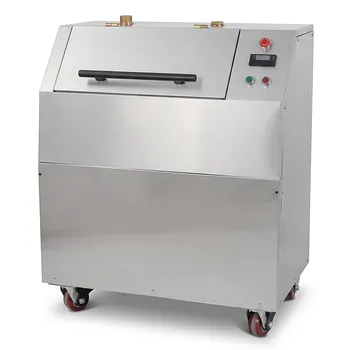
What is the specific role of a vibratory sieve shaker in ZnO membrane ceramic support pretreatment? Ensure Uniformity.
Updated 4 months ago
The vibratory sieve shaker serves as the critical gatekeeper for particle size uniformity during the pretreatment of raw materials for ZnO microfiltration membrane ceramic supports. Specifically, it is used to perform high-precision particle size classification on calcined and crushed kaolin using standard test sieves, typically with a 150 µm aperture. This process ensures that the precursor material entering the production line has a consistent physical profile, which is the fundamental requirement for successful downstream processing.
The primary role of the vibratory sieve shaker is to standardize the particle size distribution of kaolin, ensuring a uniform raw material feed. This precision directly enables the creation of a dense ceramic substrate with a uniform pore size distribution, which is essential for the mechanical and filtration integrity of the ZnO microfiltration membrane.
Achieving Precise Particle Size Classification
Classification of Kaolin Precursors
In the production of ZnO supports, kaolin must be calcined and crushed before it can be used. The vibratory sieve shaker employs high-precision vibration to force this crushed material through standard test sieves, often utilizing a 150 µm aperture to isolate the required fraction.
Removal of Agglomerates and Over-sized Particles
Beyond simple grading, the mechanical action of the shaker removes large particle agglomerates that naturally form during storage or initial crushing. Eliminating these oversized particles is vital to prevent localized defects or structural "voids" in the ceramic green body.
Maintenance of High-Precision Fractions
The shaker allows for the isolation of specific powder fractions within a micro-range, which is necessary for experimental and industrial accuracy. By ensuring the material adheres to a narrow size specification, manufacturers can predict exactly how the material will behave during the high-pressure stages of production.
Ensuring Structural Integrity and Performance
Optimization of Extrusion Molding
The uniform particle size achieved through sieving is critical for the extrusion molding process. If particle sizes vary significantly, the flow characteristics of the ceramic paste change, leading to uneven thickness or internal stresses in the extruded support.
Uniform Pore Size Distribution
The ultimate performance of a ZnO microfiltration membrane depends on the pore structure of its ceramic support. Precise sieving ensures that the raw materials pack together consistently, resulting in a uniform pore size distribution that allows for predictable filtration rates and high selectivity.
Enhancing Packing Density and Sintering Quality
Consistent particle sizing allows for a higher and more uniform packing density in the green body. This uniformity prevents abnormal grain growth during the sintering process, which is necessary to obtain a dense, mechanically stable microstructure with stable electrical and physical properties.
Understanding the Technical Trade-offs
Mesh Blinding and Maintenance
One common challenge with high-precision sieving is "blinding," where particles become lodged in the 150 µm mesh. This reduces screening efficiency and requires regular maintenance or the use of anti-blinding devices (like ultrasonic cleaners) to ensure the particle size remains within specification.
Balancing Throughput and Precision
While higher vibration amplitudes can increase the speed of material processing, excessive force can sometimes lead to particle attrition or reduced classification accuracy. Operators must balance the need for high-volume production with the strict requirement for a narrow particle size distribution.
How to Optimize Pretreatment for Your Project
Recommendations for Material Processing
- If your primary focus is filtration precision: Prioritize the use of certified 150 µm test sieves and conduct regular mesh inspections to ensure the pore size distribution of the final support remains consistent.
- If your primary focus is mechanical strength: Focus on the removal of oversized agglomerates through longer sieving cycles to ensure a higher packing density and fewer structural defects after sintering.
- If your primary focus is production throughput: Implement multi-layer vibratory shakers to grade materials in stages, which reduces the load on the fine 150 µm mesh and prevents premature blinding.
By strictly controlling particle size through vibratory sieving, you establish the physical foundation necessary for a high-performance, defect-free ZnO microfiltration membrane.
Summary Table:
| Key Stage | Technical Function | Benefit to ZnO Support |
|---|---|---|
| Classification | Isolates precise 150 µm kaolin fractions | Ensures a consistent physical profile for feed material |
| De-agglomeration | Removes oversized particles and lumps | Prevents localized defects and structural voids |
| Molding Prep | Optimizes paste flow for extrusion | Leads to uniform thickness and reduced internal stress |
| Sintering Quality | Enhances packing density of the green body | Prevents abnormal grain growth for stable microstructure |
Optimize Your Material Pretreatment with KinTek
Achieving the perfect pore size distribution starts with precision. At KinTek, we provide complete laboratory sample preparation solutions for material science, specializing in high-performance powder processing and compaction equipment.
Whether you need to standardize raw materials with our vibratory and air-jet sieve shakers, refine powders using our planetary ball and jet mills, or create dense ceramic green bodies with our Cold/Warm Isostatic Presses (CIP/WIP) and vacuum hot presses, we have the expertise to elevate your production quality. Our extensive line also includes jaw crushers, powder mixers, and XRF pellet presses designed for rigorous industrial and research standards.
Ready to enhance your lab's efficiency and filtration precision? Contact our technical team today to find the ideal solution for your ZnO microfiltration membrane project!
References
- Boukhemis Boudaira, Noureddine Karboua. Preparation and characterization of ZnO microfiltration membrane and its support using kaolin (DD3) and CaCO3. DOI: 10.1590/0366-69132016623621972
Mentioned Products
- Vibratory Sieve Shaker Electromagnetic 3D Motion Powder Particle Size Analyzer for Dry and Wet Sieving
- Laboratory Dry and Wet Three Dimensional Vibratory Sieve Shaker for Particle Analysis
- Dry Three Dimensional Vibratory Sieve Shaker
- Stainless Steel Laboratory Vibratory Test Sieve Shaker
- Heavy Duty Dry Three Dimensional Vibratory Sieve Shaker for Particle Separation
People Also Ask
- How does a vibratory sieve shaker contribute to optimizing the performance of activated carbon? Enhance Adsorption Precision
- Why is a laboratory vibratory sieve shaker necessary for processing magnesium-based borate precursor powders? Boost Activity
- Why use a vibratory sieve shaker to verify coarse aggregate grading in rubberized concrete? Ensure Structural Integrity
- What function do vibratory sieve shakers and standard test sieves serve in the preparation of adsorbents? Key Guide
- What role does a vibratory sieve shaker play in the particle size analysis of ground corn products? Enhance QC Precision

Tech Team · PowderPreparation
Last updated on May 14, 2026
Related Products
Vibratory Sieve Shaker Electromagnetic 3D Motion Powder Particle Size Analyzer for Dry and Wet Sieving

Laboratory Dry and Wet Three Dimensional Vibratory Sieve Shaker for Particle Analysis

Dry Three Dimensional Vibratory Sieve Shaker
Stainless Steel Laboratory Vibratory Test Sieve Shaker

Heavy Duty Dry Three Dimensional Vibratory Sieve Shaker for Particle Separation

Small Laboratory Vibratory Sieve Shaker for Powder Gradation and Particle Size Analysis

Small Laboratory Vibrating Sieve Shaker for Precise Particle Size Analysis
High Frequency Wet Three-Dimensional Vibrating Sieve Shaker for Dry and Wet Particle Size Analysis
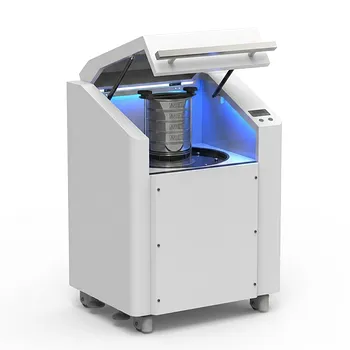
High Frequency Cabinet Type Three-Dimensional Rotary Vibrating Sieve Shaker for Dry Sieving and Particle Classification

Laboratory Vibratory Test Sieve Shaker for Precision Particle Size Analysis and Powder Grading

三维电磁微量振动筛分仪

Stainless Steel Rotary Vibrating Sieve High Precision Circular Vibratory Separator Industrial Powder Grading Machine Multi Layer Sifting Equipment

Tapping Oscillating Sieve Shaker for Dry and Wet Particle Size Analysis

Three Dimensional Rotary Vibrating Sieve
Vibratory Superfine Grinder for Ultra Fine Laboratory Powder Milling
Small Vibrating Ultrafine Grinder for Traditional Chinese Medicine
Automatic Vibrating Powder Feeder for Laboratory Material Processing Precision Vibratory Hopper Feeder for Granular and Powder Material Handling Industrial Grade Vibrating Tray Feeder for Consistent Material Sample Preparation