What is the significance of using a laboratory hydraulic press in the compaction stage? Achieve Superior Material Density
Updated 5 months ago
The laboratory hydraulic press is the essential mechanism for transforming loose, self-lubricating powder mixtures into dense, structurally sound "green bodies." By applying high axial pressure through a precision die, the press forces particles to rearrange and undergo plastic deformation. This process is critical for establishing the initial density and geometric shape required for a composite material to survive the transition from a powder mixture to a functional solid.
The primary significance of the laboratory hydraulic press lies in its ability to provide precise control over pressure and holding duration, which eliminates internal pores and density gradients. This ensures the structural integrity of the composite during sintering and maintains a stable, uniform distribution of solid lubricants within the matrix.
The Transformation from Powder to Green Body
Mechanics of Particle Rearrangement
The hydraulic press applies stable, high-intensity loads to force mixed self-lubricating powders into a mold or die. This mechanical force overcomes the friction between particles, causing them to shift and fill interstitial spaces.
Achieving Plastic Deformation
Under high pressure—often reaching hundreds of megapascals—the particles undergo plastic deformation. This deformation is necessary to create a "green body," a compacted specimen that holds its shape through mechanical interlocking before any heat treatment is applied.
Elimination of Internal Voids
A critical role of the press is the exclusion of trapped air bubbles and the reduction of porosity. By minimizing these voids, the press ensures that the matrix material and the solid lubricant are in intimate contact, which is vital for the material’s final mechanical strength.
Ensuring Material Uniformity and Stability
Preventing Density Gradients
Precise control over the pressure-holding duration is vital for eliminating density gradients within the composite. If the pressure is uneven or released too quickly, different zones of the material will have different densities, leading to structural weak points.
Maintaining Lubricant Distribution
In self-lubricating composites, the stability of the solid lubricant distribution is paramount. The controlled compression of the hydraulic press locks the lubricant particles into the matrix uniformly, preventing them from clustering or migrating during subsequent processing.
Optimizing Contact Points for Diffusion
The compaction process increases the number of physical contact points between different material phases. These contact points are essential prerequisites for element diffusion and solid-state reactions that occur during the later sintering or heat treatment stages.
Preparing for Post-Processing Success
Ensuring Structural Integrity During Sintering
A well-compacted green body is less likely to deform or crack during thermal densification. The hydraulic press provides the specimen with sufficient "green strength" to withstand the stresses of being handled and heated.
Standardizing Geometry for Testing
Laboratory presses allow for the creation of specimens with precise thickness and standardized shapes. This uniformity is critical for researchers who need to collect accurate data on properties such as Young’s modulus, hardness, and tensile strength.
Controlling Sintering Shrinkage
By achieving a high and uniform initial green density, the hydraulic press allows manufacturers to predict and study sintering shrinkage behavior. This lead to higher dimensional accuracy in the final manufactured part.
Understanding the Trade-offs and Pitfalls
The Risk of Internal Stress Concentrations
If pressure is applied too rapidly or without precision molds, it can create internal stress concentrations. These microscopic stresses may not be visible in the green body but often lead to catastrophic failure or warping during the high temperatures of sintering.
Pressure vs. Tooling Wear
While higher pressures generally lead to denser parts, exceeding the design limits of the die or the press can cause die deformation or galling. Balancing the need for density with the longevity of high-precision stainless steel molds is a constant operational trade-off.
Pressure-Holding Limits
Simply reaching a target pressure is often insufficient; the pressure-holding duration must be optimized. Inadequate holding time may allow for "spring back," where the particles slightly re-expand upon release, leading to micro-cracks and reduced structural integrity.
How to Apply This to Your Manufacturing Process
Making the Right Choice for Your Goal
- If your primary focus is mechanical data accuracy: Prioritize a press with high-precision pressure gauges and automated holding timers to ensure every test pellet is identical in density and geometry.
- If your primary focus is developing new chemical phases: Use higher compaction pressures (e.g., 200 MPa or more) to maximize particle contact points, which facilitates better element diffusion during heat treatment.
- If your primary focus is complex composite molding: Opt for a press that allows for controlled temperature integration to improve the flow of resins or binders within the powder mixture.
By mastering the compaction stage via a laboratory hydraulic press, you ensure that the final solid-lubricant composite achieves its intended performance, durability, and structural reliability.
Summary Table:
| Key Feature | Functional Role | Manufacturing Benefit |
|---|---|---|
| High Axial Pressure | Forces particle rearrangement & plastic deformation | Transforms loose powder into a stable "green body" |
| Precision Control | Eliminates internal pores & density gradients | Prevents structural weak points and cracking |
| Void Removal | Excludes trapped air bubbles | Maximizes mechanical strength and matrix contact |
| Contact Optimization | Increases physical contact points | Facilitates element diffusion during sintering |
| Standardized Tooling | Creates precise, uniform specimen shapes | Ensures accurate data for hardness and tensile testing |
Elevate Your Material Research with Precision Compaction Solutions
Achieving the perfect "green body" is the foundation of high-performance composite manufacturing. At [Company Name], we provide complete laboratory sample preparation solutions for material science, specializing in advanced powder processing and compaction equipment.
Whether you are developing self-lubricating materials or advanced ceramics, our extensive range of hydraulic presses—including Cold/Warm Isostatic Presses (CIP/WIP), standard lab presses, XRF pellet presses, and vacuum hot presses—ensures uniform density and structural integrity.
Beyond compaction, we support your entire workflow with:
- Size Reduction: Jaw/roll crushers and liquid nitrogen cryogenic grinders.
- Milling: Planetary ball, jet, and rotor mills.
- Analysis & Mixing: Sieve shakers, powder mixers, and defoaming mixers.
Ready to optimize your compaction process? Contact our technical experts today to find the right equipment for your lab!
References
- P. Sarma, Anil Borah. Solid Lubricants in Sustainable Manufacturing: A Review of Processing Techniques, Materials and Applications. DOI: 10.15282/ijame.22.4.2025.1.0978
Mentioned Products
- 6-Ton Small Single-Punch Tablet Press — Laboratory Powder & Granule Tableting Equipment / Tablet Forming Machine
- 5 Ton Single Punch Tablet Press Laboratory Small Batch Production
- Manual Tablet Press with Dual Scale Pressure Gauge for Pharmaceutical Food Chemical Laboratory Sample Preparation
- 6 Ton Variable Frequency Single Punch Tablet Press
- High Shear Laboratory Emulsifier for Mixing and Homogenization
People Also Ask
- What is the function of a laboratory press in Cr-Ti alloy evaluation? Quantify Fracture Stress & Strength
- What is the function of a laboratory press in assessing the hydrophobic performance of modified vermiculite fillers?
- What is the core function of a laboratory press in the forming of ceramic filter element green bodies? Maximize Density.
- What is the function of a laboratory press in the preparation of ceramic feed rods? Master Density and Precision
- Why is vacuum sealing and flexible packaging necessary for Aluminum Titanate powders during CIP? Ensure Peak Density

Tech Team · PowderPreparation
Last updated on May 14, 2026
Related Products
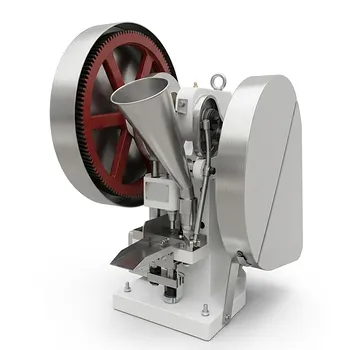
6-Ton Small Single-Punch Tablet Press — Laboratory Powder & Granule Tableting Equipment / Tablet Forming Machine
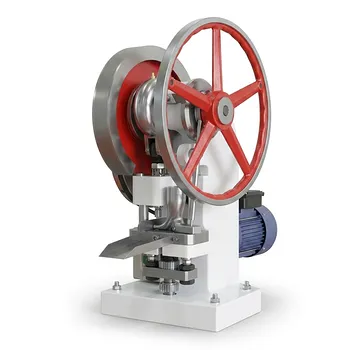
5 Ton Single Punch Tablet Press Laboratory Small Batch Production
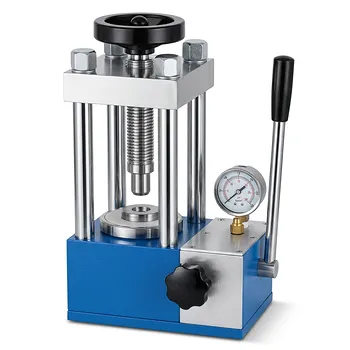
Manual Tablet Press with Dual Scale Pressure Gauge for Pharmaceutical Food Chemical Laboratory Sample Preparation
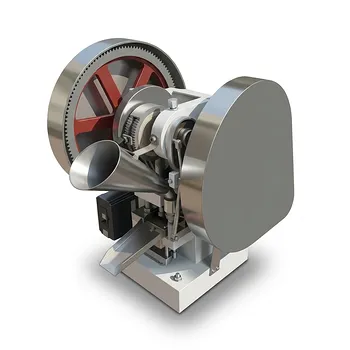
6 Ton Variable Frequency Single Punch Tablet Press
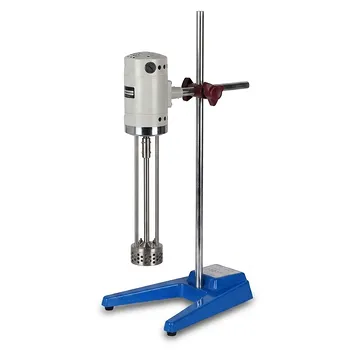
High Shear Laboratory Emulsifier for Mixing and Homogenization
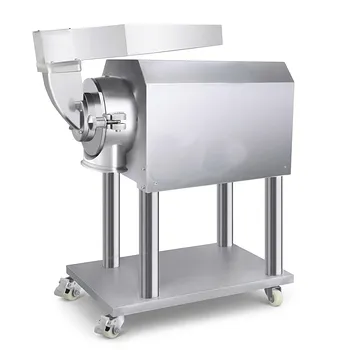
High Speed Small Laboratory Crusher for Dry Material Sample Preparation
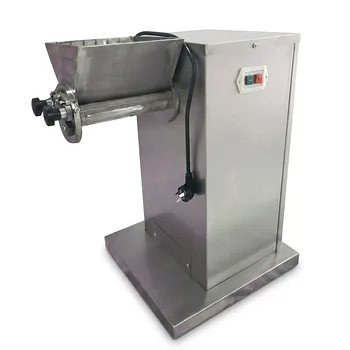
Small Laboratory Oscillating Granulator for Wet and Dry Granulation Processing
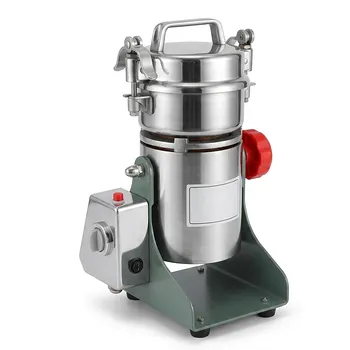
High Speed Swing Type Laboratory Pulverizer for Fine Powder Grinding and Sample Preparation