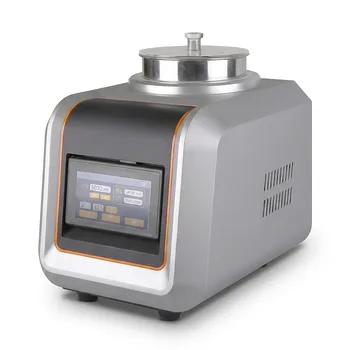
What is the role of a vibratory sieve shaker when processing sediment containing coarse particles? Boost Accuracy
Updated 5 months ago
A vibratory sieve shaker serves as the essential physical separation tool for sediment fractions that exceed the measurement capacity of optical instruments. Specifically, it is used to process coarse particles between 2 mm and 32 mm, providing the precise mass-based data required to supplement laser particle size analysis. By mechanizing the sieving process, it ensures that sediment samples are classified with a level of repeatability and accuracy that manual methods cannot replicate.
The vibratory sieve shaker bridges the technical gap between physical mass measurement and laser diffraction. It allows researchers to integrate coarse fraction data with fine-particle analysis to construct a complete, full-range particle size distribution curve.
Integration with Modern Analytical Techniques
Overcoming Laser Measurement Limits
Most laser particle size analyzers have a defined upper limit, often failing to accurately measure particles larger than 2 mm. The vibratory sieve shaker addresses this by physically grading the coarse fraction using standard test sieves. This physical separation is the only reliable way to account for the mass percentage of larger sediment components.
Constructing Comprehensive Distribution Curves
To understand the full profile of a sediment sample, data from the sieve shaker must be mathematically combined with laser analysis data. This synthesis allows researchers to calculate critical geological parameters, including mean grain size, skewness, and kurtosis. These metrics are vital for determining the origin and transport mechanisms of marine and coastal sediments.
Mitigating the "Particle Size Effect"
In geochemical analysis and X-ray fluorescence (XRF), inconsistent grain sizes can skew results, a phenomenon known as the particle size effect. Vibratory sieving standardizes the sample into specific fractions (e.g., 63 micrometers). This ensures that indicator elements, like gold or heavy metals, are analyzed within the specific fractions where they naturally concentrate.
Advantages of Mechanized Vibration
Eliminating Human Operational Error
Manual shaking is inherently inconsistent and prone to "blinding," where particles clog the sieve mesh. An electric vibratory shaker provides continuous, regular mechanical oscillation, ensuring that every particle has maximum opportunity to pass through the apertures. This standardization is critical for the reproducibility of experimental results across different laboratories.
Protecting Sample Integrity
For researchers studying eroded soil, preserving naturally formed soil aggregates is essential. High-quality vibratory shakers allow for accurate classification without destroying these aggregates. This captures the true physical state of the sediment, which is necessary for understanding erosion patterns rather than just primary particle content.
Efficiency in Heavy Mineral Separation
In coastal sediment studies, shakers are used to prepare samples for heavy mineral separation (such as ilmenite or zircon). By utilizing preset time parameters and standardized frequencies, the device produces homogenized grain-size levels. This preparation is a prerequisite for accurate mineralogical studies and correlation analysis.
Understanding the Trade-offs
The Risk of Over-Sieving
While automation increases efficiency, excessive vibration duration can lead to particle attrition, where coarse particles wear down into smaller fragments. This creates a "false fine" bias in the data. Users must calibrate vibration intensity and duration based on the hardness and fragility of the specific sediment type.
Limitations of Dry vs. Wet Sieving
Standard vibratory sieving is typically performed on dry samples, which can be problematic for sediments with high clay or silt content. Fine particles often adhere to larger grains or the sieve mesh due to electrostatic charges. In these cases, wet sieving attachments are necessary, adding complexity and time to the cleaning and drying phases of the workflow.
Making the Right Choice for Your Research
To achieve the most accurate particle size distribution, your approach to using a vibratory sieve shaker should align with your specific analytical goals:
- If your primary focus is Geochemical Mapping: Use the shaker to isolate the fine fraction (under 63 $\mu$m) to eliminate grain-size bias during XRF or ICP-MS analysis.
- If your primary focus is Sediment Transport Modeling: Prioritize a nested sieve stack that covers the 2 mm to 32 mm range to ensure your distribution curve captures the full energy profile of the depositional environment.
- If your primary focus is Soil Erosion Studies: Utilize lower vibration amplitudes to classify sediment while keeping delicate soil aggregates intact for structural analysis.
- If your primary focus is Mineral Prospecting: Standardize your sieving duration to ensure high-density minerals are fully separated into their respective size fractions for downstream heavy liquid separation.
The vibratory sieve shaker remains the definitive tool for converting raw, heterogeneous sediment into the structured data required for advanced geological and chemical inquiry.
Summary Table:
| Application Focus | Role of Vibratory Sieve Shaker | Key Outcome |
|---|---|---|
| Analytical Precision | Supplements laser measurement for particles >2 mm | Full-range distribution curves |
| Geochemical Mapping | Isolates fine fractions (e.g., <63 μm) | Eliminates grain-size bias for XRF/ICP-MS |
| Soil Science | Gentle classification at low amplitudes | Preserves natural soil aggregates |
| Mineral Prospecting | Standardized mechanical oscillation | Efficient separation of heavy minerals |
| Data Reliability | Eliminates manual shaking inconsistencies | Repeatable and reproducible results |
Precision Sample Preparation for Material Science
At our core, we provide complete laboratory sample preparation solutions designed to meet the rigorous demands of geological and material research. Whether you are analyzing sediment transport or conducting geochemical mapping, our equipment ensures accuracy from raw sample to final analysis.
Our specialized product lines include:
- Sieve Shakers & Meshes: Advanced vibratory and air-jet sieve shakers with a full range of high-precision test sieves.
- Milling & Crushing: Jaw and roll crushers, plus planetary ball, jet, rotor, and cryogenic grinders for perfect particle size reduction.
- Powder Mixing: High-efficiency powder and defoaming mixers for homogenized sample preparation.
- Hydraulic Presses: A complete spectrum including Cold/Warm Isostatic Presses (CIP/WIP), XRF pellet presses, and vacuum hot presses for material compaction.
Ready to enhance your lab's analytical capabilities? Contact our expert team today to find the ideal equipment for your specific application requirements.
References
- Mathieu D. Marineau, Scott A. Wright. Bed-material characteristics of the Sacramento–San Joaquin Delta, California, 2010–13. DOI: 10.3133/ds1026
Mentioned Products
- Vibratory Sieve Shaker Electromagnetic 3D Motion Powder Particle Size Analyzer for Dry and Wet Sieving
- Laboratory Dry and Wet Three Dimensional Vibratory Sieve Shaker for Particle Analysis
- Stainless Steel Laboratory Vibratory Test Sieve Shaker
- Heavy Duty Dry Three Dimensional Vibratory Sieve Shaker for Particle Separation
- Dry Three Dimensional Vibratory Sieve Shaker
People Also Ask
- How does a vibratory sieve shaker contribute to optimizing the performance of activated carbon? Enhance Adsorption Precision
- Why is a laboratory vibratory sieve shaker necessary for processing magnesium-based borate precursor powders? Boost Activity
- Why use a vibratory sieve shaker to verify coarse aggregate grading in rubberized concrete? Ensure Structural Integrity
- What function do vibratory sieve shakers and standard test sieves serve in the preparation of adsorbents? Key Guide
- What role does a vibratory sieve shaker play in the particle size analysis of ground corn products? Enhance QC Precision

Tech Team · PowderPreparation
Last updated on May 14, 2026
Related Products

Vibratory Sieve Shaker Electromagnetic 3D Motion Powder Particle Size Analyzer for Dry and Wet Sieving

Laboratory Dry and Wet Three Dimensional Vibratory Sieve Shaker for Particle Analysis

Stainless Steel Laboratory Vibratory Test Sieve Shaker

Heavy Duty Dry Three Dimensional Vibratory Sieve Shaker for Particle Separation

Dry Three Dimensional Vibratory Sieve Shaker

Small Laboratory Vibratory Sieve Shaker for Powder Gradation and Particle Size Analysis

High Frequency Wet Three-Dimensional Vibrating Sieve Shaker for Dry and Wet Particle Size Analysis

Small Laboratory Vibrating Sieve Shaker for Precise Particle Size Analysis

High Frequency Cabinet Type Three-Dimensional Rotary Vibrating Sieve Shaker for Dry Sieving and Particle Classification

Laboratory Vibratory Test Sieve Shaker for Precision Particle Size Analysis and Powder Grading

三维电磁微量振动筛分仪

Tapping Oscillating Sieve Shaker for Dry and Wet Particle Size Analysis

Stainless Steel Rotary Vibrating Sieve High Precision Circular Vibratory Separator Industrial Powder Grading Machine Multi Layer Sifting Equipment

Three Dimensional Rotary Vibrating Sieve
Small Vibrating Ultrafine Grinder for Traditional Chinese Medicine

Automatic Vibrating Powder Feeder for Laboratory Material Processing Precision Vibratory Hopper Feeder for Granular and Powder Material Handling Industrial Grade Vibrating Tray Feeder for Consistent Material Sample Preparation
Vibratory Superfine Grinder for Ultra Fine Laboratory Powder Milling
Vibratory Disc Mill for Rapid Fine Grinding and High Throughput Sample Preparation of Hard and Brittle Materials