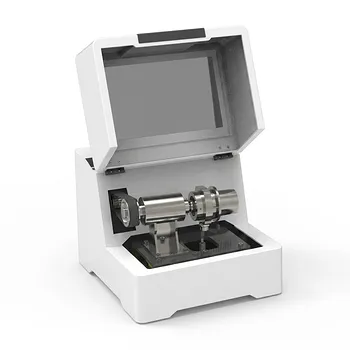
Role of Planetary Ball Mill in Alkynyl Carbon Synthesis: Driving High-Energy Mechanochemical Reactions
Updated 4 months ago
In the mechanochemical synthesis of alkynyl carbon materials, the planetary ball mill acts as a high-energy reactor that provides the mechanical force necessary to drive chemical reactions in a solvent-free environment. It functions by utilizing high-speed rotation to generate intense impact and shear forces, which forcibly disrupt the crystal lattice of solid precursors like calcium carbide ($CaC_2$). This process releases highly nucleophilic alkynyl anions, enabling them to react with organic molecules at ambient temperature and pressure.
The planetary ball mill serves as the primary energy transducer, converting mechanical kinetic energy into the chemical potential required to break rigid crystal lattices and facilitate molecular-level transformations. By overcoming diffusion barriers through constant physical renewal of reactant surfaces, it enables the synthesis of advanced carbon materials that are otherwise difficult to produce via traditional solution-based chemistry.
The Mechanism of Mechanical Activation
Disruption of the Solid Crystal Lattice
The primary role of the mill is the deep activation of solid-state reactants through high-energy impacts. In the case of alkynyl carbon synthesis, the mechanical energy is specifically used to break the ionic bonds within calcium carbide ($CaC_2$).
This lattice disruption is essential because it liberates highly nucleophilic alkynyl anions. Without this mechanical input, these reactive species would remain locked within the stable crystal structure of the carbide.
Driving Nucleophilic Substitution
Once the alkynyl anions are released, the high-energy environment of the mill triggers a nucleophilic substitution reaction. This allows the anions to bond with organic reactants, such as decabromodiphenyl ether (DP).
The planetary ball mill ensures these reactions occur efficiently at ambient temperature and pressure. This eliminates the need for the high thermal energy or specialized solvents typically required in conventional organic synthesis.
Physical Transformation and Material Processing
Particle Size Refinement and Surface Area
The mill utilizes complex centrifugal forces to cause repeated fracture and grinding of the solid materials. This process reduces the reactants to an ultrafine or nanometer scale, vastly increasing the available surface area for chemical contact.
Smaller particle sizes are critical for increasing the reactivity of the powders. By maximizing the contact points between the calcium carbide and the organic precursors, the mill accelerates the overall reaction rate.
Overcoming Diffusion Barriers
In solid-state chemistry, the accumulation of reaction products can create a barrier that prevents unreacted materials from meeting. The intense shear and impact forces of the planetary ball mill continuously break these layers and expose fresh surfaces.
This constant renewal ensures a molecular-level uniform distribution of components. Such homogeneity is vital for creating nanocomposites with consistent performance and stable structures.
Understanding the Trade-offs
Heat Generation and Thermal Control
While the process occurs at ambient pressure, the friction and high-speed impacts within the grinding jars can generate significant localized heat. If not managed, this unintended thermal energy may cause the degradation of sensitive organic precursors or lead to unwanted side reactions.
Contamination from Grinding Media
The high dynamic energies involved in the process inevitably lead to the wear and tear of the grinding balls and jar walls. This can introduce trace amounts of impurities (such as iron or zirconia) into the synthesized alkynyl carbon material.
Complexity of Scalability
While planetary ball mills are highly effective at the laboratory and pilot scale, scaling the process for industrial production is challenging. Maintaining the same energy density and collision frequency in larger vessels requires complex engineering and significantly higher power consumption.
How to Apply This to Your Synthesis Goals
To achieve the best results in the mechanochemical synthesis of alkynyl carbon materials, consider the following strategic focuses:
- If your primary focus is Maximum Reactivity: Prioritize higher rotational speeds and longer grinding durations to ensure complete disruption of the $CaC_2$ lattice and maximum release of alkynyl anions.
- If your primary focus is Material Purity: Utilize grinding jars and media made from high-hardness, chemically inert materials like tungsten carbide or zirconia to minimize contamination.
- If your primary focus is Structural Homogeneity: Optimize the ball-to-powder weight ratio and use a mix of different ball sizes to ensure uniform impact distribution and molecular-level mixing.
The planetary ball mill is not merely a mixing tool, but a sophisticated instrument of mechanical alloying that transforms the fundamental chemical landscape of solid reactants.
Summary Table:
| Function | Mechanism | Key Benefit |
|---|---|---|
| Energy Transduction | Converts kinetic energy to chemical potential | Breaks rigid $CaC_2$ crystal lattices |
| Surface Activation | Continuous shear and impact forces | Overcomes diffusion barriers via surface renewal |
| Particle Engineering | Repeated fracture and ultrafine grinding | Increases reactivity through high surface area |
| Reaction Driving | Ambient pressure nucleophilic substitution | Enables solvent-free, eco-friendly synthesis |
Elevate Your Material Synthesis with Precision Powder Processing Solutions
Achieving molecular-level homogeneity and overcoming diffusion barriers requires high-performance equipment. We provide complete laboratory sample preparation solutions for material science, specializing in professional-grade powder processing and compaction technology.
Our extensive product lines are designed to meet the rigorous demands of mechanochemical research:
- Advanced Milling: Planetary ball mills, jet mills, liquid nitrogen cryogenic grinders, and rotor mills.
- Sizing & Mixing: Sieve shakers (vibratory/air-jet), powder mixers, and defoaming mixers.
- Compaction Excellence: A full spectrum of hydraulic presses, including Cold/Warm Isostatic Presses (CIP/WIP), XRF pellet presses, and vacuum hot presses.
Whether you are refining particle size or driving complex solid-state reactions, our tools ensure the energy density and purity your research demands. Contact our experts today to find the perfect solution for your lab!
References
- Yingjie Li, Xiaojun He. Efficient Degradation of Hazardous Dechlorane Plus by Solvent‐Free Mechanochemical Strategy for Green Synthesis of Supercapacitive Alkynyl Carbon Material. DOI: 10.1002/cnl2.70043
Mentioned Products
- Vertical Semi Circular Planetary Ball Mill for Laboratory Precision Grinding
- High Energy Planetary Ball Mill for Nano Scale Grinding and Mechanical Alloying
- Vertical Production Planetary Ball Mill for High Throughput Powder Processing
- Heavy Duty Horizontal Planetary Ball Mill for Efficient Industrial Grinding and Sample Preparation
- 360° Rotating Omnidirectional Laboratory Planetary Ball Mill for Homogeneous Ultra-Fine Grinding and Mixing
People Also Ask
- What role does a planetary ball mill play in the synthesis of Li6PS5Cl (LPSCl)? Unlock High Ionic Conductivity
- Why is a planetary ball mill essential for SiBCN-rGO wet-spinning? Achieve Superior Dispersion and Spinnability
- Why is an intermittent grinding process required for perovskites in a planetary ball mill? Ensure Stability & Purity
- Why is a planetary ball mill required for PET micronization? Ensure Accurate Chemical Analysis of Reprocessed PET
- How does mechanized planetary ball milling compare to manual agate grinding? Optimize sulfide standard material precision.

Tech Team · PowderPreparation
Last updated on Jun 03, 2026
Related Products

Vertical Semi Circular Planetary Ball Mill for Laboratory Precision Grinding

High Energy Planetary Ball Mill for Nano Scale Grinding and Mechanical Alloying

Vertical Production Planetary Ball Mill for High Throughput Powder Processing

Heavy Duty Horizontal Planetary Ball Mill for Efficient Industrial Grinding and Sample Preparation

360° Rotating Omnidirectional Laboratory Planetary Ball Mill for Homogeneous Ultra-Fine Grinding and Mixing

Vertical Square Planetary Ball Mill for Laboratory Sample Preparation and Nanoscale Grinding

Miniature Planetary Ball Mill with Vacuum Grinding and High Efficiency for Laboratory Sample Preparation

High Energy Laboratory Planetary Ball Mill for Nano Grinding and Material Science Sample Preparation

High Energy Omnidirectional Planetary Ball Mill 16L

High Energy Planetary Ball Mill for Nano Scale Grinding and Colloidal Mixing in Material Science Research

High Energy Laboratory Planetary Ball Mill for Nano Grinding and Colloidal Mixing of Hard and Brittle Materials

High Energy Omnidirectional Planetary Ball Mill 20L
Horizontal Light Duty Planetary Ball Mill for Laboratory Sample Preparation

8L Planetary Ball Mill for Laboratory Grinding and Sample Preparation

Dual Station Planetary Ball Mill 24L
Planetary Ball Mill 12L

Nano High Energy Vibratory Ball Mill for Laboratory Sample Preparation

Multi-Platform Nanoscale High-Energy Vibratory Ball Mill

High Energy Hybrid Vibratory Ball Mill for Grinding Mixing and Cell Disruption