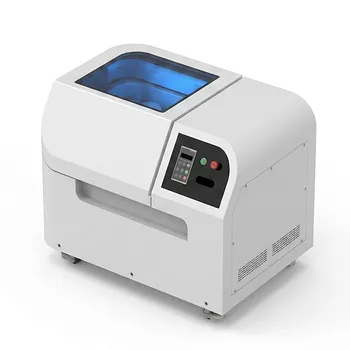
What is the role of a high-efficiency ball mill in bismuth ferrite precursor preparation? Achieve Atomic Homogeneity
Updated 5 months ago
In the synthesis of terbium-modified bismuth ferrite ceramic precursors, the high-efficiency ball mill serves as the critical mechanism for achieving atomic-level chemical homogeneity and particle refinement. By subjecting high-purity oxide precursors to prolonged mechanical energy, the mill eliminates spatial inhomogeneity and reduces particle sizes to the nanometer scale. This intensive mixing and activation phase is essential for facilitating the complex ion diffusion and lattice substitution required to form a pure-phase perovskite structure during subsequent heat treatments.
The high-efficiency ball mill transforms raw oxide powders into a highly reactive, uniform precursor by maximizing surface area and ensuring atomic-level contact between components. This mechanical processing is the foundational step that dictates the phase purity and microstructural integrity of the final modified bismuth ferrite ceramic.
Achieving Atomic-Level Homogeneity
Eliminating Spatial Inhomogeneity
The primary function of the ball mill is to ensure that components like bismuth oxide, iron oxide, and terbium dopants are distributed uniformly throughout the mixture.
Continuous operation for extended periods—often up to 48 hours—is utilized to break down large aggregates and ensure that no single component remains sequestered in localized pockets.
This deep mixing prevents the formation of secondary, unwanted phases during the calcination process by ensuring all reactants are in immediate physical contact.
Facilitating Multi-Component Ion Diffusion
Terbium-modified bismuth ferrite ($Bi_{0.8}Tb_{0.1}Pb_{0.1}Fe_{0.9}Ti_{0.1}O_3$) requires the successful lattice substitution of multiple elements.
The ball mill achieves the high-energy contact necessary for these different ions to migrate efficiently into the host crystal structure during solid-state reactions.
Without this level of intimate mixing, the diffusion distances between particles would be too great, leading to incomplete chemical reactions and a non-uniform final product.
Enhancing Reaction Kinetics via Particle Refinement
Increasing Specific Surface Area
High-efficiency mills, such as planetary ball mills, use powerful impact and shear forces to refine raw materials from hundreds of micrometers down to the nanometer scale.
Reducing the particle size significantly increases the specific surface area of the powder, which provides more sites for chemical interaction.
This physical transformation lowers the energy barrier for the formation of the single-phase perovskite structure during subsequent high-temperature stages.
Boosting Powder Reactivity and Surface Energy
The mechanical energy transferred during milling does not just break particles; it increases their surface energy.
This "mechanical activation" provides favorable kinetic conditions, allowing the solid-state reaction to proceed more rapidly or at lower temperatures.
In systems involving rare-earth oxides like terbium, this increased reactivity is vital for ensuring the dopant is fully incorporated into the bismuth ferrite lattice.
Understanding the Trade-offs and Pitfalls
Risk of Material Contamination
The high-energy nature of the process means that the grinding media (such as zirconia or alumina balls) and the mill vial are subject to wear.
Over-milling or using incompatible media can introduce impurities into the ceramic precursor, which can degrade the dielectric or magnetic properties of the final material.
Managing Temperature and Volatilization
Extended milling durations generate significant internal heat through friction and impact.
Excessive heat can lead to the agglomeration of fine powders or the premature volatilization of sensitive components like bismuth, potentially altering the intended stoichiometry of the ceramic.
Applying This to Your Synthesis Process
Selecting the Right Approach for Your Goal
To achieve the best results in your ceramic preparation, the milling strategy must align with your specific material requirements.
- If your primary focus is phase purity: Prioritize longer milling durations (e.g., 48 hours) at moderate speeds to ensure the absolute elimination of spatial inhomogeneity before calcination.
- If your primary focus is rapid sintering and densification: Utilize high-energy planetary milling to maximize particle refinement and surface area, providing the high driving force needed for dense ceramic formation.
- If your primary focus is maintaining precise stoichiometry: Employ wet milling in a medium like ethanol or acetone to manage heat generation and prevent the loss of volatile oxides during the grinding process.
By mastering the mechanical variables of the ball milling process, researchers can ensure the reliable production of high-performance, terbium-modified bismuth ferrite ceramics.
Summary Table:
| Function | Key Mechanism | Impact on Precursor |
|---|---|---|
| Homogeneity | Prolonged mechanical mixing (up to 48h) | Eliminates spatial gaps; ensures atomic-level contact between oxides. |
| Refinement | High-impact shear forces | Reduces particles to nanometer scale; increases specific surface area. |
| Activation | Mechanical energy transfer | Increases surface energy; lowers energy barriers for solid-state reactions. |
| Diffusion | Intimate ion contact | Facilitates lattice substitution and pure-phase perovskite formation. |
Optimize Your Ceramic Synthesis with Precision Equipment
Achieving phase purity in complex materials like terbium-modified bismuth ferrite requires more than just mixing—it requires precise mechanical activation. [Brand Name] provides complete laboratory sample preparation solutions tailored for material science research.
From achieving nanometer-scale refinement to ensuring the perfect density for your samples, our expertise covers the entire workflow:
- Advanced Milling: High-efficiency planetary ball mills, jet mills, and cryogenic grinders for superior particle refinement.
- Powder Processing: Specialized sieve shakers, powder mixers, and defoaming mixers to ensure material consistency.
- Advanced Compaction: A full spectrum of hydraulic presses, including Cold/Warm Isostatic Presses (CIP/WIP), vacuum hot presses, and XRF pellet presses.
Ready to elevate your research outcomes and ensure microstructural integrity?
Contact Our Technical Experts Today to find the ideal equipment solution for your laboratory.
References
- Shweta Thakur, M.A. Valente. Impedance and Modulus Spectroscopy Characterization of Tb modified Bi0.8A0.1Pb0.1Fe0.9Ti0.1O3 Ceramics. DOI: 10.1590/1980-5373-mr-2015-0504
Mentioned Products
- Miniature Planetary Ball Mill with Vacuum Grinding and High Efficiency for Laboratory Sample Preparation
- High Energy Planetary Ball Mill for Nano Scale Grinding and Mechanical Alloying
- Heavy Duty Horizontal Planetary Ball Mill for Efficient Industrial Grinding and Sample Preparation
- Vertical Production Planetary Ball Mill for High Throughput Powder Processing
- High Energy Omnidirectional Planetary Ball Mill 16L
People Also Ask
- Why is a planetary ball mill essential for SiBCN-rGO wet-spinning? Achieve Superior Dispersion and Spinnability
- What role does a planetary ball mill play in the preparation of forsterite (Mg2SiO4) ceramic raw materials? Key Insights
- How does a planetary ball mill contribute to the top-down size reduction of silica particles? Achieve Nano-Scale Precision
- Why is a benchtop planetary ball mill used for eggshell microparticles? Optimize Flame Retardant Grinding Efficiency
- Why grind lime-pozzolan specimens for TG/DTA for 3 mins? Master sample prep for high-precision thermal analysis.

Tech Team · PowderPreparation
Last updated on May 14, 2026
Related Products

Miniature Planetary Ball Mill with Vacuum Grinding and High Efficiency for Laboratory Sample Preparation
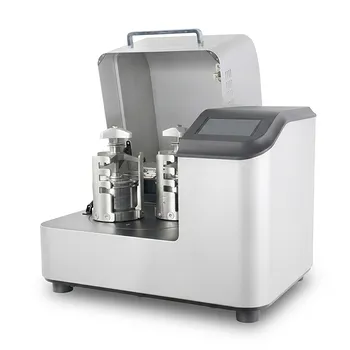
High Energy Planetary Ball Mill for Nano Scale Grinding and Mechanical Alloying
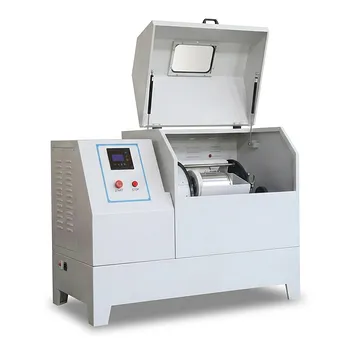
Heavy Duty Horizontal Planetary Ball Mill for Efficient Industrial Grinding and Sample Preparation

Vertical Production Planetary Ball Mill for High Throughput Powder Processing
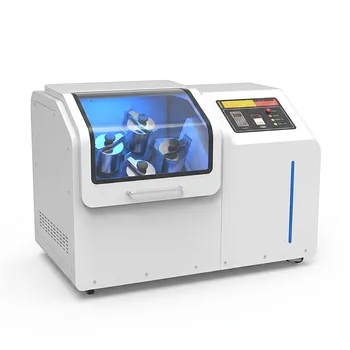
High Energy Omnidirectional Planetary Ball Mill 16L
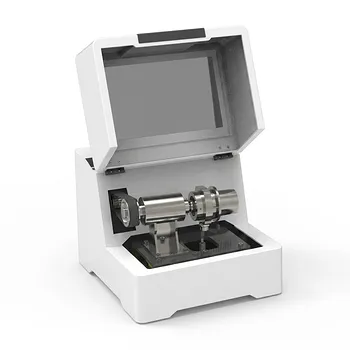
Single Tank High Energy Vibratory Ball Mill for Laboratory Grinding and Mixing
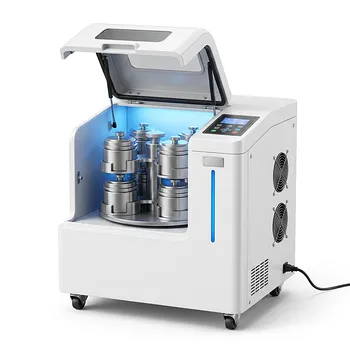
High Energy Omnidirectional Planetary Ball Mill 20L
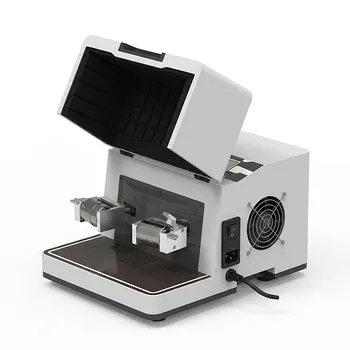
High Energy Hybrid Vibratory Ball Mill for Grinding Mixing and Cell Disruption
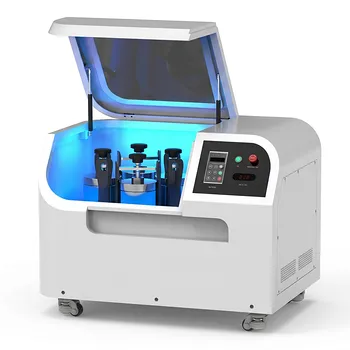
Planetary Ball Mill 12L
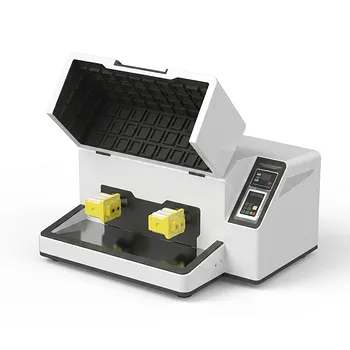
Multi-Platform Nanoscale High-Energy Vibratory Ball Mill

High Energy Laboratory Planetary Ball Mill for Nano Grinding and Material Science Sample Preparation

Nano High Energy Vibratory Ball Mill with Heating and Temperature Control

High Throughput Micro Ball Mill for Cryogenic Grinding and Laboratory Cell Disruption

Vertical Square Planetary Ball Mill for Laboratory Sample Preparation and Nanoscale Grinding
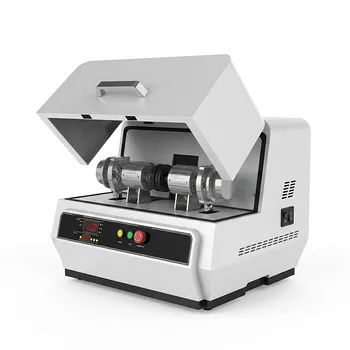
Dual Jar High Energy Vibratory Ball Mill
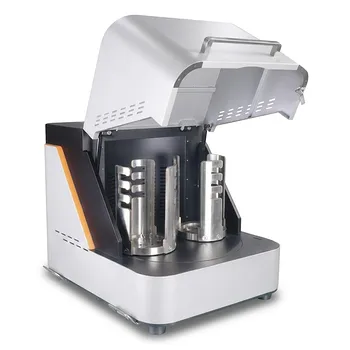
High Energy Laboratory Planetary Ball Mill for Nano Grinding and Colloidal Mixing of Hard and Brittle Materials
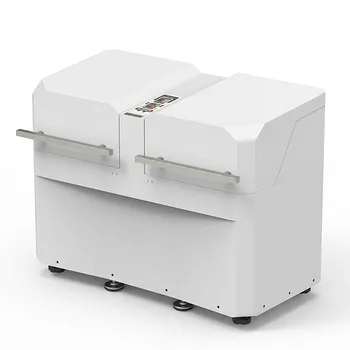
Dual Station Planetary Ball Mill 24L
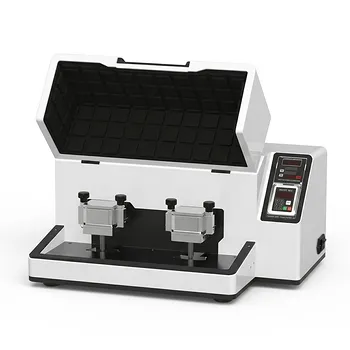
Nanoscale High Energy Vibratory Ball Mill Low Temperature

Nano High Energy Vibratory Ball Mill for Laboratory Sample Preparation