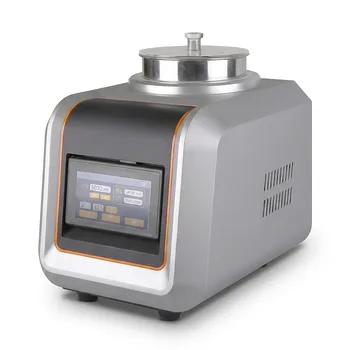
What is the primary purpose of using a vibratory sieve shaker after the crushing and grinding of copper ore samples? Roles
Updated 3 months ago
The primary purpose of using a vibratory sieve shaker is to achieve precise classification and grading of ground copper ore powder. This process ensures that the experimental material adheres to specific particle size standards, such as an average size of 27 micrometers or a threshold where 80% of the material is under 100 microns. By strictly controlling the particle size distribution, researchers eliminate the influence of size variations on flotation kinetics and leaching efficiency, which is essential for ensuring the reproducibility of results.
A vibratory sieve shaker acts as a critical quality control mechanism that translates raw ground ore into standardized fractions. This standardization allows for the accurate assessment of mineral liberation and the optimization of chemical reaction kinetics in downstream metallurgical processes.
Achieving Precise Particle Size Distribution
Eliminating Variable Interference
In metallurgical testing, particle size is a significant variable that can skew results if not tightly controlled. Using a vibratory sieve shaker ensures that every sample used in a study has the same physical characteristics, allowing researchers to isolate the effects of other chemical or mechanical factors.
Defining Specific Surface Area
Copper ore requires a specific surface area to react effectively during sulfuric acid leaching. The sieve shaker ensures that the material is fine enough to provide sufficient reaction activity without being so fine that it creates handling or filtration issues.
Generating Accurate Distribution Curves
High-frequency mechanical vibrations allow for the rapid calculation of Gaudin-Schumann distribution curves. By obtaining accurate mass percentage data from multiple sieve layers (e.g., 90μm, 180μm, and 250μm), engineers can visualize the effectiveness of their grinding circuits.
Optimizing Metallurgical Performance
Determining Economic Liberation
The sieve shaker is used to identify the economic liberation particle size, which is the point where mineral grains are sufficiently freed from the waste rock. This data is vital for evaluating how metal content is distributed across different fractions and helps in setting the most cost-effective grinding parameters.
Stabilizing Chemical Reaction Kinetics
Uniform particle sizes contribute to the stability of slurry concentration during the leaching stage. When particle sizes are inconsistent, leaching rates can become unpredictable; the sieve shaker removes oversized particles to ensure the copper leaching rate reaches a stable equilibrium.
Enhancing Experimental Reproducibility
Manual sieving is prone to human error and inconsistency in force and duration. Automated vibratory shakers provide superior repeatability, ensuring that the physical classification of coal or copper samples is identical across different batches or laboratory locations.
Understanding the Trade-offs
Mechanical Wear and Sieve Blinding
High-frequency vibrations, while efficient, can lead to sieve blinding, where particles become lodged in the mesh openings. This reduces the effective screening area and can result in inaccurate data if the sieves are not regularly cleaned or if the vibration intensity is incorrectly calibrated.
Limits of Dry Sieving
While vibratory shakers are highly effective for many applications, dry sieving may struggle with extremely fine or cohesive powders that tend to agglomerate. In these instances, the material may require wet sieving or specialized anti-static treatments to prevent particles from sticking together and distorting the classification results.
How to Apply This to Your Project
Before selecting your sieving parameters, identify the primary goal of your mineral analysis to ensure the shaker settings align with your technical requirements.
- If your primary focus is Lab-Scale Reproducibility: Use standardized vibratory durations and amplitudes to ensure every sample fraction meets the exact micrometer requirements for flotation testing.
- If your primary focus is Industrial Grinding Optimization: Analyze the mass percentage of each size fraction to determine if your current grinding duration is reaching the target economic liberation size.
- If your primary focus is Chemical Leaching Efficiency: Prioritize removing oversized particles to maintain a consistent specific surface area, which stabilizes reaction kinetics and slurry density.
Standardizing your classification process with a vibratory sieve shaker is the most reliable way to transform raw ore into actionable metallurgical data.
Summary Table:
Key Benefits of Vibratory Sieve Shakers in Ore Analysis
| Feature | Benefit to Metallurgical Testing | Impact on Research |
|---|---|---|
| Precise Classification | Ensures uniform particle size distribution. | Eliminates size as a variable in flotation kinetics. |
| Economic Liberation | Identifies the optimal point for mineral grain separation. | Improves cost-effectiveness of grinding circuits. |
| Surface Area Control | Standardizes the area available for chemical reactions. | Stabilizes sulfuric acid leaching rates. |
| Automated Vibration | Removes human error compared to manual sieving. | Enhances experimental reproducibility and data accuracy. |
Elevate Your Mineral Analysis with Professional Sample Prep
Achieving accurate metallurgical data starts with precise sample preparation. Our brand provides complete laboratory sample preparation solutions tailored for material science and powder processing.
From initial reduction using our jaw and roll crushers to fine grinding with planetary ball, jet, or cryogenic mills, we ensure your material is perfectly prepared. Our high-precision vibratory and air-jet sieve shakers provide the standardized classification required for stable reaction kinetics. Furthermore, we offer a full range of hydraulic presses (CIP/WIP) and pellet presses for downstream material characterization.
Need to optimize your particle size distribution? Contact us today to discover how our specialized powder processing and compaction equipment can enhance your laboratory's efficiency and results.
References
- Baisui Han, Atsushi Shibayama. Copper Recovery from Silicate-Containing Low-Grade Copper Ore Using Flotation Followed by High-Pressure Oxidative Leaching. DOI: 10.4144/rpsj.64.3
Mentioned Products
- Vibratory Sieve Shaker Electromagnetic 3D Motion Powder Particle Size Analyzer for Dry and Wet Sieving
- Laboratory Dry and Wet Three Dimensional Vibratory Sieve Shaker for Particle Analysis
- Stainless Steel Laboratory Vibratory Test Sieve Shaker
- Heavy Duty Dry Three Dimensional Vibratory Sieve Shaker for Particle Separation
- Dry Three Dimensional Vibratory Sieve Shaker
People Also Ask
- How does a vibratory sieve shaker contribute to optimizing the performance of activated carbon? Enhance Adsorption Precision
- Why is a laboratory vibratory sieve shaker necessary for processing magnesium-based borate precursor powders? Boost Activity
- Why use a vibratory sieve shaker to verify coarse aggregate grading in rubberized concrete? Ensure Structural Integrity
- What function do vibratory sieve shakers and standard test sieves serve in the preparation of adsorbents? Key Guide
- What role does a vibratory sieve shaker play in the particle size analysis of ground corn products? Enhance QC Precision

Tech Team · PowderPreparation
Last updated on Jun 03, 2026
Related Products

Vibratory Sieve Shaker Electromagnetic 3D Motion Powder Particle Size Analyzer for Dry and Wet Sieving

Laboratory Dry and Wet Three Dimensional Vibratory Sieve Shaker for Particle Analysis

Stainless Steel Laboratory Vibratory Test Sieve Shaker

Heavy Duty Dry Three Dimensional Vibratory Sieve Shaker for Particle Separation

Dry Three Dimensional Vibratory Sieve Shaker

Small Laboratory Vibratory Sieve Shaker for Powder Gradation and Particle Size Analysis

High Frequency Wet Three-Dimensional Vibrating Sieve Shaker for Dry and Wet Particle Size Analysis

Small Laboratory Vibrating Sieve Shaker for Precise Particle Size Analysis

High Frequency Cabinet Type Three-Dimensional Rotary Vibrating Sieve Shaker for Dry Sieving and Particle Classification

Laboratory Vibratory Test Sieve Shaker for Precision Particle Size Analysis and Powder Grading

三维电磁微量振动筛分仪

Tapping Oscillating Sieve Shaker for Dry and Wet Particle Size Analysis

Stainless Steel Rotary Vibrating Sieve High Precision Circular Vibratory Separator Industrial Powder Grading Machine Multi Layer Sifting Equipment

Three Dimensional Rotary Vibrating Sieve
Small Vibrating Ultrafine Grinder for Traditional Chinese Medicine

Automatic Vibrating Powder Feeder for Laboratory Material Processing Precision Vibratory Hopper Feeder for Granular and Powder Material Handling Industrial Grade Vibrating Tray Feeder for Consistent Material Sample Preparation
Vibratory Superfine Grinder for Ultra Fine Laboratory Powder Milling
Vibratory Disc Mill for Rapid Fine Grinding and High Throughput Sample Preparation of Hard and Brittle Materials