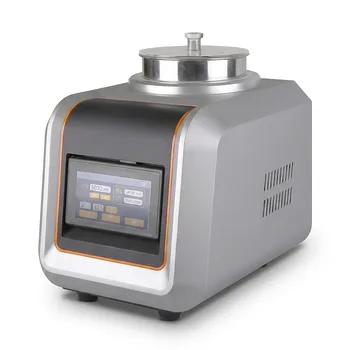
What critical control role does a vibratory sieve shaker play in the beta-SiAlON powder preparation workflow? Key Insights
Updated 5 months ago
The vibratory sieve shaker serves as the primary mechanical gatekeeper in the beta-SiAlON synthesis workflow. Its critical role involves the precise classification of initially crushed powder to remove incompletely reacted aggregates and oversized particles before they reach the fine milling stage. This intervention ensures that the precursor material possesses the necessary consistency to produce a defect-free, high-performance ceramic microstructure.
Core Takeaway: A vibratory sieve shaker provides the essential "quality floor" for beta-SiAlON production by eliminating oversized aggregates that would otherwise compromise ball milling efficiency and lead to catastrophic microstructure defects during sintering.
The Pre-Milling Quality Gate
Removing Incompletely Reacted Aggregates
During the initial preparation of beta-SiAlON, the raw material often contains large particles or clusters that did not react fully during synthesis. Using standard sieves—typically around 220 μm—the shaker mechanically isolates these aggregates to prevent them from entering the downstream process. This ensures that the powder chemistry remains uniform and free from localized impurities.
Optimizing Ball Milling Efficiency
By establishing a strict upper limit on particle size, the sieve shaker ensures that the subsequent fine ball milling stage operates under predictable conditions. This prevents the mill from having to process outliers, which significantly reduces the time required to reach the target particle size distribution. Consistency at this stage is the foundation for repeatable batch production.
Standardizing Mechanical Rearrangement
The shaker utilizes standardized mechanical vibration and impact actions to cause particles to continuously rearrange and "jump" on the mesh. This allows particles to attempt passage in multiple orientations, ensuring that the particle width—the critical dimension for screening—accurately corresponds with the sieve opening. This mechanical precision is vital for isolating specific powder fractions with high accuracy.
The Impact on Sintering and Microstructure
Ensuring Uniform Packing Density
The particle size distribution (PSD) controlled by the sieve shaker directly dictates how well the powder packs during the pressing and molding of the green body. A well-classified powder results in a uniform packing density, which is essential for even shrinkage during the sintering process. Without this control, the ceramic may develop internal voids or structural weaknesses.
Inhibiting Abnormal Grain Growth
Precise control of the initial particle size prevents the occurrence of abnormal grain growth during high-temperature sintering. If large particles remain in the mix, they can act as seeds for irregular crystal structures, leading to a brittle or porous final product. Proper sieving ensures a dense, homogenous microstructure that is necessary for stable mechanical and electrical properties.
Eliminating Kinetic Variability
In an experimental or industrial setting, isolating a narrow particle size distribution (such as 44–74 µm) eliminates size as a variable in reaction kinetics. This allows engineers to focus on internal chemistry and pore structure without the "noise" created by inconsistent particle dimensions. This level of control is what allows beta-SiAlON to achieve its high thermal and mechanical stability.
Understanding the Trade-offs
Sieve Blinding and Mesh Wear
Continuous use of vibratory shakers can lead to sieve blinding, where fine particles become lodged in the mesh, effectively changing the opening size. This requires regular maintenance and cleaning to ensure the accuracy of the classification remains within tolerance. Furthermore, abrasive materials like silicon carbide or SiAlON can cause gradual wear on the mesh, necessitating frequent calibration.
Throughput vs. Precision
There is a fundamental trade-off between the amplitude of the vibration and the precision of the separation. Higher amplitudes increase throughput but may cause "bouncing" that allows oversized particles to bypass the mesh or causes fragile aggregates to break prematurely. Finding the optimal vibration frequency is critical to balancing production speed with the required material purity.
How to Apply This to Your Project
Recommendations for Process Optimization
- If your primary focus is maximizing mechanical strength: Use a multi-stage sieving process to ensure a narrow particle size distribution, which minimizes the risk of abnormal grain growth.
- If your primary focus is reducing production costs: Prioritize the pre-milling sieve stage to reduce ball milling duration and decrease the wear and tear on milling media.
- If your primary focus is research and development: Employ precision test sieves (20 µm to 160 µm) to isolate specific fractions, allowing for a clear analysis of how particle size affects sintering kinetics.
Properly integrated vibratory sieving transforms beta-SiAlON from a raw crushed material into a precision-engineered powder ready for high-performance applications.
Summary Table:
| Process Stage | Primary Function | Impact on beta-SiAlON Quality |
|---|---|---|
| Pre-Milling | Aggregate Removal | Ensures uniform chemistry; prevents localized impurities. |
| Classification | Particle Size Control | Optimizes milling efficiency; creates a repeatable "quality floor." |
| Sieving Accuracy | Mechanical Rearrangement | Ensures particle width matches mesh for high-precision fractions. |
| Sintering Prep | Packing Density Control | Inhibits abnormal grain growth; prevents internal voids and defects. |
Elevate Your Material Synthesis with Precision Powder Solutions
Achieving the perfect ceramic microstructure requires rigorous control over every stage of sample preparation. At our facility, we provide complete laboratory sample preparation solutions tailored for material science professionals.
Whether you are refining beta-SiAlON or developing new advanced ceramics, our specialized equipment ensures consistency and performance:
- Powder Processing: High-performance vibratory and air-jet sieve shakers, planetary ball mills, jet mills, and crushers (jaw/roll).
- Mixing & Homogenization: Advanced powder mixers and vacuum defoaming mixers.
- Advanced Compaction: A full spectrum of hydraulic presses, including Cold/Warm Isostatic Presses (CIP/WIP), vacuum hot presses, and XRF pellet presses.
Don't let inconsistent particle sizes compromise your research. Contact our experts today to discover how our equipment can optimize your workflow and enhance your material properties.
References
- Mohammed Shahien, Toshitaka Sakurai. Combustion Synthesis and Sintering of β-Sialon Ceramics (z = 2). DOI: 10.2472/jsms.57.1248
Mentioned Products
- Vibratory Sieve Shaker Electromagnetic 3D Motion Powder Particle Size Analyzer for Dry and Wet Sieving
- Laboratory Dry and Wet Three Dimensional Vibratory Sieve Shaker for Particle Analysis
- Stainless Steel Laboratory Vibratory Test Sieve Shaker
- Heavy Duty Dry Three Dimensional Vibratory Sieve Shaker for Particle Separation
- Dry Three Dimensional Vibratory Sieve Shaker
People Also Ask
- How does a vibratory sieve shaker contribute to optimizing the performance of activated carbon? Enhance Adsorption Precision
- Why is a laboratory vibratory sieve shaker necessary for processing magnesium-based borate precursor powders? Boost Activity
- Why use a vibratory sieve shaker to verify coarse aggregate grading in rubberized concrete? Ensure Structural Integrity
- What function do vibratory sieve shakers and standard test sieves serve in the preparation of adsorbents? Key Guide
- What role does a vibratory sieve shaker play in the particle size analysis of ground corn products? Enhance QC Precision

Tech Team · PowderPreparation
Last updated on May 14, 2026
Related Products

Vibratory Sieve Shaker Electromagnetic 3D Motion Powder Particle Size Analyzer for Dry and Wet Sieving

Laboratory Dry and Wet Three Dimensional Vibratory Sieve Shaker for Particle Analysis

Stainless Steel Laboratory Vibratory Test Sieve Shaker

Heavy Duty Dry Three Dimensional Vibratory Sieve Shaker for Particle Separation

Dry Three Dimensional Vibratory Sieve Shaker

Small Laboratory Vibratory Sieve Shaker for Powder Gradation and Particle Size Analysis

High Frequency Wet Three-Dimensional Vibrating Sieve Shaker for Dry and Wet Particle Size Analysis

Small Laboratory Vibrating Sieve Shaker for Precise Particle Size Analysis

High Frequency Cabinet Type Three-Dimensional Rotary Vibrating Sieve Shaker for Dry Sieving and Particle Classification

Laboratory Vibratory Test Sieve Shaker for Precision Particle Size Analysis and Powder Grading

三维电磁微量振动筛分仪

Tapping Oscillating Sieve Shaker for Dry and Wet Particle Size Analysis

Stainless Steel Rotary Vibrating Sieve High Precision Circular Vibratory Separator Industrial Powder Grading Machine Multi Layer Sifting Equipment

Three Dimensional Rotary Vibrating Sieve
Small Vibrating Ultrafine Grinder for Traditional Chinese Medicine

Automatic Vibrating Powder Feeder for Laboratory Material Processing Precision Vibratory Hopper Feeder for Granular and Powder Material Handling Industrial Grade Vibrating Tray Feeder for Consistent Material Sample Preparation
Vibratory Superfine Grinder for Ultra Fine Laboratory Powder Milling
Vibratory Disc Mill for Rapid Fine Grinding and High Throughput Sample Preparation of Hard and Brittle Materials