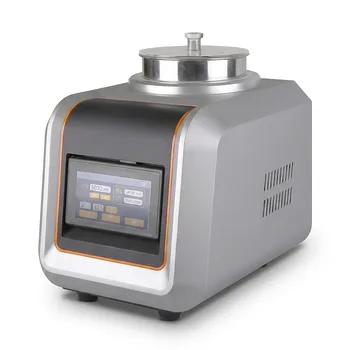
What are the key functions of a vibratory sieve shaker in lightweight mortar production? Ensure Stability & Gradation
Updated 4 months ago
Ensuring precise particle size distribution is the primary function of a vibratory sieve shaker in lightweight mortar production. By strictly controlling the gradation of fine aggregates—typically keeping them below 4.75mm—the shaker determines the fineness modulus necessary to maintain slurry stability and prevent the structural collapse of the mortar during its expansion phase.
The vibratory sieve shaker acts as a critical quality control gate that optimizes the internal skeletal support of the mortar. By isolating specific particle fractions, it ensures the mixture achieves the necessary porosity and mechanical strength required for lightweight applications.
Particle Size Distribution and Gradation Control
Determining the Fineness Modulus
The shaker uses a series of stacked test sieves to calculate the fineness modulus of raw materials like river or sea sand. This value is a numerical index that indicates the average particle size, allowing producers to categorize the sand into specific grading zones.
Enforcing Maximum Particle Size Limits
In lightweight mortar, it is vital to ensure that fine aggregates do not exceed a 4.75mm threshold. The mechanical vibration of the shaker efficiently separates oversized particles that could otherwise compromise the uniformity of the mixture.
Achieving Precise Particle Classification
By employing a controlled three-dimensional throwing motion, the shaker ensures that materials are evenly distributed across the mesh surface. This high-precision separation allows for the isolation of specific fractions within a micro-range, which is essential for consistent mixing kinetics.
Impact on Slurry Stability and Mortar Integrity
Preventing Slurry Settlement
Strictly screening aggregates helps optimize the suspension stability of the mortar slurry. If particles are too coarse or heavy, they will settle at the bottom, leading to an inconsistent density throughout the final product.
Protecting the Bubble Structure
During the gas-forming expansion phase of lightweight mortar, the integrity of the bubble structure is delicate. Precise sieving prevents large, heavy aggregates from causing these bubbles to collapse, which would result in a loss of volume and insulation properties.
Optimizing Internal Skeletal Support
Properly graded aggregates create a dense internal structure by minimizing voids between particles. This optimization enhances the overall mechanical performance and volume stability of the mortar in its hardened state.
Understanding the Trade-offs and Limitations
Mechanical vs. Manual Sieving
While manual sieving is possible, it lacks the reproducibility and frequency required for industrial standards. Vibratory shakers provide the consistent vertical acceleration and circular movement necessary to meet strict grading standards like ASTM C136.
Risk of Sieve Blinding and Overloading
If the shaker is overloaded or the material is too damp, the mesh openings can become "blinded" or blocked. This leads to inaccurate data and poor material quality, making sample size management and dry/wet analysis capabilities essential features.
Vibration Intensity and Particle Degradation
Setting the vibration intensity too high can lead to particle attrition, where more fragile aggregates break down into smaller pieces during the test. This results in a fineness modulus that does not accurately reflect the actual state of the raw material bulk.
Applying Sieve Analysis to Your Production Goal
How to Apply This to Your Project
To maximize the effectiveness of a vibratory sieve shaker in your production line, tailor your screening process to your specific performance requirements.
- If your primary focus is Slurry Stability: Use the shaker to strictly eliminate all particles above the 4.75mm limit to prevent settling and ensure a uniform density.
- If your primary focus is Mechanical Strength: Analyze the particle distribution to ensure the sand falls within "Zone II" grading to optimize packing density and minimize internal voids.
- If your primary focus is Process Consistency: Implement standardized vibration intervals and amplitudes to ensure that every batch of raw material meets the same fineness modulus benchmarks.
Precise aggregate grading through vibratory sieving is the technical foundation for a stable, high-strength, and lightweight mortar structure.
Summary Table:
| Key Function | Technical Mechanism | Production Benefit |
|---|---|---|
| Gradation Control | Calculates Fineness Modulus | Ensures optimal internal skeletal support |
| Size Limitation | Enforces <4.75mm threshold | Prevents slurry settlement & density loss |
| Precise Classification | 3D throwing motion | Ensures consistent mixing kinetics |
| Quality Assurance | Reproducible mechanical sieving | Meets ASTM C136 standards for reliability |
| Structure Protection | Eliminates oversized aggregates | Protects delicate bubble structure in mortar |
Optimize Your Material Consistency with Expert Laboratory Solutions
At [Brand Name], we provide complete laboratory sample preparation solutions tailored for material science and industrial production. We specialize in high-precision powder processing and compaction equipment designed to meet the most rigorous standards.
Our extensive product range includes:
- Sieve Shakers: Vibratory and air-jet models with a wide variety of test sieves and meshes for precise grading.
- Milling & Grinding: Planetary ball mills, jet mills, disc mills, and liquid nitrogen cryogenic grinders.
- Crushers: Robust jaw and roll crushers for primary sample reduction.
- Hydraulic Presses: A full spectrum including Cold/Warm Isostatic Presses (CIP/WIP), XRF pellet presses, and vacuum hot presses.
- Mixing Equipment: Powder mixers and vacuum defoaming mixers for uniform sample preparation.
Ready to enhance your mortar production or material research? Contact our technical team today to discover how our specialized equipment can improve your workflow and product quality.
References
- Ramesh Kumar Paikara, Tek Raj Gyawali. Study of Aerated Lightweight Mortar Using Aluminium Powder and Local Materials. DOI: 10.3126/hijase.v4i1.56868
Mentioned Products
- Vibratory Sieve Shaker Electromagnetic 3D Motion Powder Particle Size Analyzer for Dry and Wet Sieving
- Laboratory Dry and Wet Three Dimensional Vibratory Sieve Shaker for Particle Analysis
- Stainless Steel Laboratory Vibratory Test Sieve Shaker
- Heavy Duty Dry Three Dimensional Vibratory Sieve Shaker for Particle Separation
- Dry Three Dimensional Vibratory Sieve Shaker
People Also Ask
- How does a vibratory sieve shaker contribute to optimizing the performance of activated carbon? Enhance Adsorption Precision
- Why is a laboratory vibratory sieve shaker necessary for processing magnesium-based borate precursor powders? Boost Activity
- Why use a vibratory sieve shaker to verify coarse aggregate grading in rubberized concrete? Ensure Structural Integrity
- What function do vibratory sieve shakers and standard test sieves serve in the preparation of adsorbents? Key Guide
- What role does a vibratory sieve shaker play in the particle size analysis of ground corn products? Enhance QC Precision

Tech Team · PowderPreparation
Last updated on Jun 03, 2026
Related Products

Vibratory Sieve Shaker Electromagnetic 3D Motion Powder Particle Size Analyzer for Dry and Wet Sieving

Laboratory Dry and Wet Three Dimensional Vibratory Sieve Shaker for Particle Analysis

Stainless Steel Laboratory Vibratory Test Sieve Shaker

Heavy Duty Dry Three Dimensional Vibratory Sieve Shaker for Particle Separation

Dry Three Dimensional Vibratory Sieve Shaker

Small Laboratory Vibratory Sieve Shaker for Powder Gradation and Particle Size Analysis

High Frequency Wet Three-Dimensional Vibrating Sieve Shaker for Dry and Wet Particle Size Analysis

Small Laboratory Vibrating Sieve Shaker for Precise Particle Size Analysis

High Frequency Cabinet Type Three-Dimensional Rotary Vibrating Sieve Shaker for Dry Sieving and Particle Classification

Laboratory Vibratory Test Sieve Shaker for Precision Particle Size Analysis and Powder Grading

三维电磁微量振动筛分仪

Tapping Oscillating Sieve Shaker for Dry and Wet Particle Size Analysis

Stainless Steel Rotary Vibrating Sieve High Precision Circular Vibratory Separator Industrial Powder Grading Machine Multi Layer Sifting Equipment

Three Dimensional Rotary Vibrating Sieve
Small Vibrating Ultrafine Grinder for Traditional Chinese Medicine

Automatic Vibrating Powder Feeder for Laboratory Material Processing Precision Vibratory Hopper Feeder for Granular and Powder Material Handling Industrial Grade Vibrating Tray Feeder for Consistent Material Sample Preparation
Vibratory Superfine Grinder for Ultra Fine Laboratory Powder Milling
Vibratory Disc Mill for Rapid Fine Grinding and High Throughput Sample Preparation of Hard and Brittle Materials