What are the benefits of applying 400 MPa of pressure during hot press sintering? Achieve Maximum Composite Density
Updated 3 months ago
Applying 400 MPa during hot press sintering is a high-pressure strategy designed to achieve near-theoretical density and superior structural integrity in metal matrix composites (MMCs). By operating at this extreme pressure—often at temperatures reaching 1000°C—the process effectively eliminates residual porosity, accelerates atomic diffusion, and ensures a robust bond between the metal matrix and reinforcement particles.
Applying 400 MPa of pressure is a critical requirement for maximizing the mechanical performance and hardness of composites, as it overcomes the resistance of hard reinforcement particles to ensure a fully dense and unified material structure.
Maximizing Densification through Pore Elimination
The Role of Pressure in Void Reduction
High pressure of 400 MPa physically forces the closure of internal voids and bubbles that naturally occur in powder mixtures. By eliminating these air gaps, the material achieves a much higher density than is possible through conventional sintering.
Accelerating Atomic Diffusion
At high temperatures, this extreme pressure promotes rapid diffusion between powder particles. The pressure increases the contact area between particles, allowing atoms to migrate more efficiently across boundaries and create a solid, continuous mass.
Overcoming Internal Resistance
In composites featuring hard reinforcements like SiC particles, the matrix often struggles to fill the spaces around the hard phase. 400 MPa provides the necessary force to deform the metal matrix around these particles, ensuring no "dead zones" or empty pockets remain.
Optimizing Interfacial Integrity
Strengthening the Matrix-Reinforcement Bond
The primary benefit of high-pressure sintering is the creation of a strong interfacial bond. For iron matrices containing hard SiC particles, 400 MPa is essential to ensure the matrix and reinforcement are locked together at the molecular and mechanical levels.
Enhancing Mechanical Interlocking
Beyond chemical bonding, high pressure facilitates tight mechanical interlocking. By forcing the metal matrix into the microscopic irregularities of the reinforcement surface, the process prevents delamination and stress concentrations that lead to premature failure.
Ensuring Homogeneous Distribution
Applying uniaxial pressure helps maintain a homogeneous distribution of reinforcement particles throughout the metal matrix. This uniformity is vital for preventing localized weaknesses and ensuring the composite's properties are consistent throughout the entire component.
Impact on Mechanical and Thermal Performance
Enhancing Macro-Hardness
The combination of high density and strong interfacial bonding directly increases the macro-hardness of the composite. Materials sintered at 400 MPa are significantly more resistant to wear and deformation than those processed at lower pressures.
Balancing Thermal Properties
High-pressure sintering yields composites with balanced thermal expansion and high thermal conductivity. By removing the insulating effect of internal pores, the material can transfer heat more efficiently, which is critical for high-performance engineering applications.
Preventing Structural Delamination
Maintaining continuous high pressure throughout the sintering cycle ensures that the finished product does not suffer from internal stress concentration. This leads to a more durable part that can withstand rigorous mechanical loading without cracking.
Understanding the Trade-offs
Equipment and Tooling Stress
Operating at 400 MPa places extreme mechanical stress on the mold cavity and sintering equipment. This often requires the use of specialized, high-strength tool materials and results in a shorter lifespan for the molds.
Process Control Complexity
Achieving and maintaining such high pressure requires precise hydraulic control systems. Any fluctuations in pressure during the high-temperature phase can lead to density gradients, where one part of the component is denser than another, potentially compromising structural integrity.
How to Apply This to Your Project
When deciding whether to utilize 400 MPa for your sintering process, consider your primary performance requirements and material system.
- If your primary focus is maximizing hardness: Apply 400 MPa to ensure the matrix is fully consolidated around hard ceramic reinforcements, which is essential for wear-resistant applications.
- If your primary focus is thermal management: Use high pressure to eliminate internal voids that act as thermal insulators, thereby maximizing the thermal conductivity of the finished composite.
- If your primary focus is structural reliability: Maintain continuous high pressure to promote the strongest possible interfacial adhesion and prevent delamination under mechanical stress.
The strategic application of 400 MPa pressure transforms a simple powder mixture into a high-performance, fully dense composite capable of meeting the most demanding engineering specifications.
Summary Table:
| Key Benefit | Mechanism of Action | Impact on Material Quality |
|---|---|---|
| Maximum Densification | Eliminates internal voids and air bubbles | Achieves near-theoretical density |
| Rapid Atomic Diffusion | Increases particle contact area | Stronger, continuous material mass |
| Interfacial Integrity | Forces matrix into reinforcement irregularities | Prevents delamination and stress failure |
| Enhanced Hardness | Optimizes consolidation around hard phases | Superior wear and deformation resistance |
| Thermal Efficiency | Removes insulating pore effects | Balanced expansion and high conductivity |
Elevate Your Material Research with Precision Sintering Solutions
Achieving 400 MPa at high temperatures requires specialized, robust equipment. At [Company Name], we provide complete laboratory sample preparation solutions tailored for material science. Our expertise in powder processing and compaction equipment ensures you achieve the structural integrity and density your composites demand.
Our extensive product line includes:
- Advanced Hydraulic Presses: Cold/Warm Isostatic Presses (CIP/WIP), standard lab presses, and XRF pellet presses.
- High-Performance Hot Presses: Specialized vacuum hot presses and standard hot presses designed for extreme pressure and temperature cycles.
- Comprehensive Powder Processing: From jaw/roll crushers and cryogenic grinders to planetary ball mills and jet mills.
- Sizing & Mixing: Vibratory sieve shakers, powder mixers, and defoaming mixers.
Ready to optimize your MMC sintering process? Contact us today to discuss your project requirements and discover how our precision engineering can enhance your laboratory's capabilities.
References
- Azam Beigi Kheradmand, Bejan Hamawandi. Tribological Characterization of Reinforced Fe Matrix Composites with Hybrid Reinforcement of C, Cu, and SiC Particulates. DOI: 10.3390/cryst12050598
Mentioned Products
- 6-Ton Small Single-Punch Tablet Press — Laboratory Powder & Granule Tableting Equipment / Tablet Forming Machine
- 5 Ton Single Punch Tablet Press Laboratory Small Batch Production
- Enhanced 9 Punch Rotary Tablet Press for Powder Compaction
- 6 Ton Variable Frequency Single Punch Tablet Press
- Ordinary Type Rotary Tablet Press for Pharmaceutical Chemical Food Electronic Industries
People Also Ask
- What is the function of a laboratory press in Cr-Ti alloy evaluation? Quantify Fracture Stress & Strength
- What is the function of a laboratory press in assessing the hydrophobic performance of modified vermiculite fillers?
- What is the core function of a laboratory press in the forming of ceramic filter element green bodies? Maximize Density.
- What is the function of a laboratory press in the preparation of ceramic feed rods? Master Density and Precision
- Why is vacuum sealing and flexible packaging necessary for Aluminum Titanate powders during CIP? Ensure Peak Density

Tech Team · PowderPreparation
Last updated on Jun 03, 2026
Related Products
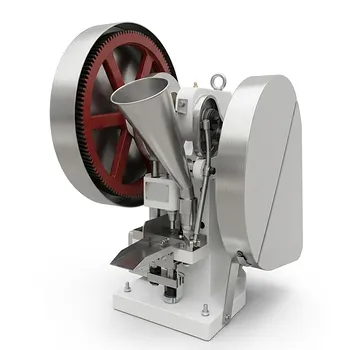
6-Ton Small Single-Punch Tablet Press — Laboratory Powder & Granule Tableting Equipment / Tablet Forming Machine
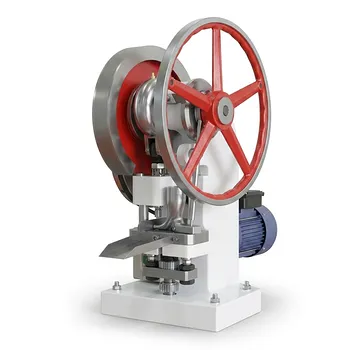
5 Ton Single Punch Tablet Press Laboratory Small Batch Production
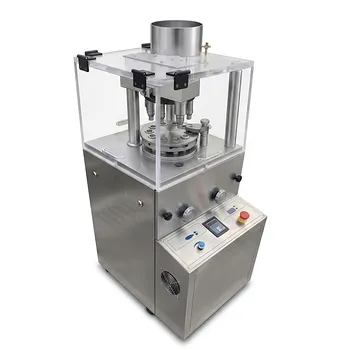
Enhanced 9 Punch Rotary Tablet Press for Powder Compaction
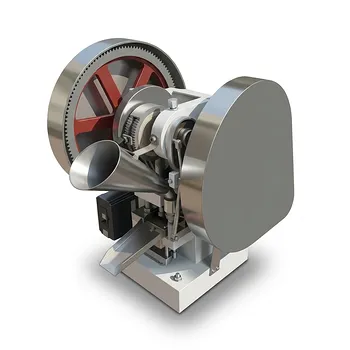
6 Ton Variable Frequency Single Punch Tablet Press
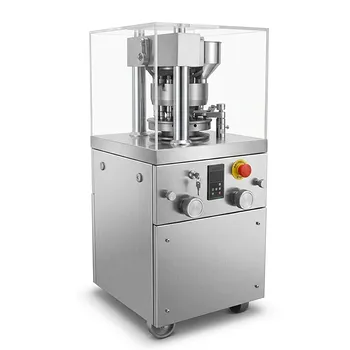
Ordinary Type Rotary Tablet Press for Pharmaceutical Chemical Food Electronic Industries
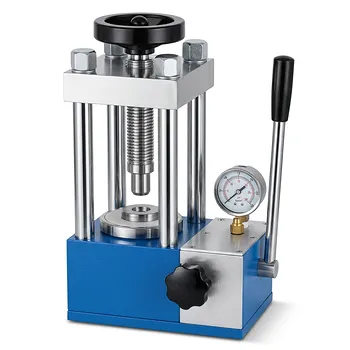
Manual Tablet Press with Dual Scale Pressure Gauge for Pharmaceutical Food Chemical Laboratory Sample Preparation
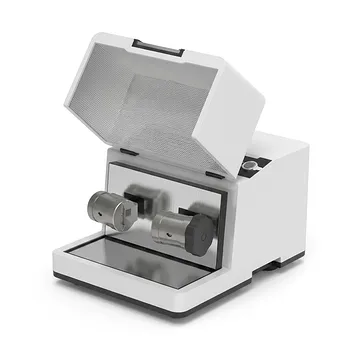
Heating Temperature Controlled High Energy Vibratory Ball Mill
Water Cooled Airflow Ultra Fine Grinder for Low Temperature Material Processing
Water Cooled Pulse Jet Ultrafine Grinder