What advantages does a laboratory ball mill with a closed-circuit system offer? Maximize Manganese Ore Recovery
Updated 5 months ago
A closed-circuit laboratory ball mill is the catalyst for precision in manganese ore processing. By integrating a classification step that returns oversized particles for further grinding, this system achieves a uniform particle size—often below 0.5mm. This approach prevents the loss of valuable minerals through over-pulverization while ensuring maximum liberation for gravity or magnetic separation.
The primary advantage of a closed-circuit system is its ability to maintain a precise circulating load. This balances grinding efficiency with mineral liberation to prevent the creation of unrecoverable "slimes" that hinder downstream performance.
Enhancing Mineral Liberation and Downstream Performance
Achieving Precise Size Control
Manganese ore requires specific sizing, typically below 0.5mm, to effectively unlock the target minerals from the surrounding rock.
A closed-circuit system ensures that only material meeting this exact size specification exits the milling stage.
Eliminating Over-Pulverization
Over-grinding creates ultra-fine particles, known as slimes, which are often impossible to capture in gravity or magnetic separation stages.
By removing on-spec material quickly, the system protects the physical integrity of the manganese minerals and boosts overall recovery rates.
Optimizing Mineral Liberation
Sufficient mineral liberation is the most critical indicator for successful downstream processing.
A laboratory mill equipped with a closed-circuit system guarantees that minerals are freed from the matrix without being crushed into an unusable state.
Bridging the Gap Between Laboratory and Industry
Simulating Industrial Residence Time
Closed-circuit setups, especially those utilizing mills with increased length, better replicate the actual residence time of ore in full-scale operations.
This allows engineers to observe breakage characteristics and physical properties that will occur during industrial-scale production.
Improving Sample Representativeness
Larger laboratory mills can process a greater mass of material while maintaining standard grinding media ratios.
Increasing the sample size reduces measurement uncertainty and ensures that lab results are statistically significant for large-scale plant design.
Replicating Complex Particle Distributions
Advanced laboratory milling replicates the physical and chemical characteristics of commercial products, including fineness distribution and component composition.
This level of detail makes optimization models more effective when transitioning from a controlled lab environment to real-world factory quality control.
Understanding the Trade-offs
System Complexity and Calibration
Closed-circuit systems require more sophisticated monitoring of the circulating load compared to simple batch grinding.
Incorrect calibration of the classification unit can lead to circuit bottlenecks or inconsistent feed rates that skew test results.
Higher Operational and Maintenance Needs
These systems involve more moving parts and interconnected components than a standard batch mill.
As a result, they require more frequent cleaning to prevent cross-contamination between different ore samples and more rigorous maintenance to ensure mechanical consistency.
Optimizing Your Manganese Grinding Protocol
To get the most out of your laboratory grinding tests, align your equipment configuration with your ultimate production goals.
- If your primary focus is maximizing mineral recovery: Utilize the closed-circuit system to minimize slimes and ensure minerals reach the exact degree of liberation required for separation.
- If your primary focus is industrial scalability: Invest in a longer laboratory mill to accurately simulate the breakage characteristics and residence times of commercial-scale units.
- If your primary focus is data accuracy: Process larger sample masses within an integrated system to reduce measurement uncertainty and improve the representativeness of your test data.
Ultimately, a closed-circuit laboratory mill transforms grinding from a generic reduction process into a strategic preparation stage that directly dictates the success of manganese recovery.
Summary Table:
| Feature | Closed-Circuit System Advantage | Impact on Manganese Processing |
|---|---|---|
| Size Control | Integrated classification returns oversized particles | Achieves precise particle sizing (typically <0.5mm) |
| Material Integrity | Rapid removal of on-spec material | Prevents over-pulverization and the creation of "slimes" |
| Mineral Liberation | Controlled grinding environment | Maximizes the release of minerals from the host rock |
| Scalability | Replicates industrial residence times | Ensures lab results are statistically significant for plant design |
| Recovery Rate | Optimizes feed for downstream separation | Boosts efficiency in gravity and magnetic separation stages |
Optimize Your Mineral Processing with Expert Solutions
Transform your manganese ore research with high-precision laboratory equipment designed for accuracy and scalability. [Our Brand Name] provides complete laboratory sample preparation solutions for material science, specializing in advanced powder processing and compaction equipment.
Our extensive product line includes:
- Grinding & Milling: Planetary ball mills, jet mills, disc mills, and rotor mills, plus jaw and roll crushers.
- Classification: Sieve shakers (vibratory/air-jet) with a full range of test sieves and meshes.
- Compaction & Pressing: A full spectrum of hydraulic presses, including Cold/Warm Isostatic Presses (CIP/WIP), XRF pellet presses, and vacuum hot presses.
- Mixing: Powder mixers and high-performance defoaming mixers.
Whether you are refining mineral liberation protocols or simulating industrial-scale production, our equipment ensures the physical and chemical integrity of your samples. Contact us today to find your perfect laboratory solution!
References
- Patitapaban Mishra, Khageswar Mahanta. Upgradation of Low-Grade Siliceous Manganese Ore from Bonai-Keonjhar Belt, Orissa, India. DOI: 10.4236/jmmce.2009.81005
Mentioned Products
- Vertical Semi Circular Planetary Ball Mill for Laboratory Precision Grinding
- Laboratory Disc Mill for Ore and Mineral Sample Preparation
- Vertical Production Planetary Ball Mill for High Throughput Powder Processing
- High Energy Omnidirectional Planetary Ball Mill 16L
- 8L Planetary Ball Mill for Laboratory Grinding and Sample Preparation
People Also Ask
- What role does a planetary ball mill play in the synthesis of Li6PS5Cl (LPSCl)? Unlock High Ionic Conductivity
- Why is a planetary ball mill essential for SiBCN-rGO wet-spinning? Achieve Superior Dispersion and Spinnability
- Why is an intermittent grinding process required for perovskites in a planetary ball mill? Ensure Stability & Purity
- Why is a planetary ball mill required for PET micronization? Ensure Accurate Chemical Analysis of Reprocessed PET
- How does mechanized planetary ball milling compare to manual agate grinding? Optimize sulfide standard material precision.

Tech Team · PowderPreparation
Last updated on May 14, 2026
Related Products
Vertical Semi Circular Planetary Ball Mill for Laboratory Precision Grinding
Laboratory Disc Mill for Ore and Mineral Sample Preparation
Vertical Production Planetary Ball Mill for High Throughput Powder Processing
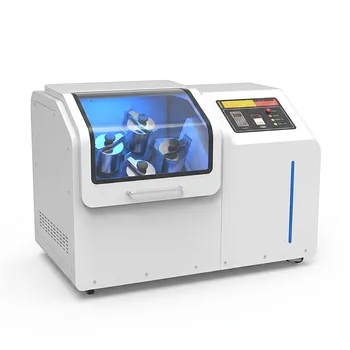
High Energy Omnidirectional Planetary Ball Mill 16L
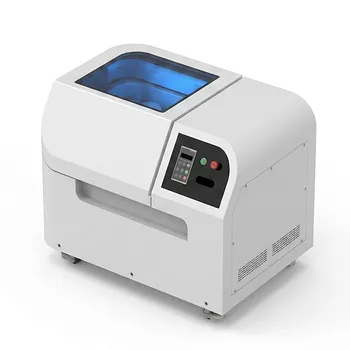
8L Planetary Ball Mill for Laboratory Grinding and Sample Preparation
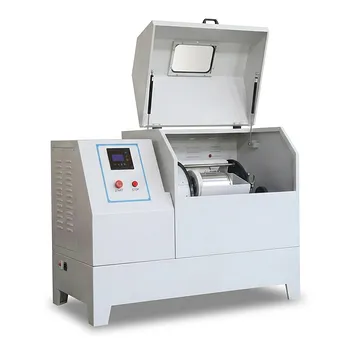
Heavy Duty Horizontal Planetary Ball Mill for Efficient Industrial Grinding and Sample Preparation
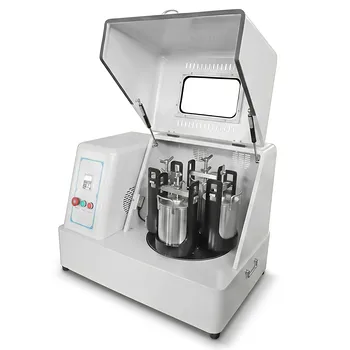
Vertical Square Planetary Ball Mill for Laboratory Sample Preparation and Nanoscale Grinding
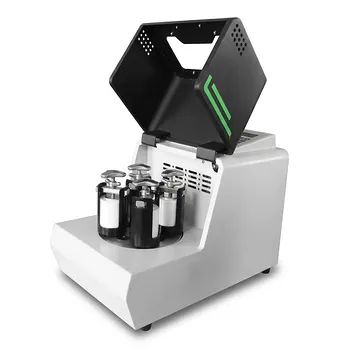
Miniature Planetary Ball Mill with Vacuum Grinding and High Efficiency for Laboratory Sample Preparation
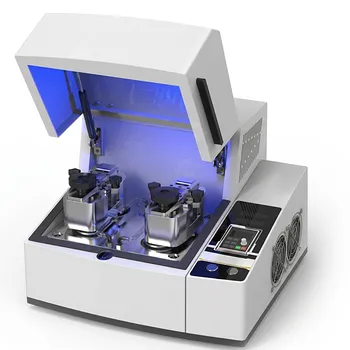
Laboratory Nano High Energy Ball Mill Ultrafine Grinding Mechanical Alloying
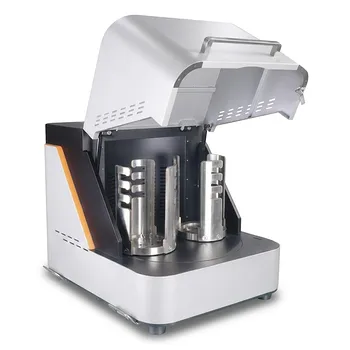
High Energy Laboratory Planetary Ball Mill for Nano Grinding and Colloidal Mixing of Hard and Brittle Materials
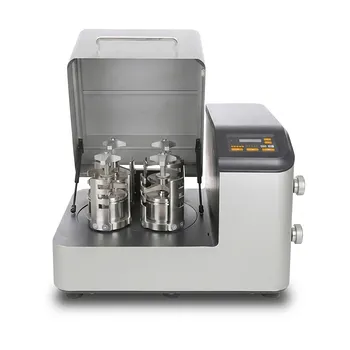
High Energy Planetary Ball Mill for Nano Scale Grinding and Colloidal Mixing in Material Science Research
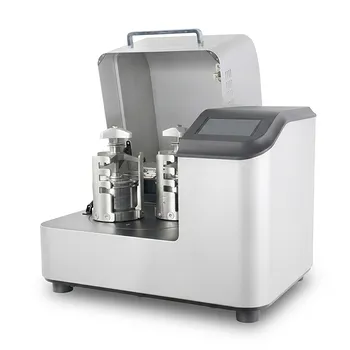
High Energy Planetary Ball Mill for Nano Scale Grinding and Mechanical Alloying