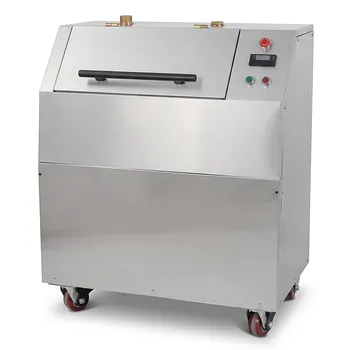
How a Vibratory Sieve Shaker Assesses E-waste Modified Soil: Optimize Grading & Stability
Updated 5 months ago
A vibratory sieve shaker is the primary tool used to determine the particle size distribution (PSD) of ground E-waste and soil mixtures by applying standardized mechanical energy to a nested stack of sieves. This process allows engineers to quantify the mass percentage of various size ranges and calculate the coefficient of uniformity ($C_u$) and the coefficient of curvature ($C_c$). These metrics are essential for determining if the resulting soil-E-waste composite is well-graded, which is a fundamental requirement for achieving high structural density and stability.
Core Takeaway: The vibratory sieve shaker provides the empirical data required to assess whether E-waste additives improve or hinder soil gradation. By accurately defining the material's particle distribution, it enables the optimization of mixing ratios for maximum engineering performance.
The Role of Particle Size Distribution (PSD)
Standardizing Mechanical Classification
The shaker utilizes high-frequency vibrations to ensure that soil and E-waste particles are uniformly distributed across the entire surface of each sieve. This mechanical action drives particles to pass through the standardized mesh apertures until they reach a sieve that restricts their movement based on size.
Unlike manual sieving, a vibratory shaker provides highly repeatable physical screening energy. This consistency is vital for classifying mixtures according to global standards like AASHTO, ensuring that experimental results are comparable across different projects.
Calculating Uniformity and Curvature
The data obtained from a sieve analysis is plotted on a gradation curve to derive the $C_u$ and $C_c$ values. These parameters indicate the range of particle sizes present and the "smoothness" of the distribution.
A well-graded material, characterized by specific $C_u$ and $C_c$ thresholds, contains a wide variety of particle sizes that fill the voids between larger grains. This identification is critical for ensuring the E-waste qualifies as a viable stabilizing agent for the soil matrix.
Impact on Soil Engineering Properties
Achieving Higher Density and Stability
The primary goal of modifying soil with E-waste is often to increase the ultimate strength and density of the material. By using a sieve shaker to verify a well-graded distribution, engineers ensure that the E-waste particles effectively interlock with the soil particles.
When the gradation is optimized, the mixture exhibits better fluidity during processing and higher resistance to deformation. This is particularly important when E-waste plastic or glass is used as a lightweight aggregate in specialized soil-cement or concrete applications.
Minimizing the 'Particle Effect'
Uniformity in particle size is not only important for structural integrity but also for analytical precision. A vibratory sieve shaker helps prepare a uniform 2 mm standard mesh sample, which is the key to reducing the "particle effect" in advanced testing.
This preparation minimizes baseline drift and scattering noise during subsequent laboratory analyses, such as spectroscopy. By ensuring a consistent particle size, technicians can more accurately predict how the modified soil will react to chemical stabilizers like lime or bagasse ash.
Understanding the Trade-offs
The Requirement for Dry Samples
Vibratory sieving is primarily designed for dry soil samples and crushed E-waste. If the material contains significant moisture, particles may clump together or clog the mesh apertures, leading to inaccurate gradation data and an underestimation of the "fines" content.
Risk of Particle Degradation
Extended shaking durations or excessive vibration amplitudes can cause mechanical attrition, especially with brittle E-waste components like glass or certain plastics. This can artificially increase the percentage of fine particles in the sample, resulting in a skewed gradation curve that does not represent the original material.
Noise and Maintenance
Mechanical vibratory shakers generate significant noise and vibration, which may require dedicated laboratory space or dampening mounts. Additionally, the sieves themselves are precision instruments that require regular calibration and cleaning to prevent "blinding," where particles become permanently lodged in the mesh.
Making the Right Choice for Your Goal
How to Apply This to Your Project
To maximize the value of vibratory sieve analysis in your soil-E-waste research, consider the following recommendations based on your primary objective:
- If your primary focus is Structural Load-Bearing: Prioritize the calculation of $C_u$ and $C_c$ to ensure the E-waste creates a well-graded mixture that maximizes interlocking density.
- If your primary focus is Chemical Stabilization: Use the shaker to precisely quantify the silt and clay content, as these fractions dictate the required volume of stabilizers like lime or ash.
- If your primary focus is Laboratory Accuracy: Strictly adhere to standardized vibration frequencies and durations to prevent particle degradation and ensure the repeatability of your spectroscopy or water-stability models.
Ultimately, the vibratory sieve shaker transforms raw, inconsistent waste materials into quantifiable engineering data, allowing for the precise design of stable, high-performance modified soils.
Summary Table:
| Feature/Parameter | Role in E-waste Soil Analysis | Engineering Benefit |
|---|---|---|
| PSD Determination | Quantifies mass percentage of particle size ranges | Optimizes mixing ratios for performance |
| $C_u$ & $C_c$ Calculation | Defines uniformity and curvature of the mixture | Ensures a well-graded, high-density matrix |
| Mechanical Vibration | Provides repeatable, standardized screening energy | Ensures compliance with AASHTO standards |
| Sample Preparation | Reduces the 'particle effect' and scattering noise | Enhances precision in analytical testing |
Elevate Your Material Research with Expert Sample Prep Solutions
Achieve unmatched precision in your soil and material studies with [Brand Name]. We specialize in providing complete laboratory sample preparation solutions designed for the rigorous demands of material science.
Whether you are assessing E-waste stabilization or developing new composites, our extensive product line supports every stage of your workflow:
- Grading & Classification: High-performance vibratory and air-jet sieve shakers with precision test sieves.
- Size Reduction: Advanced jaw/roll crushers, planetary ball mills, and cryogenic grinders.
- Compaction & Synthesis: A full spectrum of hydraulic presses, including Cold/Warm Isostatic Presses (CIP/WIP), hot presses, and vacuum systems.
Ready to optimize your laboratory's efficiency and data accuracy? Contact our technical experts today to find the perfect equipment for your project!
References
- Mangesh Chaugule, Shailendra Banne. Improvement of Black Cotton Soil Properties Using E-waste. DOI: 10.9790/1684-1403017681
Mentioned Products
- Vibratory Sieve Shaker Electromagnetic 3D Motion Powder Particle Size Analyzer for Dry and Wet Sieving
- Laboratory Dry and Wet Three Dimensional Vibratory Sieve Shaker for Particle Analysis
- Dry Three Dimensional Vibratory Sieve Shaker
- Stainless Steel Laboratory Vibratory Test Sieve Shaker
- Heavy Duty Dry Three Dimensional Vibratory Sieve Shaker for Particle Separation
People Also Ask
- How does a vibratory sieve shaker contribute to optimizing the performance of activated carbon? Enhance Adsorption Precision
- Why is a laboratory vibratory sieve shaker necessary for processing magnesium-based borate precursor powders? Boost Activity
- Why use a vibratory sieve shaker to verify coarse aggregate grading in rubberized concrete? Ensure Structural Integrity
- What function do vibratory sieve shakers and standard test sieves serve in the preparation of adsorbents? Key Guide
- What role does a vibratory sieve shaker play in the particle size analysis of ground corn products? Enhance QC Precision

Tech Team · PowderPreparation
Last updated on May 14, 2026
Related Products

Vibratory Sieve Shaker Electromagnetic 3D Motion Powder Particle Size Analyzer for Dry and Wet Sieving
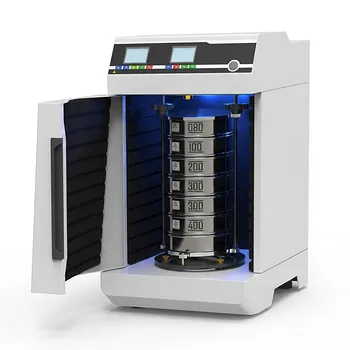
Laboratory Dry and Wet Three Dimensional Vibratory Sieve Shaker for Particle Analysis
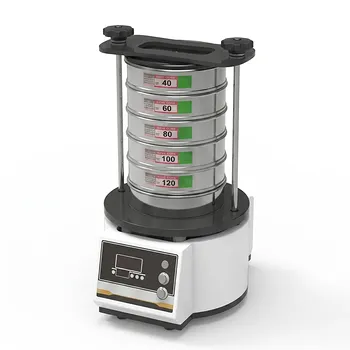
Dry Three Dimensional Vibratory Sieve Shaker

Stainless Steel Laboratory Vibratory Test Sieve Shaker

Heavy Duty Dry Three Dimensional Vibratory Sieve Shaker for Particle Separation

Small Laboratory Vibratory Sieve Shaker for Powder Gradation and Particle Size Analysis

Small Laboratory Vibrating Sieve Shaker for Precise Particle Size Analysis

High Frequency Wet Three-Dimensional Vibrating Sieve Shaker for Dry and Wet Particle Size Analysis
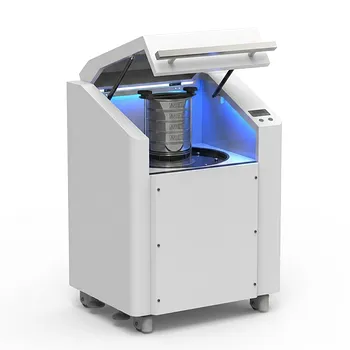
High Frequency Cabinet Type Three-Dimensional Rotary Vibrating Sieve Shaker for Dry Sieving and Particle Classification

Laboratory Vibratory Test Sieve Shaker for Precision Particle Size Analysis and Powder Grading

三维电磁微量振动筛分仪

Stainless Steel Rotary Vibrating Sieve High Precision Circular Vibratory Separator Industrial Powder Grading Machine Multi Layer Sifting Equipment
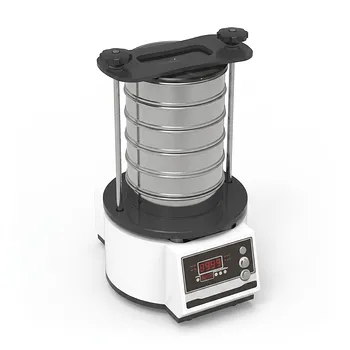
Tapping Oscillating Sieve Shaker for Dry and Wet Particle Size Analysis

Three Dimensional Rotary Vibrating Sieve
Vibratory Superfine Grinder for Ultra Fine Laboratory Powder Milling
Small Vibrating Ultrafine Grinder for Traditional Chinese Medicine
Automatic Vibrating Powder Feeder for Laboratory Material Processing Precision Vibratory Hopper Feeder for Granular and Powder Material Handling Industrial Grade Vibrating Tray Feeder for Consistent Material Sample Preparation