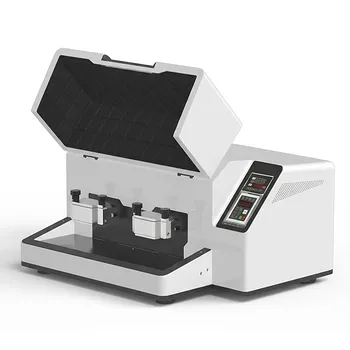
How does a planetary ball mill contribute to the processing of Titanium Diboride (TiB2)? Achieve Precision Dispersion
Updated 3 months ago
The planetary ball mill is a critical tool for the high-energy processing of Titanium Diboride ($\text{TiB}_2$), functioning primarily to eliminate particle agglomeration and achieve a highly refined, uniform dispersion. By utilizing high-hardness grinding media and intense mechanical forces, the mill ensures that $\text{TiB}_2$ secondary phase powders are prepared for subsequent coating or sintering processes. This processing is essential for creating the uniform, micron-scale coating layers required for advanced ceramic and metal-matrix composites.
Core Takeaway: A planetary ball mill transforms $\text{TiB}_2$ from bulk or agglomerated states into a highly dispersed, mechanically activated secondary phase. This ensures macroscopic homogenization and reactivity, which are vital for preventing phase separation and stress concentration in the final composite material.
De-agglomeration and Precision Particle Refinement
Eliminating Interparticle Adhesion
$\text{TiB}_2$ powders often suffer from significant agglomeration, which can compromise the integrity of a composite. The planetary ball mill utilizes high-energy impact and shear forces to break these clusters apart, ensuring each particle acts as an individual unit.
Achieving Micron-Scale Dispersion
By using high-hardness grinding media, such as silicon nitride balls, the mill refines the $\text{TiB}_2$ powder to a precise size. This high level of dispersion is a prerequisite for dry coating processes, where $\text{TiB}_2$ must form a uniform layer on the surface of primary particles like Silicon Carbide ($\text{SiC}$).
Increasing Specific Surface Area
The mechanical grinding process significantly increases the specific surface area of the $\text{TiB}_2$ particles. This heightened surface area enhances the reactivity of the powder, making it more effective during subsequent chemical reactions or densification stages.
Mechanical Activation and Synthesis
Inducing Mechanochemical Reactions
Beyond simple mixing, the planetary ball mill provides the energy necessary to break atomic bonds within reactants. This mechanical activation promotes solid-state diffusion, allowing for the synthesis of nanocrystalline $\text{TiB}_2$ at significantly lower temperatures than traditional methods.
Embedding Reinforcements in Ductile Matrices
In metal-matrix composites, the mill's high-speed rotation generates centrifugal forces that crush brittle particles and embed them into ductile matrices, such as Titanium. This creates a composite powder where the reinforcement is physically locked into the matrix, ensuring a stable microstructure.
Facilitating In-Situ Phase Formation
The high-energy environment can induce in-situ chemical reactions during the milling process itself. This allows for the formation of new phases and core-shell structures that are essential for the mechanical stability of the final sintered block.
Homogenization of Dissimilar Materials
Overcoming Density and Size Disparity
$\text{TiB}_2$ often has a different density and particle size compared to matrix powders like $\text{Ti6Al4V}$. The complex motion trajectory of the planetary mill—combining revolution and rotation—ensures these dissimilar materials reach a state of high macroscopic homogenization.
Preventing Phase Separation
Effective mixing prevents the "clumping" of the reinforcement phase, which would otherwise lead to local stress concentrations. By ensuring a uniform distribution, the planetary mill guarantees that the final composite exhibits stable and predictable mechanical properties.
Understanding the Trade-offs
Energy Intensity vs. Material Integrity
While high-energy milling is necessary for refinement, it can lead to excessive deformation of powder particles and significant temperature increases. If the energy input is not carefully controlled, it may negatively alter the morphology of the matrix powder.
Contamination Risks
The use of high-hardness grinding media is necessary to process $\text{TiB}_2$, but it introduces the risk of media wear. Small amounts of the grinding balls (e.g., silicon nitride) can wear down and contaminate the powder, potentially affecting the purity of the final product.
The Low-Energy Alternative
In some applications, a horizontal planetary ball mill at lower speeds is preferred. This approach provides enough impact for mixing while preventing the heat and deformation associated with high-energy settings, providing a "high-quality mixed precursor" without altering particle shape.
Applying This to Your Material Goal
How to Apply This to Your Project
- If your primary focus is synthesizing nanocrystalline $\text{TiB}_2$: Use high-energy settings and high-hardness media to maximize mechanical activation and solid-state diffusion.
- If your primary focus is surface coating ($\text{TiB}_2$ on $\text{SiC}$): Prioritize de-agglomeration and high dispersion to ensure a uniform, micron-scale layer is achievable during dry coating.
- If your primary focus is maintaining matrix particle shape: Utilize low-speed rotation or a horizontal mill setup to achieve homogenization without inducing excessive mechanical strain or heat.
By mastering the mechanical energy of the planetary ball mill, processors can move beyond simple mixing to achieve the precise microstructural control required for high-performance $\text{TiB}_2$ composites.
Summary Table:
| Process Function | Key Benefit | Resulting Outcome |
|---|---|---|
| De-agglomeration | Breaks interparticle adhesion | High-dispersion micron-scale powders |
| Mechanical Activation | Induces solid-state diffusion | Synthesis of nanocrystalline phases |
| Homogenization | Overcomes density/size disparity | Uniform distribution; no phase separation |
| Embedding/Coating | Physical locking into matrices | Stable core-shell or composite structures |
Elevate Your Material Research with Precision Sample Preparation
Are you looking to optimize the processing of Titanium Diboride (TiB2) or other advanced ceramics? At [Brand Name], we provide complete laboratory sample preparation solutions for material science, specializing in high-performance powder processing and compaction equipment.
Our extensive product line is designed to help you achieve the exact microstructural control required for high-performance composites, including:
- Advanced Milling: Planetary ball mills, jet mills, and cryogenic grinders for mechanical activation and precision refinement.
- Powder Processing: Crushers, sieve shakers, and high-efficiency mixers (powder/defoaming).
- Precision Compaction: A full spectrum of hydraulic presses, including Cold/Warm Isostatic Presses (CIP/WIP), vacuum hot presses, and XRF pellet presses.
Ready to enhance your lab's efficiency and material performance? Contact us today to discuss your project!
References
- Zeynep Sude Bulut, Salih Çağrı Özer. Improved Thermoelectric Properties of SiC Composites with Optimized TiB2 Network Structures. DOI: 10.2339/politeknik.1625094
Mentioned Products
- High Energy Laboratory Planetary Ball Mill for Nano Grinding and Colloidal Mixing of Hard and Brittle Materials
- 8L Planetary Ball Mill for Laboratory Grinding and Sample Preparation
- Vertical Semi Circular Planetary Ball Mill for Laboratory Precision Grinding
- Planetary Ball Mill 12L
- Vertical Square Planetary Ball Mill for Laboratory Sample Preparation and Nanoscale Grinding
People Also Ask
- What role does a high-energy planetary ball mill play in processing quenched bioactive glass? Achieve Nano-Scale Precision
- What role does a high-energy planetary ball mill play in magnesium-based hydrogen storage alloy preparation?
- What is the primary function of a high-energy planetary ball mill in Ni2MnSn synthesis? Optimize Solid-State Alloying.
- What role does a planetary ball mill play in nano-mineral filler prep? Achieve Sub-100nm Precision & Performance
- What is the role of a high-energy planetary ball mill in Li2ZrO3 and LBS prep? Achieve Superior Electrolyte Density

Tech Team · PowderPreparation
Last updated on Jun 03, 2026
Related Products

High Energy Laboratory Planetary Ball Mill for Nano Grinding and Colloidal Mixing of Hard and Brittle Materials

8L Planetary Ball Mill for Laboratory Grinding and Sample Preparation

Vertical Semi Circular Planetary Ball Mill for Laboratory Precision Grinding
Planetary Ball Mill 12L

Vertical Square Planetary Ball Mill for Laboratory Sample Preparation and Nanoscale Grinding

360° Rotating Omnidirectional Laboratory Planetary Ball Mill for Homogeneous Ultra-Fine Grinding and Mixing

High Energy Laboratory Planetary Ball Mill for Nano Grinding and Material Science Sample Preparation

Miniature Planetary Ball Mill with Vacuum Grinding and High Efficiency for Laboratory Sample Preparation
Horizontal Light Duty Planetary Ball Mill for Laboratory Sample Preparation

Heavy Duty Horizontal Planetary Ball Mill for Efficient Industrial Grinding and Sample Preparation

High Energy Planetary Ball Mill for Nano Scale Grinding and Colloidal Mixing in Material Science Research

Dual Station Planetary Ball Mill 24L

High Energy Planetary Ball Mill for Nano Scale Grinding and Mechanical Alloying

Vertical Production Planetary Ball Mill for High Throughput Powder Processing

High Energy Omnidirectional Planetary Ball Mill 20L

High Energy Omnidirectional Planetary Ball Mill 16L
Multi-Platform Nanoscale High-Energy Vibratory Ball Mill
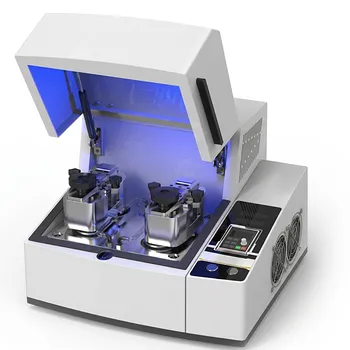
Laboratory Nano High Energy Ball Mill Ultrafine Grinding Mechanical Alloying

High Energy Hybrid Vibratory Ball Mill for Grinding Mixing and Cell Disruption