The Sleeping Giant in the Ash: How a Laboratory Ball Mill Unlocks High-Volume Sustainable Cement
Aug 02, 2026
The Waste Paradox
We are sitting on a mountain of a problem that looks like a solution. Coal fly ash. It is the fine, grey residue of combustion, a billion-ton industrial legacy stored in ponds and landfills. For decades, we have known it can replace a portion of cement—the carbon-intensive glue that holds our world together.
But there is a catch. It is a psychological and chemical one.
We tend to think of mixing as simple addition. Put two things together, and you get the sum of their parts. With fly ash and cement, that math fails. Raw fly ash is lazy. Its smooth, glassy spheres sit idly in the cement paste for weeks, inert passengers waiting for the chemical party to start. They wait for calcium hydroxide, a byproduct of cement hydration, to slowly coax them into reacting.
The result? A structure weak in its infancy, slow to cure, and limited in how much waste we can actually use. You can only replace so much cement before the building crumbles under its own timeline. The ash needs a wake-up call.
The Truth About Mechanical Activation
This is not a story about complex chemical doping or exotic additives. It is a story about mechanical brute force. About energy. And it starts in the grinding jar of a laboratory ball mill.
The principle is as simple as it is transformative: You must break something to make it reactive.
Mechanical activation via a laboratory ball mill overcomes the natural chemical dormancy of coal fly ash by applying high-energy impact and shear forces. This is not mixing. It is structural surgery on a microscopic scale. The mill becomes the engine that turns an inert filler into a hungry, reactive pozzolan—a material capable of locking carbon-emitting cement out of the mix without sacrificing the early strength that builders demand.
The Three Materials Science Miracles
When the mill starts, three transformations happen in parallel.
1. The Disappearance of Size
Raw, unclassified fly ash often arrives with a median particle size around 60 microns. It is coarse, erratic, and bulky. A high-energy ball mill does not just break these particles; it obliterates them, driving the median size down to 5 microns.
This is a 10x geometric disappearance. The specific surface area—the total reactive interface available to water—explodes exponentially. Think of it as the difference between a single large rock and a cloud of fine dust. The dust interacts with its environment immediately.
2. The Shattering of the Shield
But size is only the first act. The profound transformation is morphological. Fly ash particles are predominantly spherical micro-beads, a result of their thermal history. Their smooth, outer skin is a chemically resistant aluminosilicate shell.
The ball mill fractures these spheres ruthlessly. It is a landscape of tiny, exploded planets. This shattering exposes the internal, active mineral components that were previously sealed away. The ash is no longer a collection of inert marbles; it is a jagged, high-surface-energy field of debris ready to bond.
3. The Wounds in the Crystal Lattice
This is where the romance of engineering meets materials science. At the atomic level, the impact of the grinding media does not just create smaller pieces. It induces trauma in the mineral lattice. It creates lattice defects—dislocations, vacancies, and broken bonds within the crystalline structures of mullite and quartz.
These atomic wounds are the holy grail. They are zones of thermodynamic weakness. They dramatically lower the energy barrier for silicon and aluminum atoms to leap into solution. The material, previously locked in a stable glass, becomes chemically active. It is hungry.
The Reaction in the Concrete Matrix
How does this engineered hunger manifest in a block of blended cement?
Silencing the Induction Period
The biggest complaint about fly ash cement is its slow crawl. Portland cement reacts fast; fly ash does not. This leaves a window of vulnerability in the first 7 to 28 days.
Mechanically activated fly ash closes that window. By seeding the mix with billions of highly reactive, defect-ridden particles, you shorten the chemical induction period. The ash begins consuming calcium hydroxide—a byproduct of the main cement reaction—almost immediately.
The Pozzolanic Feeding Frenzy
Think of calcium hydroxide as a weakness. It is a relatively weak, water-soluble layer that sits between the hard calcium silicate hydrate (C-S-H) gels.
Activated fly ash acts as a strategic scavenger. It hunts down this calcium hydroxide and converts it into more C-S-H gel—the true source of concrete's strength. This secondary reaction densifies the matrix, filling the capillary pores. The concrete becomes not just stronger, but impermeable. The very flaw of the hydration process is converted into structural integrity.
Homogeneity at the Limit
There is a final, practical magic. A ball mill is a mixer of unparalleled violence. When you co-grind fly ash with hydrated lime or calcined clay, you are not blending three distinct powders. You are forging microscopic composite particles. This ensures that every single grain of the final product holds the exact stoichiometric recipe for the reaction, eliminating the weak spots that arise from heterogeneous mixing.
The Engineer's Dilemma: The Trade-off Matrix
If more grinding were always better, the solution would be trivial. But the universe charges a fee for energy, and the psychological trap here is to optimize for one variable while ignoring the machine's limits.
The Energy Cliff
The grindability curve is not linear. Reducing particles to 20 microns might be efficient. Pushing them below 5 microns demands a logarithmic increase in power consumption. You are fighting particle strength, electrostatic forces, and the simple physics of diminishing returns. The laboratory ball mill allows you to map this cliff precisely—to find the economic inflection point where reactivity gain meets energy reality.
Agglomeration: The Self-Defeating Loop
Grind fine enough, and the particles stop playing by the rules. Van der Waals forces and static charge take over. Particles begin to clump, forming agglomerates that mimic the behavior of coarse grains. You have spent energy to create a fine powder, but it has spontaneously assembled itself back into large, non-reactive clusters. The effective surface area collapses.
A laboratory-scale mill reveals this critical process limit before you scale it to a pilot plant. It tells you where the madness begins.
The Hidden Ingredient: Wear Metals
Steel balls against rock. The mill lining and grinding media erode. Trace amounts of iron or chromium leach into your "sustainable" binder. For standard cement, this might be a minor footnote. For specific chemical applications or white cement, it is a dealbreaker.
This contamination is not a failure of the concept; it is a parameter to be analyzed. The right mill design—ceramic linings, zirconia media, controlled atmosphere grinding—turns this variable from a contaminant into a controlled input.
From the Lab Bench to the World
The laboratory ball mill is not just a preparation tool. It is a time machine and a forecasting engine. It lets you see the future of a material.
A Roadmap for the Project Manager
How you deploy the mill defines your business case. The objective is not always "grind to the limit."
If your primary focus is early-stage strength: Prioritize ultra-fine grinding to the sub-5-micron range. You are paying an energy premium to maximize the immediate pozzolanic reaction. This is the high-performance additive strategy.
If your primary focus is cost-efficiency: Target a moderate reduction in particle size. You want to fracture the glassy shell without riding the exponential cost curve of ultra-fine milling. You are looking for the "knee" of the reactivity curve—maximum bang for your energy buck.
If your primary focus is high-volume substitution: Use a planetary or stirred mill to maximize the disruption of the aluminosilicate structure. Your goal is to replace as much Portland cement as possible, clinker factor be damned. You need maximum activation to compensate for the missing early-age strength.
The required tool is not a single device. It is a configured system.
To map that particle-size cliff, you need a high-energy planetary ball mill capable of delivering the impact energy to shatter glass phases. To understand the starting material, you need jaw crushers and vibratory sieve shakers to define the feed. And when you transition from powder to a solid test specimen, you turn to advanced compaction—perhaps an XRF pellet press for immediate chemical analysis, or a vacuum hot press to consolidate your novel binder into a dense, defect-free composite for mechanical testing.
The development of a sustainable material is a chain of sample preparation. The science lives and dies in these processing steps.
The laboratory ball mill stands at the center. It is the pacemaker for the sleeping giant in the ash. By controlling the mechanics, you control the chemistry, and by controlling the chemistry, you can finally promise a high-volume, green cement that performs today, not just a decade from now.
When your specifications demand that you wake the material up, the grinding jar becomes the most important structural engineering tool in the lab. The quality of the activation dictates the reliability of the asset.
Quick Links
Suggested Products
360° Rotating Omnidirectional Laboratory Planetary Ball Mill for Homogeneous Ultra-Fine Grinding and Mixing Vertical Semi Circular Planetary Ball Mill for Laboratory Precision Grinding High Energy Laboratory Planetary Ball Mill for Nano Grinding and Material Science Sample Preparation Laboratory Nano High Energy Ball Mill Ultrafine Grinding Mechanical Alloying Vertical Square Planetary Ball Mill for Laboratory Sample Preparation and Nanoscale GrindingFurther Reading
The Energy Budget of a Single Impact: How the Ball-to-Powder Ratio Shapes Nanocrystalline Reality The 65-Micron Gate: Unlocking the True Isotopic Fingerprint of Portland Cement The High-Energy Gamble: What SiBCN-rGO Fibers Teach Us About Perfect Homogenization The Forge at 10,000 g: How a Planetary Ball Mill Designs Self-Lubricating Composites Atom by Atom The Alchemist's Hammer: How a Planetary Ball Mill Solves the Diffusion Dilemma in Rare-Earth Doped Ceramics
PowderPreparation
Last updated on May 14, 2026
Related Products

360° Rotating Omnidirectional Laboratory Planetary Ball Mill for Homogeneous Ultra-Fine Grinding and Mixing
Vertical Semi Circular Planetary Ball Mill for Laboratory Precision Grinding

High Energy Laboratory Planetary Ball Mill for Nano Grinding and Material Science Sample Preparation
Laboratory Nano High Energy Ball Mill Ultrafine Grinding Mechanical Alloying

Vertical Square Planetary Ball Mill for Laboratory Sample Preparation and Nanoscale Grinding

Miniature Planetary Ball Mill with Vacuum Grinding and High Efficiency for Laboratory Sample Preparation
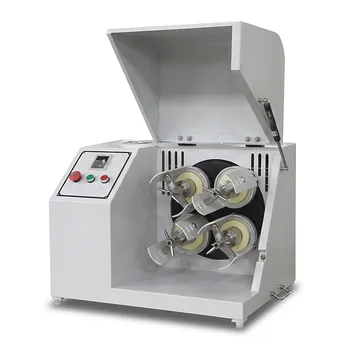
Horizontal Light Duty Planetary Ball Mill for Laboratory Sample Preparation
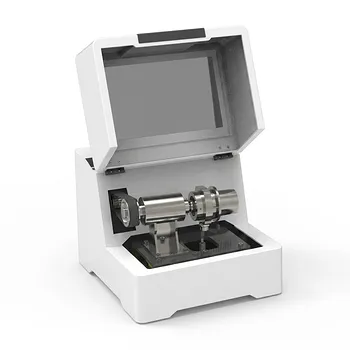
Single Tank High Energy Vibratory Ball Mill for Laboratory Grinding and Mixing

Nano High Energy Vibratory Ball Mill for Laboratory Sample Preparation

8L Planetary Ball Mill for Laboratory Grinding and Sample Preparation
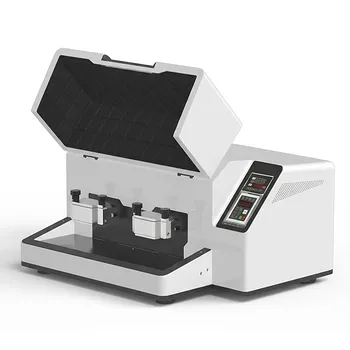
Nanoscale High-Energy Vibratory Ball Mill for Laboratory Sample Preparation, Mechanochemistry, and Mechanical Alloying
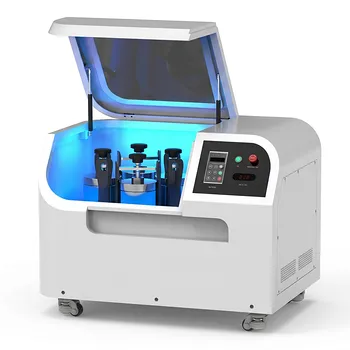
Planetary Ball Mill 12L
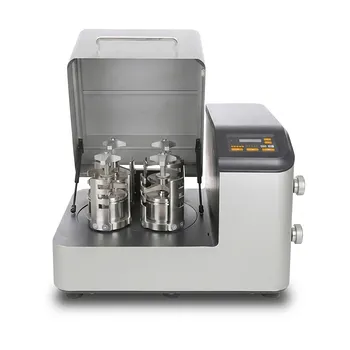
High Energy Planetary Ball Mill for Nano Scale Grinding and Colloidal Mixing in Material Science Research

High Throughput Micro Ball Mill for Cryogenic Grinding and Laboratory Cell Disruption

High Energy Hybrid Vibratory Ball Mill for Grinding Mixing and Cell Disruption

Heavy Duty Horizontal Planetary Ball Mill for Efficient Industrial Grinding and Sample Preparation
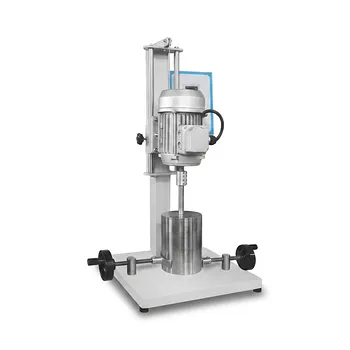
Laboratory Basket Sand Mill for Wet Grinding and Dispersion of Viscous Slurries

High Energy Planetary Ball Mill for Nano Scale Grinding and Mechanical Alloying

Vertical Production Planetary Ball Mill for High Throughput Powder Processing