The Pressure Principle: Why Sodium-Ion Batteries Live or Die in a Hydraulic Press
Sep 27, 2026
The Promise and the Problem
Sodium is abundant. It covers our planet in literal oceans, promising a future free from lithium’s geopolitical and supply-chain anxieties. But sodium is also heavy and sluggish. A sodium ion is a cannonball where lithium is a bullet. To build a battery that can compete, you cannot simply swap the active material. You must rebuild the physics of the electrode itself.
A battery electrode begins as a slurry—a chaotic, wet mixture of hard carbon particles, conductive additives, and binders painted onto a metal foil. When the solvent evaporates, what remains is a ghost structure. It is a fragile, loosely stacked house of cards. You have created the material, but you have not yet created the function.
Between this porous ghost and a working battery stands one instrument: the laboratory hydraulic press.
The Hidden Architecture of Compaction
A dry, unpressed electrode is not a conductor. It is a suggestion of a conductor. Under a microscope, you would see air gaps, stray particles, and a random stack of electrochemical dead ends.
The Physics of Contact
Electricity does not jump. It cannot leap over the microscopic chasms between hard carbon particles. In an unpressed electrode, every gap is a resistor. Every disconnected particle is a dead zone. You have loaded the active material, but you are not using it.
Think of the conductive network as a city's road system. The active material particles are the storage warehouses. The carbon black is the highway. Without compaction, your warehouses are connected only by dirt paths and interrupted bridges.
This is the core insight: Pressing at specific pressures—often starting around 4.7 tons/cm²—does not merely flatten the material. It forges a metallic-level intimacy. It forces particles into elastic and plastic deformation, creating cold-welded junctions where electrons flow almost unimpeded.
Making a Bond That Lasts
The current collector—a smooth metal foil—is a terrible surface to stick to. The dried slurry holds on by the weakest van der Waals forces. It is a temporary arrangement waiting to fail.
When a hydraulic press applies controlled force, it drives the active material into the foil's micro-roughness. This is a mechanical interlock. The pressure creates a transition zone where coating and collector become one system. This bond must survive hundreds of charge-discharge cycles, each cycle puffing and contracting the material by a few percent.
Without this bond, the electrode delaminates silently inside the cell. The capacity fades not because the material is dead, but because it has simply disconnected itself from the battery. The electrons are trapped in a floating island, unable to reach the terminal.
The Summary Table of Transformation:
| Pressing Function | What Happens at the Particle Level | The Unseen Consequence |
|---|---|---|
| Densification | Eliminates porous voids | Prevents wasted electrolyte and maximizes energy in a given space |
| Compaction | Builds a low-resistance electronic network | Stops the battery from turning electricity into waste heat |
| Pressure Bonding | Anchors the coating into the current collector | Prevents silent structural death during cycling |
| Pore Structuring | Creates a uniform, balanced porosity | Allows the cannonball sodium ions to swim fast and deep |
The Energy Density Equation
The outer casing of a battery cell is a fixed real estate market. You cannot build outward; you can only build upward. Energy density is a volumetric game. A thick, fluffy electrode wastes precious space that could hold active material.
Packing More Power
The hydraulic press compacts the electrode to a fraction of its original thickness. This is not merely cosmetic thinning. You are increasing the ratio of active mass to the dead volume of casing, separator, and current collector. In hard carbon anodes for sodium-ion batteries, this volumetric compaction is existential. It is the margin between a data sheet that is merely interesting and a cell that is commercially viable.
The Electrolyte Path
Electrolyte must live in the pores. It is the medium through which ions swim. If you compact too aggressively, you seal the pool. The ions cannot reach the deep storage sites of the carbon.
This is the delicate trade-off the press must manage: build a perfect electronic superhighway while leaving precisely engineered, interconnected channels for the liquid. A non-uniform press—one with plates slightly out of parallel—creates a topographical map of tragedy. Dense zones starved of electrolyte sit right next to loose zones that disintegrate, creating hot spots that accelerate local destruction.
The Researcher's Dilemma
Sodium-ion research lives in a paradox of precision.
Chasing a Repeatable Signal
If you are running Cyclic Voltammetry to study the fundamental electrochemistry of a novel hard carbon, a slight variation in electrode thickness changes everything. A thicker electrode introduces voltage drops and ion-transport limitations that mask the material's true signature.
Your Electrochemical Impedance Spectroscopy data becomes a mirror of your pressing technique, not your material’s properties. To isolate the science, you must eliminate the physical variability. Only a press with digital, repeatable force control makes this possible. You are not pressing an electrode; you are constructing the physical basis for a valid experiment.
Managing the Sodium-Specific Stress
Sodium ions are bigger than lithium ions. When they crowd into carbon, the material swells significantly. A poorly compacted electrode has no slack in its structure. It fractures. It creates a fresh, reactive surface that greedily consumes the liquid electrolyte, drying out a corner of the cell forever.
Pre-compaction is pre-conditioning. It creates a consolidated structure that breathes together, distributing the expansion stress across a connected network rather than snapping brittle, isolated bonds. The press creates a material that is ready for the strain of its own operation.
Choosing Your Pressure Strategy
Your application determines the exact setting of the press, and a standard, high-precision laboratory hydraulic press from a complete solution provider is the most reliable way to execute this. The machine is not a commodity; it is the architect of your electrode’s microstructure.
A Decision Map for the User
- If your goal is peak volumetric energy density: You walk the line of maximum compaction. You are seeking the point just before the porosity slams shut, which requires a press capable of holding an exact, high load without drifting.
- If your goal is extreme-rate capability: You opt for a moderate, precise pressure. You need to eliminate ohmic resistance without collapsing the large transit pores. Clean, parallel platens are critical here to avoid creating dense zones that bottleneck the current.
- If your goal is fundamental research consistency: Your press must be the most constant variable in the lab. A digital hydraulic unit with true isostatic pressure distribution ensures the electrode you make on Monday is identical to the one you make on Friday, turning your data from anecdote into evidence.
- If your goal is solid-state architecture: You require extreme uniaxial or isostatic pressure (often 375 MPa or more) to fuse the interface between the hard carbon and the solid electrolyte into a continuous, gap-free ion channel.
The Artifact of Force
A battery electrode is a remarkably dense storage medium for both mass and charge, a synthetic structure that owes its entire functional existence to the few seconds it spent under the platen of a hydraulic press. That press is the silent partner in every metric of performance—the coulombic efficiency, the resistance, and the long, slow process of cycle aging.
To build the electrode correctly is to build a system where the electronic and ionic pathways are in perfect, deliberate balance. This is the foundation that all the advanced electrochemistry sits upon, and it is the precise, repeatable logic you control with a press engineered not just for force, but for the physical truth of your material. The integration of a full-spectrum material preparation workflow—from initial powder processing in planetary ball mills and cryogenic grinders to classification with air-jet sieve shakers—ensures that the powder you load into the die is as uniform as the force you compress it with. Contact Our Experts
Quick Links
Suggested Products
6-Ton Small Single-Punch Tablet Press — Laboratory Powder & Granule Tableting Equipment / Tablet Forming Machine 5 Ton Single Punch Tablet Press Laboratory Small Batch Production Manual Tablet Press with Dual Scale Pressure Gauge for Pharmaceutical Food Chemical Laboratory Sample Preparation 6 Ton Variable Frequency Single Punch Tablet Press High Shear Laboratory Emulsifier for Mixing and HomogenizationFurther Reading
From Dust to Data: How Precision Laboratory Presses Forge Truth in Mineral Testing The Layers That Wouldn’t Lie Flat: Why Nine Sheets of Ceramic Demand a Laboratory Press That Thinks in Microns The Hidden Fracture: Why Ceramic Feed Rods Fail Before the First Melt The Invisible Architect: How Compaction Psychology Shapes Your LSM Ceramic’s Fate The Invisible Architect of Powder: How a Single Additive Saves Ductile Metals from Themselves
PowderPreparation
Last updated on May 14, 2026
Related Products
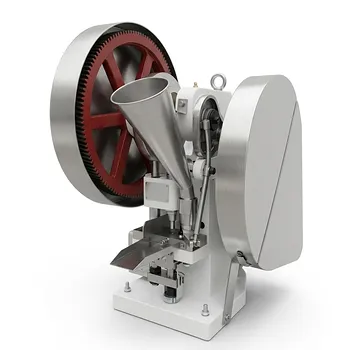
6-Ton Small Single-Punch Tablet Press — Laboratory Powder & Granule Tableting Equipment / Tablet Forming Machine
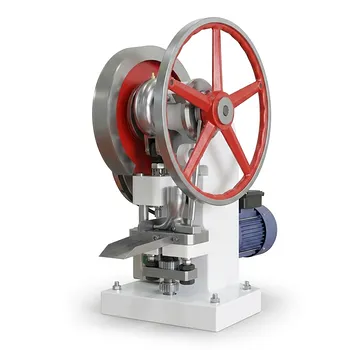
5 Ton Single Punch Tablet Press Laboratory Small Batch Production
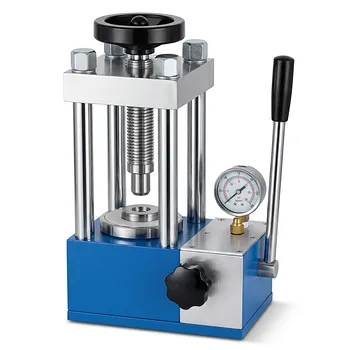
Manual Tablet Press with Dual Scale Pressure Gauge for Pharmaceutical Food Chemical Laboratory Sample Preparation
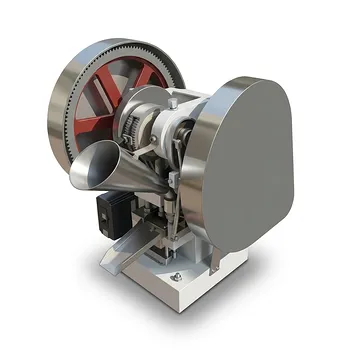
6 Ton Variable Frequency Single Punch Tablet Press
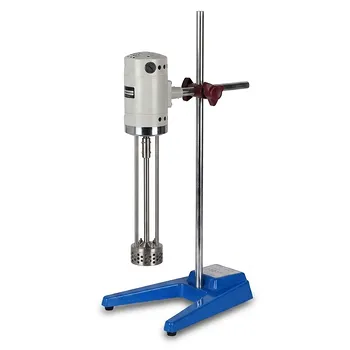
High Shear Laboratory Emulsifier for Mixing and Homogenization
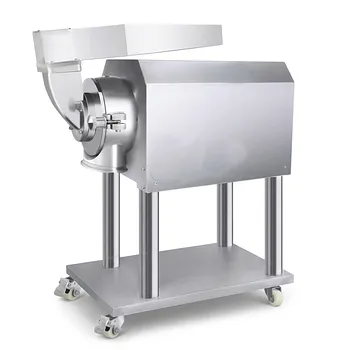
High Speed Small Laboratory Crusher for Dry Material Sample Preparation
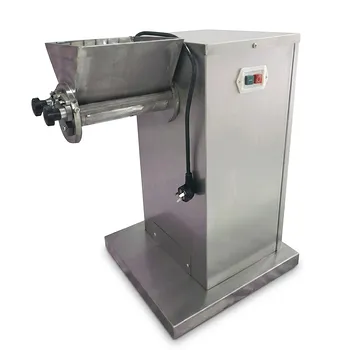
Small Laboratory Oscillating Granulator for Wet and Dry Granulation Processing
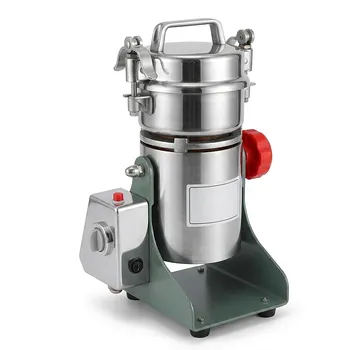
High Speed Swing Type Laboratory Pulverizer for Fine Powder Grinding and Sample Preparation