The Particle Whisperer: How a Vibratory Sieve Shaker Decodes Pine Bark into a Predictable Engineering Material
May 28, 2026
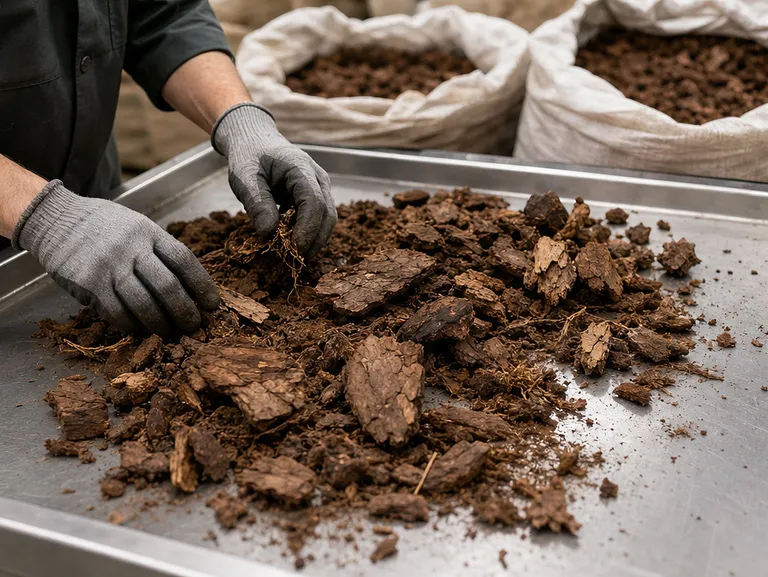
The Weight of a Pile of Bark
A horticulturist stares at a mountain of pine bark. It looks uniform — dark, fibrous, earthy. But she knows better. Inside that pile, chaos reigns. Some particles are splinter-sharp needles. Others are flat flakes. The sizes range from boulders to dust. Yet the patient who depends on this material — a greenhouse full of fragile root systems — does not tolerate chaos. It needs exactly the right balance of water, air, and mechanical support.
She needs a number. A fingerprint. But how do you assign a single identity to a material that nature made deliberately inconsistent?
This is where the vibratory sieve shaker enters the story. Not as a machine that simply shakes, but as a translator. It converts the wild, organic randomness of pine bark into a language engineers and biologists can act on: particle size distribution.
The Hidden Grammar of Particles
Why Size Tells the Whole Story
In material science, particle size is never just about size. It is a proxy for behavior. Every granule of bark is a tiny valve that controls how water moves, how air stays, and how roots breathe. Measuring this distribution is the first and most essential step in turning a natural byproduct into a high-performance substrate.
The vibratory sieve shaker performs this measurement with a kind of relentless patience no human hand can replicate. It imposes a controlled mechanical stress — frequency and amplitude — that forces particles to confront mesh apertures, pass through if they can, or stay behind as proof of their dimension.
At the end of the test, you don't have a guess. You have a physical fingerprint. And that fingerprint is the master key.
The Physics of a Substrate's Soul
From the particle size distribution, three performance-defining metrics emerge. They are not abstract. They dictate whether a plant thrives or dies, whether an extraction process yields 40% or 80%, and whether an industrial composite delaminates under load.
Air Space, Water-Holding, and the Breathing Substrate
Coarse particles form macropores. These drain fast, inviting oxygen into the root zone. Fine particles create micropores that cling to moisture like a lifeline. The ratio between these two fractions — measured across a stack of test sieves — writes the respiratory history of the plant root. Too much air space, and the substrate becomes a desert. Too much water-holding, and the roots literally drown.
Bulk Density and the Economics of Weight
Shipping pine bark across continents adds cost by the kilogram. The packing geometry of particles — how fines fill the voids between coarse fragments — determines bulk density. A vendor who ignores this overpays for freight and delivers an inconsistent product. Sieve data transforms this from an art into a calculable, controllable parameter.
Beyond Horticulture: When Bark Becomes a Chemical Reactor
Pine bark is not just a soil substitute. It is a chemical reservoir of lipophilic waxes, antioxidant polyphenols, and structural lignins. Extraction industries grind it to specific targets — often below 1 mm or 2 mm — to maximize the surface area-to-volume ratio.
The Extraction Curve
A particle that is too large shields its interior from solvents. Too small, and the material clogs percolation columns. The vibratory sieve shaker defines the exact moment where diffusion pressure meets permeability. Operators who control this distribution improve extraction kinetics and bump yields without investing an extra dollar in solvents or time.
Industrial Uniformity: The Glue That Holds
In adhesive-reinforced composites, bark particles act as a cheap, renewable filler. But the viscosity of the bonding mixture is allergic to size variation. A shift from 0.2 mm to 1.25 mm in particle diameter changes everything — wetting behavior, spread rate, final bond strength. Here, the sieve shaker provides the uniformity index, a numerical proof that consistency will not be left to chance.
The Trade-Offs No One Warns You About
When Needles Lie
Vibratory sieving carries a hidden assumption: that particles are spherical. Pine bark is acicular and flaky. An elongated needle can fall vertically through an aperture it should technically not pass. The result? A slight systematic error that makes fines appear more abundant than they truly are. This is not a failure of the method; it is a reminder that every measurement is a negotiation with geometry.
The Danger of Over-Shaking
Brittle bark particles, subjected to excessive vibration, fracture. The machine, intended to measure, starts to manufacture new fines. The data drifts. A skilled operator learns that the goal is not maximum shaking, but the minimum energy that achieves complete separation. Precision, as always, lives in restraint.
Building Your Characterization Protocol
How to Align Sieving Strategy with Purpose
Your sieving protocol should be as specific as your end goal. Here is a practical map:
| Goal | Sieve Range Focus | The Metric That Matters |
|---|---|---|
| **Horticultural Substrate Quality** | Broad range (e.g., 0.5 mm to 12.5 mm) | Air space vs. water-holding capacity balance |
| **Chemical Extraction Yield** | Fine range (below 1 mm or 2 mm) | Surface area-to-volume ratio |
| **Industrial Composite Manufacturing** | Tight, specific fraction (e.g., 0.2–1.25 mm) | Uniformity index (Iθ) |
| **Logistics & Packaging** | Full distribution curve | Particle packing ratio and bulk density |
The Romance of a Mechanical Stillness
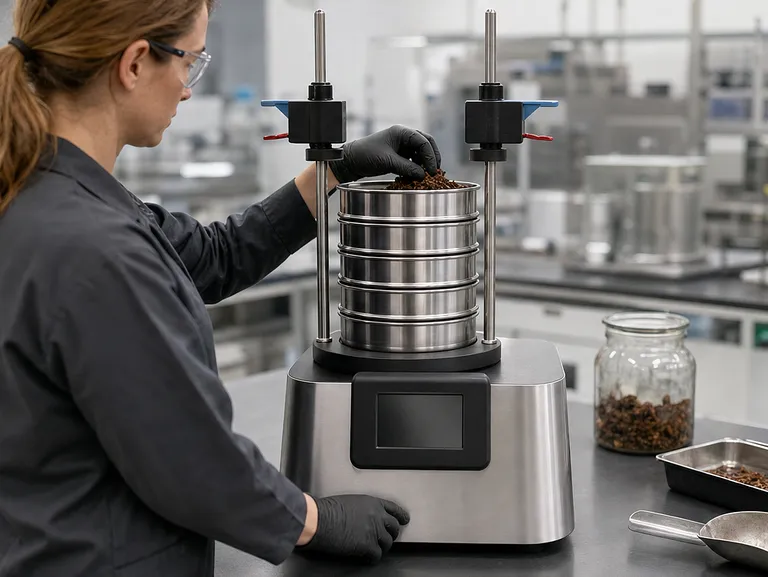
There is an engineer's romance hidden in this work. A pile of pine bark, at first glance, is just waste from a sawmill. But place it on a sieve shaker, and you are asking a fundamental question: what are you made of, really? The vibration is a kind of honest interrogation. The mesh stacks are silent witnesses. The result — a set of mass fractions on a spreadsheet — is an act of translation. It turns nature's indifference into human understanding.
This is what draws materials scientists to the bench. Not the data itself, but the moment when a raw material confesses its nature and becomes a predictable, engineerable substance.
From Fingerprint to Functional Material: The Equipment Behind the Data
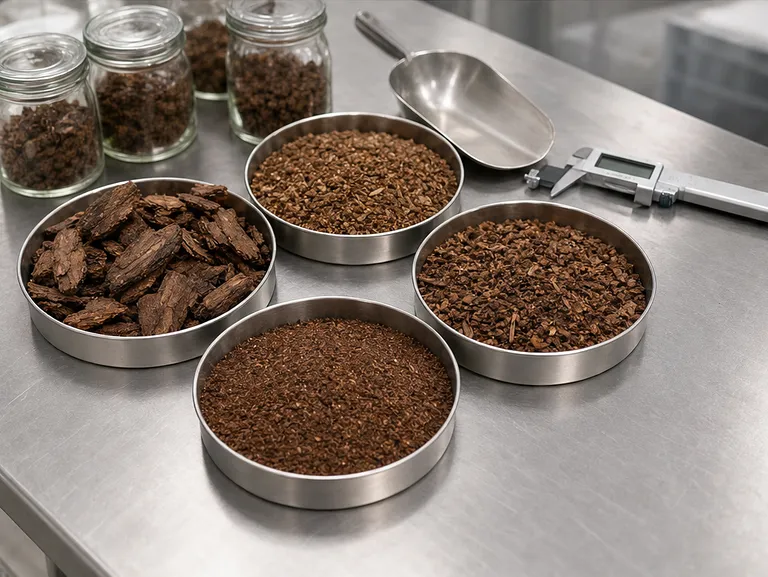
Defining a “physical fingerprint” requires absolute mechanical precision. The vibratory sieve shaker is the analytical heart, but it does not work alone. Sample preparation is the unglamorous first act that determines everything that follows. If the original material is not properly crushed, ground, or homogenized, the sieving data becomes a fiction.
We provide the complete ecosystem for this transformation.
Complete Sample Preparation, End to End
Before pine bark even meets a sieve, it often must be reduced to a manageable size. Our jaw and roll crushers handle coarse breaking. For heat-sensitive or volatile constituents in bark, liquid nitrogen cryogenic grinders preserve chemical profiles while delivering brittle fracture. If your goal is to analyze extractives down to the nanoscale, planetary ball mills and jet mills refine the powder to analytical fineness.
The Precision Grading Engine
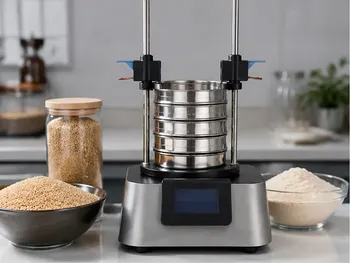
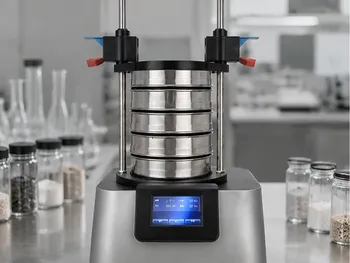
Our vibratory sieve shakers and air-jet sieve shakers, paired with certified test sieves down to the finest meshes, produce repeatable, publishable particle size distributions. They remove the operator's subjectivity from the equation. The frequency, amplitude, and duration are dialed in digitally, transforming a once-artisanal process into a scientific instrument.
Beyond Powder: Compacting Your Insight
For researchers who need to go further — perhaps to form a bark-based composite pellet for XRF analysis or to simulate sintering behavior — our hydraulic presses complete the story. Cold Isostatic Presses (CIP), Warm Isostatic Presses (WIP), XRF pellet presses, and vacuum hot presses convert characterized powder into testable solids. This is the ultimate validation loop: measure, form, test, confirm.
Closing the Loop

Pine bark taught us a principle that applies to every powder, every mineral, every pharmaceutical granule: you cannot control what you cannot measure. The vibratory sieve shaker gives you that measurement, not as an abstraction, but as a repeatable physical routine that cuts through nature's noise. When you combine it with the right crushing, milling, and compaction equipment, you create a material characterisation pipeline that delivers truth, not guesswork.
Whether you are optimizing a horticultural substrate for maximum root aeration, scaling up a polyphenol extraction process, or qualifying a renewable filler for industrial adhesives, your data — and your economics — will never be better than your preparation.
Quick Links
Suggested Products
Vibratory Sieve Shaker Electromagnetic 3D Motion Powder Particle Size Analyzer for Dry and Wet Sieving Laboratory Dry and Wet Three Dimensional Vibratory Sieve Shaker for Particle Analysis Stainless Steel Laboratory Vibratory Test Sieve Shaker Heavy Duty Dry Three Dimensional Vibratory Sieve Shaker for Particle Separation Dry Three Dimensional Vibratory Sieve ShakerFurther Reading
The Hidden Economics of Particle Size: Why the Most Overlooked Variable in Material Science Controls Everything The Invisible Architecture of Powder: How a Vibratory Sieve Shaker Decides What Your Amaranth Bread Becomes The Particle-Size Lever: Why the Most Overlooked Step in Catalyst Design Determines Everything Else When Glass Melts Fail, It Was Never the Furnace: The Hidden Economics of Sand Gradation The Quarter-Millimeter Margin: Why Vibratory Sieve Precision Determines Artificial Stone Profitability
PowderPreparation
Last updated on May 15, 2026
Related Products
Vibratory Sieve Shaker Electromagnetic 3D Motion Powder Particle Size Analyzer for Dry and Wet Sieving
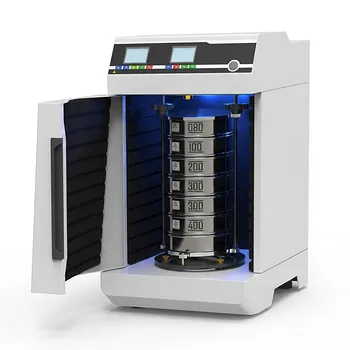
Laboratory Dry and Wet Three Dimensional Vibratory Sieve Shaker for Particle Analysis
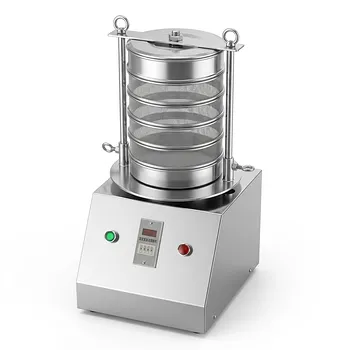
Stainless Steel Laboratory Vibratory Test Sieve Shaker
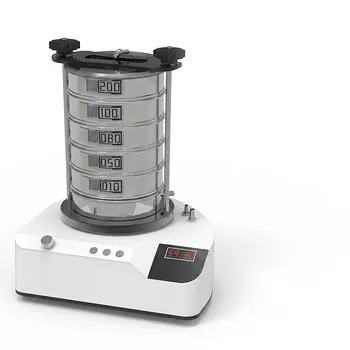
Heavy Duty Dry Three Dimensional Vibratory Sieve Shaker for Particle Separation

Dry Three Dimensional Vibratory Sieve Shaker
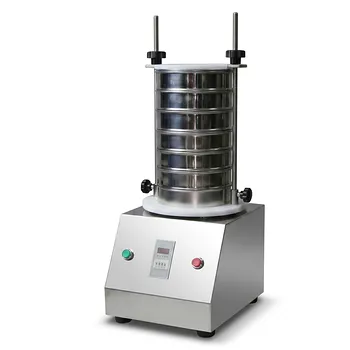
Small Laboratory Vibratory Sieve Shaker for Powder Gradation and Particle Size Analysis

High Frequency Wet Three-Dimensional Vibrating Sieve Shaker for Dry and Wet Particle Size Analysis
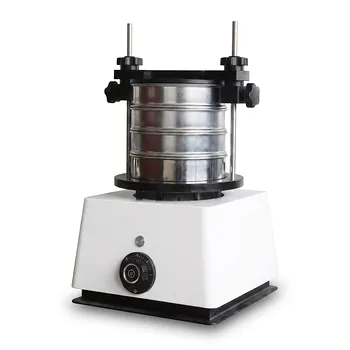
Small Laboratory Vibrating Sieve Shaker for Precise Particle Size Analysis
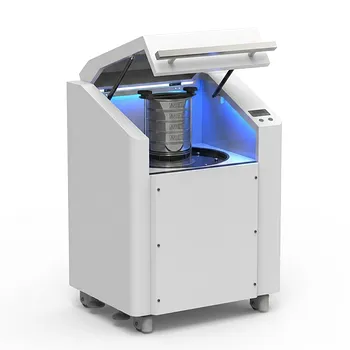
High Frequency Cabinet Type Three-Dimensional Rotary Vibrating Sieve Shaker for Dry Sieving and Particle Classification
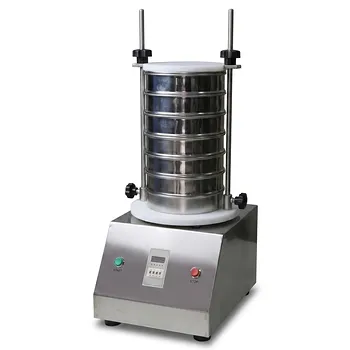
Laboratory Vibratory Test Sieve Shaker for Precision Particle Size Analysis and Powder Grading
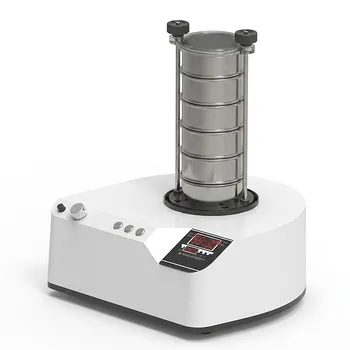
三维电磁微量振动筛分仪

Tapping Oscillating Sieve Shaker for Dry and Wet Particle Size Analysis
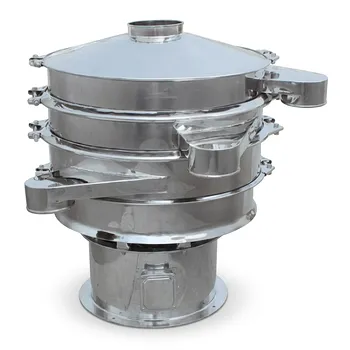
Stainless Steel Rotary Vibrating Sieve High Precision Circular Vibratory Separator Industrial Powder Grading Machine Multi Layer Sifting Equipment
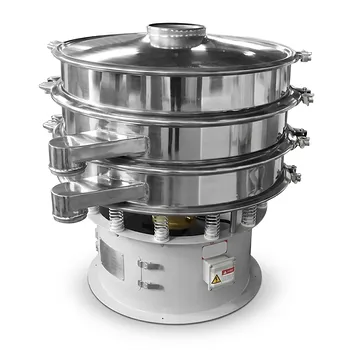
Three Dimensional Rotary Vibrating Sieve
Small Vibrating Ultrafine Grinder for Traditional Chinese Medicine
Automatic Vibrating Powder Feeder for Laboratory Material Processing Precision Vibratory Hopper Feeder for Granular and Powder Material Handling Industrial Grade Vibrating Tray Feeder for Consistent Material Sample Preparation
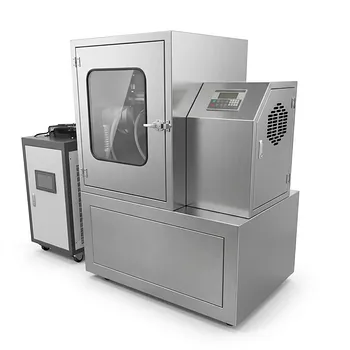
Vibratory Superfine Grinder for Ultra Fine Laboratory Powder Milling
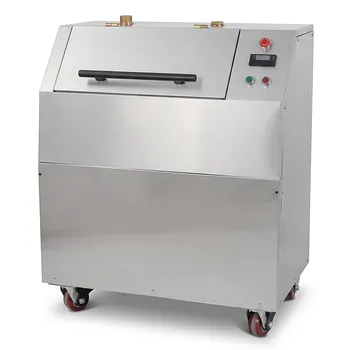
Vibratory Disc Mill for Rapid Fine Grinding and High Throughput Sample Preparation of Hard and Brittle Materials