The 75-Micron Mystery: How the Humble Sieve Decides Whether Your Brick Becomes a Wall or Returns to Dust
Jun 14, 2026
The Builder’s Heartbreak You Can’t See Coming
The first cracks appeared before the walls were even plastered. Hairline fractures tracing the edges of perfectly pressed bricks, then widening into a map of failure. The builder—an experienced hand with clay and cement—couldn’t understand it. The mix felt right. The press delivered full tonnage. The cure was slow and damp. So why was the structure eating itself?
He sent a sample to the lab. The report came back with a single, devastating line: silty clay, not sandy loam. The soil he had trusted—dug from his own site, smelling of rain and promise—was 40% silt and 18% clay. It had never stood a chance.
We are wired to trust what we can see: color, texture, the satisfying thunk of a dense block. But the real architecture of a stabilized earth brick lives at scales the human eye cannot resolve, down to 75 microns and below. The sieve makes that invisible world visible. It separates the skeleton from the glue. And in that separation lies the difference between a home that stands for generations and one that crumbles before the roof goes on.
The Invisible Skeleton: What Particle Distribution Actually Controls
Soil is not a single material. It’s a chaotic assembly of mineral fragments that define the brick’s entire engineering personality. When you compact soil and stabilizer into a block, you are not “making earth solid.” You are asking coarse particles to form a load-bearing skeleton and fine particles to fill the spaces between them, all while cement or lime bridges the remaining gaps. If one fraction dominates, the whole system fails.
Structural engineers call this the particle-size distribution (PSD) curve. Builders feel it as bricks that warp, crack, or absorb water like a sponge. The stakes are not subtle. A poorly graded soil can reduce compressive strength by half even when cement dosage is identical.
Your press applies the same force either way. Your stabilizer costs the same. Only the raw material’s internal grading determines what you get in return. This is not a mixing problem. It’s a measurement problem. And it starts with the sieve.
From Dust to Data: How a Vibratory Sieve Shaker Works
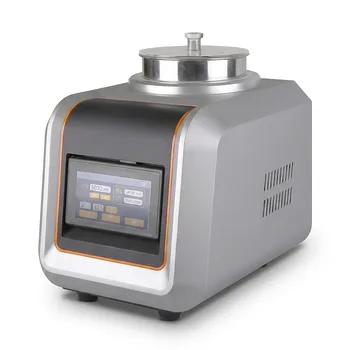
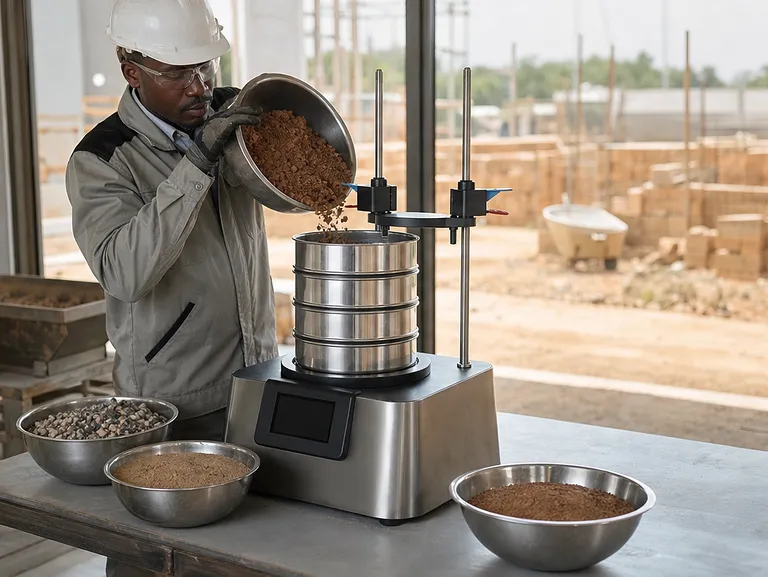
A vibratory sieve shaker does one thing exquisitely well: it imposes mechanical order on granular chaos.
The procedure is deceptively simple but mathematically profound.
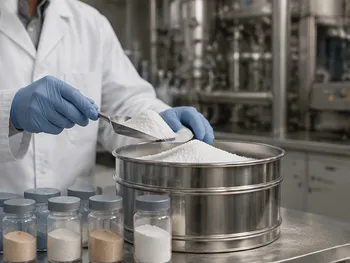
- A representative soil sample—dried, weighed, and sometimes predispersed—is placed on the top sieve of a nested stack.
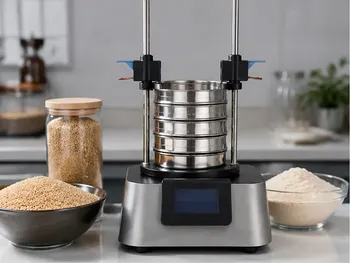
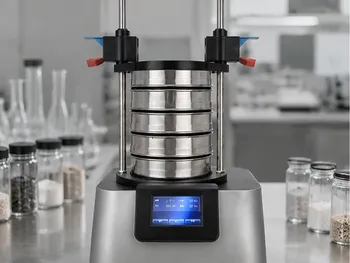
- Standard test sieves, each with progressively smaller apertures, cascade from 4.75 mm (gravel territory) down to 0.075 mm (75 microns, the boundary between sand and silt).
- The shaker applies controlled three-dimensional vibration. It does not just shake; it tumbles, rotates, and taps particles into a continuous vertical motion, presenting every grain to every opening until each finds its home.
After a precisely timed interval, you weigh the mass retained on each sieve. What emerges is a distribution chart—a fingerprint of the soil’s engineering soul.
The data reveals at a glance whether the material contains enough coarse sand (roughly 45–65% for typical sandy loam), a modest but critical silt fraction, and a manageable clay content. It tells you if nature has already done the mixing for you or if blending is mandatory before the first brick is pressed.
The Art of Soil Classification: Chasing Sandy Loam
Stabilized earth construction hunts a specific texture: sandy loam. This class sits at the sweet spot where sufficient coarse skeleton meets just enough cohesive fines to lock under pressure but not so much that drying shrinkage tears the brick apart.
Using the sieve data, a technician classifies the soil according to standardized systems (USCS, AASHTO, or local norms). A typical target reads something like:
| Fraction | Ideal Range (%) | Why It Matters |
|---|---|---|
| Gravel (>4.75 mm) | 0–10% | Provides occasional large anchors; too much hinders pressing. |
| Sand (0.075–4.75 mm) | 45–65% | Forms the primary compressive skeleton. |
| Silt (0.002–0.075 mm) | 15–30% | Fills voids; excessive silt weakens binder bonding. |
| Clay (<0.002 mm) | 10–20% | Provides workability and green strength; too much causes shrinkage and cracking. |
If the sieve analysis shows you are not in sandy loam, you must change your material, blend with imported sands, or redesign your stabilizer system. The sieve does not merely describe the soil; it dictates the entire process economics.
Dosage Economics: The Stabilizer’s Delicate Balance
Cement and lime are expensive. They account for a dominant share of per-brick cost. The temptation to “add a little extra for safety” is powerful and almost always wrong.
Here the sieve provides a psychological brake on our worst instinct: overcompensation. Research shows that fine-grained soils with high clay fractions demand disproportionate amounts of cement just to overcome the expansive clay morphology. You get a weak, brittle brick that cost more than it should.
Conversely, a well-graded sandy loam revealed by sieve analysis uses stabilizer with near-perfect efficiency. The coarse skeleton carries the load. The fines lock the matrix. The cement only has to bridge the remaining micro-voids. The result is higher strength at lower additive cost.
It’s a lean manufacturing principle applied to earth: measure first, dose precisely, profit from the physics.
The Compaction Connection: Packing Particles Like Nature Never Could
The press you use—whether a manual CINVA-Ram or a fully automated hydraulic station—applies vertical confinement pressure. But particle grading determines how efficiently that pressure translates into density.
A well-graded soil has a continuous spread of sizes. Each void between coarse grains accommodates a medium grain; each medium void, a fine grain. When the sieve confirms this graduation, the press achieves maximum dry density at lower pressure. You get a denser, less porous brick without requiring marginal energy input.
- Uniformly graded sand: Packs with large voids. Requires high stabilizer fill. Water enters easily.
- Well-graded sandy loam: Packs to near-zero continuous voids. Natural density is high. Water permeability plummets.
That is the physical foundation the sieve guarantees. Without it, you’re fighting porosity with prayer.
When Sieves Are Not Enough: The Limits and the Maintenance Covenant
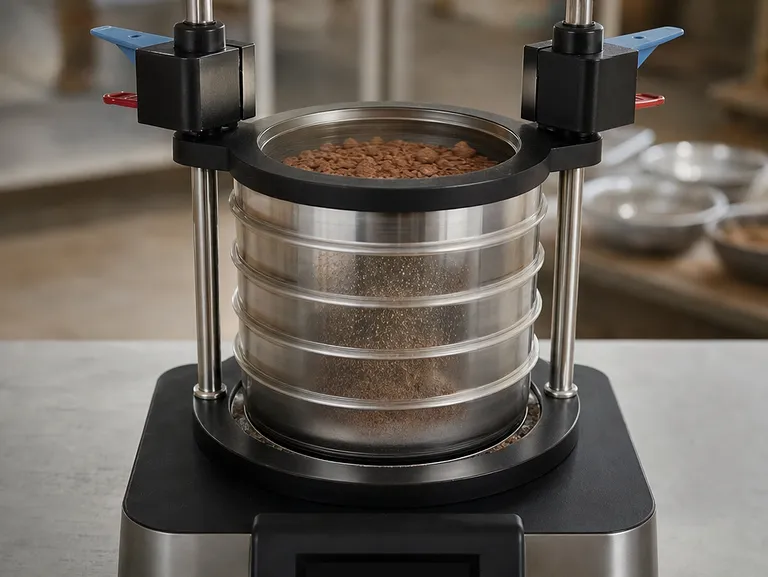
For all their power, vibratory sieve shakers have a vulnerability: fines adhesion. Dried clays can cling to larger sand grains or clog mesh openings, leading to an underestimated silt-plus-clay fraction. A technician who takes the dry-sieve result as gospel may inadvertently classify a marginal soil as acceptable.
The answer is not to abandon sieving but to respect its boundaries. Pair it with hydrometer analysis for the sub-75-micron fraction. Use a wet-sieving method when cohesive soils demand it. The sieve shaker remains the indispensable first step; it just shouldn’t be the only one.
Then there is equipment integrity. Test sieves are not immortal. Abrasive quartz particles stretch woven wire mesh. Frame seals fail. A single deformed aperture can skew an entire distribution curve, moving you from “sandy loam” to “loamy sand” on paper while reality stays the same—and fails accordingly.
This is not a consumable to neglect:
- Inspect mesh under light after every series.
- Replace any sieve with visible wave, dent, or stretched opening.
- Calibrate against reference materials regularly.
- Choose sieves in stainless steel or brass, not cheap unknowns.
In stabilized-earth engineering, the sieve is a precision instrument, not a kitchen strainer.
Beyond Sieves: A Full Material Laboratory for Earth Construction
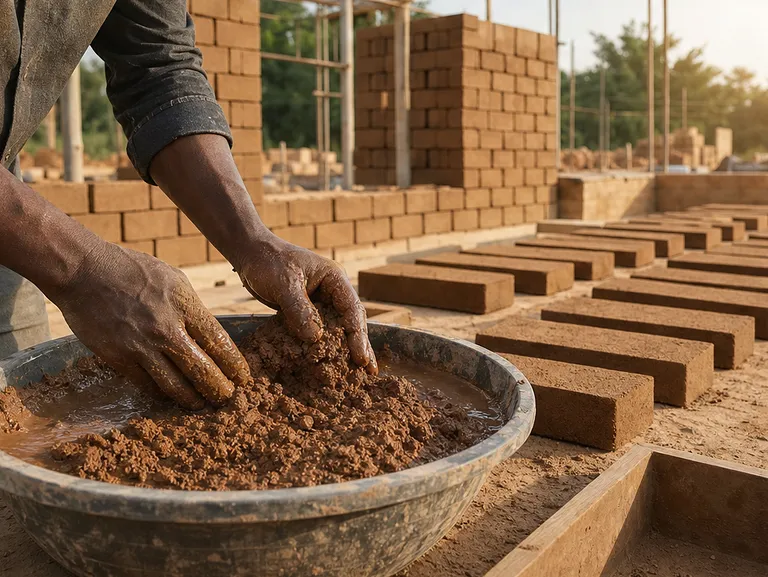
The sieve analysis tells you what you have. But to transform that knowledge into a high-performance brick, you need an integrated chain of lab-scale processing and compaction equipment that replicates real production—and improves upon it.
This is where the laboratory becomes a miniature factory.
From clods to powder Raw soil rarely arrives clean and dry. Laboratory jaw crushers break down aggregated lumps. For fragile or thermally sensitive materials, liquid nitrogen cryogenic grinders preserve mineral structure while delivering uniform fineness. Planetary ball mills, jet mills, and rotor mills generate the controlled particle-size fractions you need to blend a custom sandy loam when nature refuses to cooperate.
From powder to homogeneous mix Powder mixers and defoaming mixers ensure that stabilizer, soil, and any admixture become one material before the press ever touches them. Inhomogeneity here wrecks the statistical validity of your sieve data; uniform mixing makes the PSD curve a true predictive tool.
From mix to compacted specimen Hydraulic presses close the loop. Standard lab presses for initial specimen forming. XRF pellet presses for geochemical characterization. Cold and warm isostatic presses (CIP/WIP) for advanced ceramics or high-value earth-composite research. Hot presses and vacuum hot presses for materials that demand exact thermal and atmospheric control.
The vibratory sieve shaker and precision test sieves remain the analytical heart. But the chambers and pumps around it give you the power to act on what the sieves reveal.
The Engineer’s Romance: Rebuilding the Earth One Grain at a Time
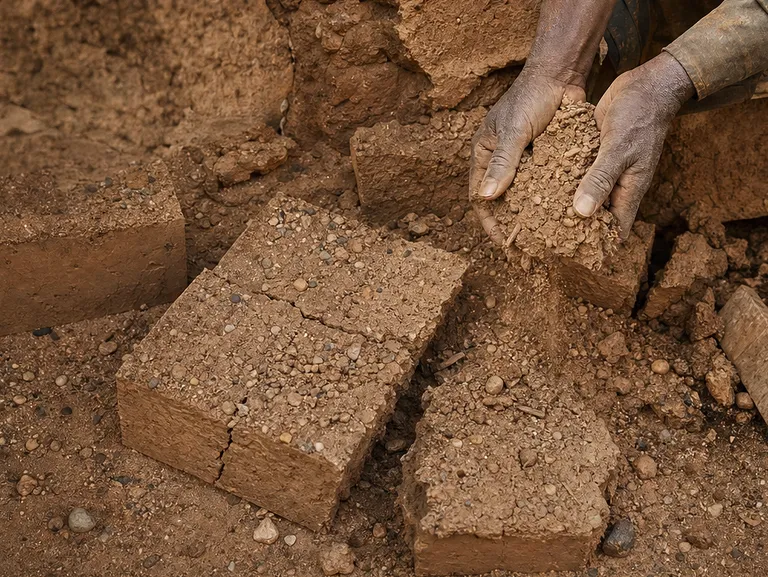
There is something deeply human about wanting to build with the ground beneath our feet. It promises sustainability, affordability, a connection to place. But romance without rigor is how walls fall down. The sieve is the bridge between poetry and load-bearing reality.
It turns a handful of ambiguous soil into a distribution curve, a classification, a formula. It tells you when to stop adding cement, when to bring in sand, and when your material is ready for the press. It makes stabilized earth engineering a science of prediction, not a series of hopeful mistakes.
And the beauty of it is this: the equipment that does all this—vibratory shakers, test sieves, crushers, mills, mixers, and compaction presses—fits inside a modest lab. The same principles that build skyscrapers play out on a benchtop. No mystery remains hidden below 75 microns.
When you run that sieve stack and see the fractions add up to exactly the sandy loam you need, you are not just looking at soil. You are looking at the skeleton of a building that will outlive you. That’s worth measuring for.
Contact Our Experts to configure a complete soil preparation and analysis system tailored to your stabilized earth project.
Quick Links
Suggested Products
Vibratory Sieve Shaker Electromagnetic 3D Motion Powder Particle Size Analyzer for Dry and Wet Sieving Laboratory Dry and Wet Three Dimensional Vibratory Sieve Shaker for Particle Analysis Stainless Steel Laboratory Vibratory Test Sieve Shaker Heavy Duty Dry Three Dimensional Vibratory Sieve Shaker for Particle Separation Dry Three Dimensional Vibratory Sieve ShakerFurther Reading
The Hidden Economics of Particle Size: Why the Most Overlooked Variable in Material Science Controls Everything The Invisible Architecture of Powder: How a Vibratory Sieve Shaker Decides What Your Amaranth Bread Becomes The Particle-Size Lever: Why the Most Overlooked Step in Catalyst Design Determines Everything Else When Glass Melts Fail, It Was Never the Furnace: The Hidden Economics of Sand Gradation The Quarter-Millimeter Margin: Why Vibratory Sieve Precision Determines Artificial Stone Profitability
PowderPreparation
Last updated on May 15, 2026
Related Products

Vibratory Sieve Shaker Electromagnetic 3D Motion Powder Particle Size Analyzer for Dry and Wet Sieving
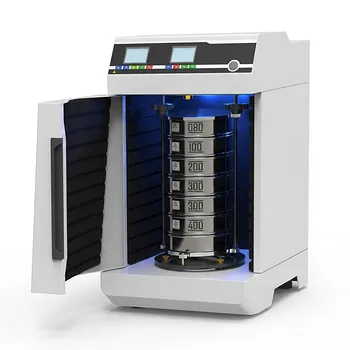
Laboratory Dry and Wet Three Dimensional Vibratory Sieve Shaker for Particle Analysis
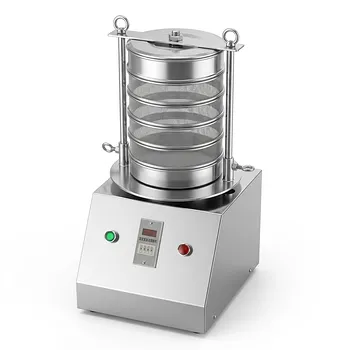
Stainless Steel Laboratory Vibratory Test Sieve Shaker

Heavy Duty Dry Three Dimensional Vibratory Sieve Shaker for Particle Separation

Dry Three Dimensional Vibratory Sieve Shaker

Small Laboratory Vibratory Sieve Shaker for Powder Gradation and Particle Size Analysis
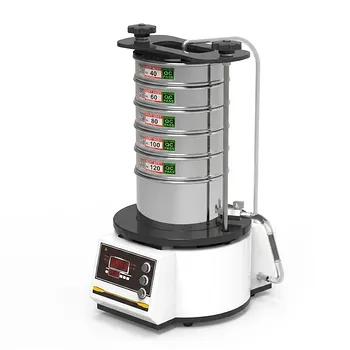
High Frequency Wet Three-Dimensional Vibrating Sieve Shaker for Dry and Wet Particle Size Analysis

Small Laboratory Vibrating Sieve Shaker for Precise Particle Size Analysis
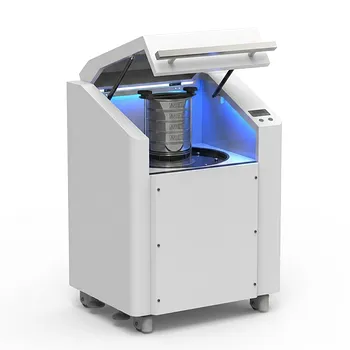
High Frequency Cabinet Type Three-Dimensional Rotary Vibrating Sieve Shaker for Dry Sieving and Particle Classification

Laboratory Vibratory Test Sieve Shaker for Precision Particle Size Analysis and Powder Grading

三维电磁微量振动筛分仪

Tapping Oscillating Sieve Shaker for Dry and Wet Particle Size Analysis

Stainless Steel Rotary Vibrating Sieve High Precision Circular Vibratory Separator Industrial Powder Grading Machine Multi Layer Sifting Equipment

Three Dimensional Rotary Vibrating Sieve
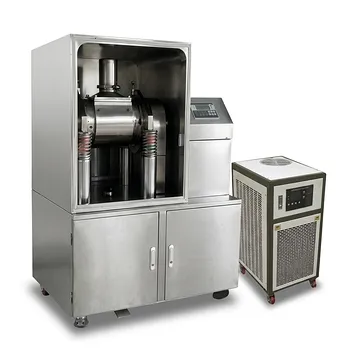
Small Vibrating Ultrafine Grinder for Traditional Chinese Medicine
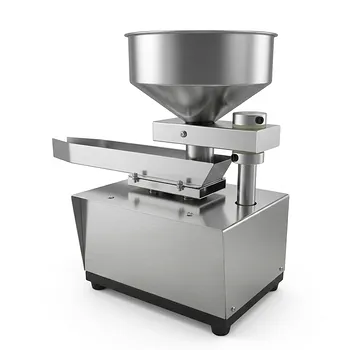
Automatic Vibrating Powder Feeder for Laboratory Material Processing Precision Vibratory Hopper Feeder for Granular and Powder Material Handling Industrial Grade Vibrating Tray Feeder for Consistent Material Sample Preparation
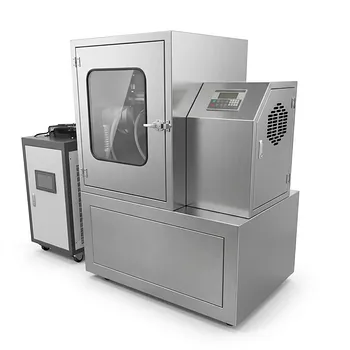
Vibratory Superfine Grinder for Ultra Fine Laboratory Powder Milling
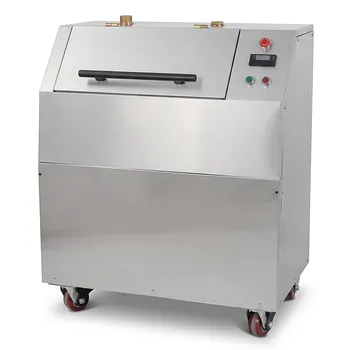
Vibratory Disc Mill for Rapid Fine Grinding and High Throughput Sample Preparation of Hard and Brittle Materials