The Hidden Geometry of Grain: What Multi-Dimensional Sieving Reveals About Process, Nutrition, and Consistency
Jun 15, 2026
The Moment the Dust Settles
A nutritionist stares at two batches of ground grain. Both look identical in the palm of her hand. Yet one will fuel efficient livestock fermentation; the other will pass through the digestive tract largely untouched. The difference is invisible to the human eye. It lives in the geometry of the particles themselves, in the distribution curve that separates optimal nutrition from costly waste.
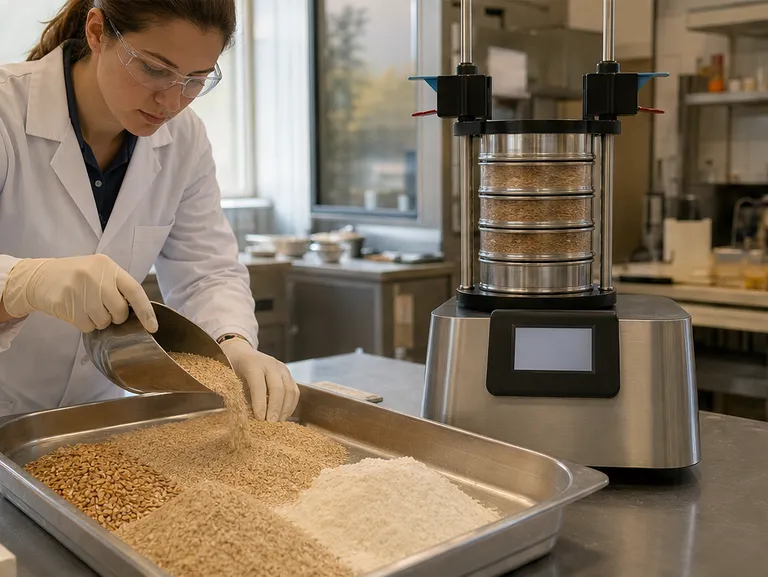
Before a grain can be understood, it must be measured. And the most truthful instrument for that measurement is not a scanning electron microscope or a laser diffraction analyzer—it is a stack of precisely calibrated sieves, shaken by a machine that never gets tired, never gets bored, and never cuts corners.
The Psychology of Powder: Why We Crave the Number
Human beings are pattern-seeking creatures. We want to hold a single number that tells us everything: Is this batch good? Will it perform? Without quantitative particle size data, we fall back on intuition. “It feels fine.” “The mill sounds right.” This is not laziness; it is the brain conserving energy. But in material science, intuition is the silent architect of inconsistency.
A multi-dimensional vibratory sieve shaker replaces the ambiguity of touch with the certainty of mass fractions. It does not guess. It discriminates. It tells you, in grams, exactly what proportion of your sample is too coarse, too fine, or just right. That data becomes the psychological anchor—the undeniable truth—that lets you make decisions with confidence rather than instinct.
The Mechanical Ritual That Guarantees Repeatability
Programmed Agitation as a Scientific Constant
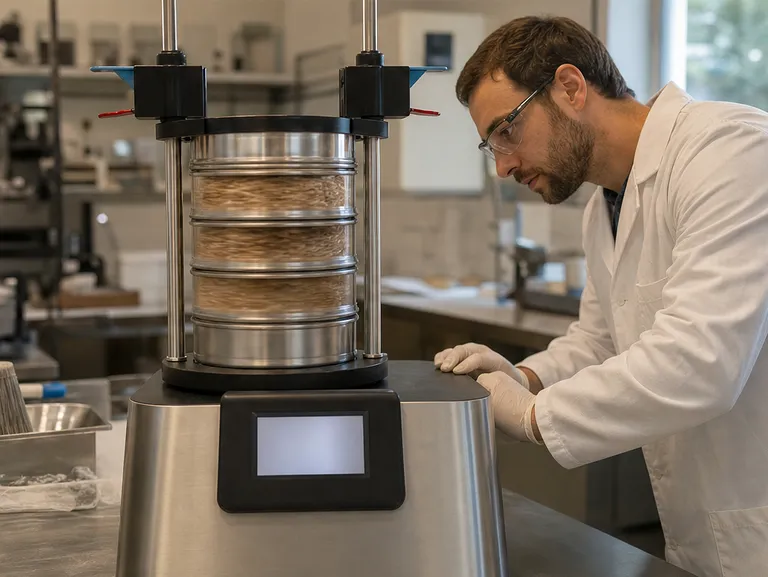
Manual sieving introduces a variable that ruins data: the human factor. One technician shakes vigorously for two minutes; another shakes gently for five. Neither is wrong, but they are not comparable. A vibratory sieve shaker solves this by applying consistent frequency and amplitude to the entire sieve stack. The machine treats every sample identically, converting grain segregation from an art into a reproducible protocol.
The Vertical Sieve Stack: A Ladder of Resolution
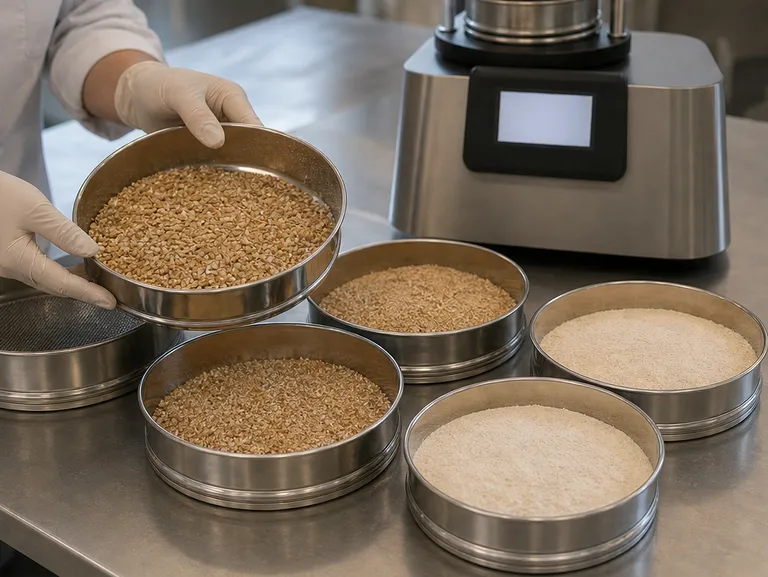
Analytical sieves are stacked in descending order, typically from 4.00 mm down to 0.125 mm for grain applications. Each sieve in the stack acts as a gatekeeper, capturing particles larger than its mesh aperture while allowing smaller ones to pass through. The result is not just a single number but a complete size profile—a spectral decomposition of the grain’s physical identity.
Time as a Controlled Input
Setting a fixed sieving duration ensures that every batch undergoes the same mechanical energy exposure. This temporal standardization is what separates a screening exercise from a scientifically rigorous particle size distribution analysis. Without it, sample-to-sample comparisons become meaningless.
From Mass Fractions to Process Intelligence
The Arithmetic of mPS
After sieving, the mass retained on each sieve is weighed. These weight percentages feed a straightforward calculation to determine the mean particle size (mPS) . The formula is not complex, but its implications are profound. The mPS gives you a single numeric proxy for the entire distribution, a compact expression of the grinding process’s output.
The Power of D10, D50, and D90
While mPS summarizes central tendency, the full distribution curve reveals uniformity. Three numbers define the spread:
- D10: 10% of the mass consists of particles smaller than this size. It flags the fines that may cause dust problems or over-fermentation.
- D50: The median particle size. It is the “characteristic” particle that splits the mass in half.
- D90: 90% of the mass is smaller than this size. It highlights the coarse tail that may limit digestibility.
Monitoring these three metrics turns a quality control check into a diagnostic tool. A shift in D90, for example, can signal worn mill screens or blades before anyone opens the machine.
Predicting Fermentation and Digestion Rates
In nutritional science, particle size controls the surface area available for microbial attack. Finer grinding means faster fermentation, but go too fine and you risk dust and digestive upset. A precise particle size distribution lets you dial in exactly the surface-area-to-volume ratio that maximizes metabolic efficiency—a quantitative recipe instead of a guess.
Where Sieving Goes Wrong—and How Reliability Engineering Saves It
Sieve Blinding: The Invisible Saboteur
Particles near the mesh size inevitably lodge in the apertures, blocking them. Sieve blinding produces a misleading shift toward coarser measurements because mass that should have passed gets artificially retained. High-quality shakers address this through anti-blinding accessories—bouncing balls, sliders, or even ultrasonic deblinding systems integrated into the sieve stack. Without these, your distribution data is silently compromised.
The Moisture Trap
Grain that retains moisture clumps together, aggregating into pseudo-particles that the sieve reads as large. A sample that sits at 15% moisture will produce a completely different size profile than the same grain dried to 10%. Sample preparation protocols must control drying before the shaker ever runs, and the equipment itself must tolerate the minor residual moisture that real-world workflows inevitably introduce.
The Unseen Drift of Calibration
Vibration frequencies are not eternal. Springs age. Motors drift. A shaker that was true last year might be operating at 95% of its specified amplitude today, introducing systematic error into every measurement. A laboratory that treats its sieve shaker as a black box risks basing critical decisions on data that has quietly degraded. Regular calibration and mechanical verification are not optional—they are the price of trustworthy numbers.
Beyond the Single Instrument: The Complete Sample Preparation Ecosystem
The sieve shaker does not work in isolation. Before grain ever reaches the sieve stack, it must be ground to a representative state. And after sieving, the sized fractions often feed additional processes. Viewing the shaker as part of a complete preparation workflow changes how you invest in equipment.
- Before Sieving: A reliable grinding step is essential. Jaw crushers and roll crushers reduce coarse grain, while planetary ball mills, jet mills, and even liquid nitrogen cryogenic grinders can achieve the ultra-fine particle sizes sometimes required. The better the initial grinding, the more meaningful the sieving results.
- After Sieving: Sized powders frequently become candidates for pressing—XRF pellet presses for elemental analysis, or hot presses and vacuum hot presses for material synthesis. Accurate sizing upstream directly influences the quality of these downstream compacts.
- Supporting Processes: Powder mixers and defoaming mixers ensure that the material entering the sieve stack is homogeneous, while air-jet sieve shakers offer a gentler alternative for agglomerative or fragile particles.
A full-spectrum laboratory partner that provides crushers, mills, sieve shakers, mixers, and hydraulic presses under one technical umbrella eliminates the integration risk. It means the vibration frequency you set matches the grinding output you designed, and the pressing step receives powders sized exactly to specification.
The Sieve Shaker as the Lab’s Conscience

There is a quiet honesty to a well-calibrated multi-dimensional vibratory sieve shaker. It does not care about your production targets. It does not flatter your grinding setup. It simply reports what is—and in that report lies the power to improve.
When you trust your particle size distribution data, you stop debating whether a process change “feels” effective. You look at the D50. You check the D90. You know, with engineer’s certainty, that the nutritional trial will be reproducible, that the next batch will match the last, and that your quality control metrics are grounded in physics, not opinion.
The grain reveals itself through the sieve stack. The rest is just listening.
Quick Links
Suggested Products
Vibratory Sieve Shaker Electromagnetic 3D Motion Powder Particle Size Analyzer for Dry and Wet Sieving Laboratory Dry and Wet Three Dimensional Vibratory Sieve Shaker for Particle Analysis Dry Three Dimensional Vibratory Sieve Shaker Stainless Steel Laboratory Vibratory Test Sieve Shaker Heavy Duty Dry Three Dimensional Vibratory Sieve Shaker for Particle SeparationFurther Reading
The Invisible Architecture of Powder: How a Vibratory Sieve Shaker Decides What Your Amaranth Bread Becomes The Hidden Economics of Particle Size: Why the Most Overlooked Variable in Material Science Controls Everything The Particle-Size Lever: Why the Most Overlooked Step in Catalyst Design Determines Everything Else The Hidden Geometry of Your Morning Coffee: What Particle Size Reveals About Control and Chaos The Arithmetic of Interlock: Why Sieve Shakers Are the Storytellers of Pavement Strength
PowderPreparation
Last updated on May 15, 2026
Related Products

Vibratory Sieve Shaker Electromagnetic 3D Motion Powder Particle Size Analyzer for Dry and Wet Sieving

Laboratory Dry and Wet Three Dimensional Vibratory Sieve Shaker for Particle Analysis

Dry Three Dimensional Vibratory Sieve Shaker

Stainless Steel Laboratory Vibratory Test Sieve Shaker

Heavy Duty Dry Three Dimensional Vibratory Sieve Shaker for Particle Separation

Small Laboratory Vibratory Sieve Shaker for Powder Gradation and Particle Size Analysis

Small Laboratory Vibrating Sieve Shaker for Precise Particle Size Analysis

High Frequency Wet Three-Dimensional Vibrating Sieve Shaker for Dry and Wet Particle Size Analysis

High Frequency Cabinet Type Three-Dimensional Rotary Vibrating Sieve Shaker for Dry Sieving and Particle Classification

Laboratory Vibratory Test Sieve Shaker for Precision Particle Size Analysis and Powder Grading

三维电磁微量振动筛分仪

Stainless Steel Rotary Vibrating Sieve High Precision Circular Vibratory Separator Industrial Powder Grading Machine Multi Layer Sifting Equipment

Tapping Oscillating Sieve Shaker for Dry and Wet Particle Size Analysis

Three Dimensional Rotary Vibrating Sieve
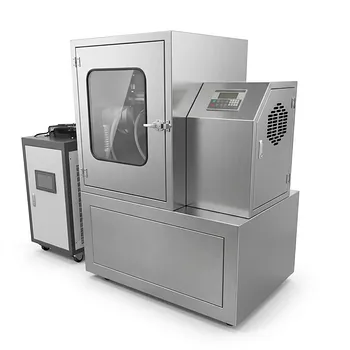
Vibratory Superfine Grinder for Ultra Fine Laboratory Powder Milling
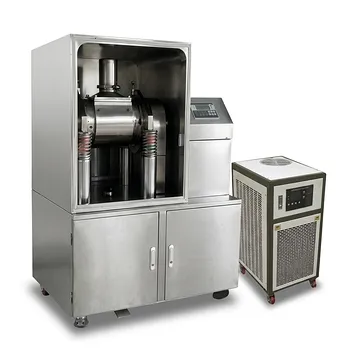
Small Vibrating Ultrafine Grinder for Traditional Chinese Medicine

Automatic Vibrating Powder Feeder for Laboratory Material Processing Precision Vibratory Hopper Feeder for Granular and Powder Material Handling Industrial Grade Vibrating Tray Feeder for Consistent Material Sample Preparation