The Invisible Architecture of Powder: Why Mixing Graphene-Coated Copper with Aluminum Demands a Planetary-Scale Solution
Sep 03, 2026
The Morning a Composite Failed Before It Began
The SEM image told the story in cold, grey shades. A 6061 aluminum matrix composite reinforced with graphene-coated copper—Gr@Cu—showed not a uniform dispersion of strength, but clustered islands. The graphene had agglomerated. The copper shells had separated. The sample, pressed and sintered with care, had already failed not under load but under the microscope.
The engineer had done everything right: precise stoichiometry, high-purity powders, a carefully controlled atmosphere. And yet, the mixing step—a simple tumbling mixer—had quietly undone months of work.
This is the quiet tragedy of advanced powder metallurgy. It looks simple. Pour. Mix. Press. But the physics of mixing nanoparticles is not a gentle suggestion; it’s a ruthless system of van der Waals forces, density differentials, and surface-energy mismatches. When you blend Gr@Cu particles with soft, ductile 6061 aluminum powder, you aren’t just stirring two ingredients. You’re fighting physics.
The real question isn’t whether you can mix them. It’s whether you can build a stable architecture at the micron scale that survives everything that comes next.
The Mixing Paradox: Why Gentle Blending Fails
Low-energy mixers—tumblers, V-blenders, even some ribbon blenders—rely on diffusion and convection. They move particles past each other. For coffee grounds, that works. For graphene-coated copper and aluminum, it’s a recipe for segregation.
Three forces conspire against you:
- Agglomeration: The graphene coating produces high-surface-area particles that cling together through van der Waals forces far stronger than gravity.
- Density mismatch: Copper is denser than aluminum. In any gentle movement, the heavier Gr@Cu sinks, leaving a gradient.
- Morphological incompatibility: Spherical aluminum particles offer minimal surface contact for hard, irregular Gr@Cu. Simple blending leaves only weak physical adsorption.
The result is a mixture that appears homogeneous to the naked eye but is structurally segregated at the scale that matters. It’s the kind of invisible failure that emerges only after sintering, when mechanical tests fall short of predictions.
The Planetary Ball Mill: Controlled Chaos as a Design Tool
There’s a moment in every serious materials lab when you stop trying to coax powders into cooperation and instead orchestrate their collisions.
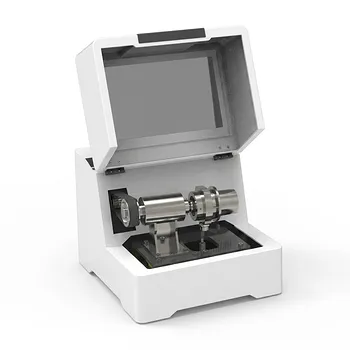
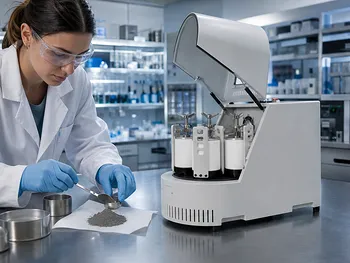
A planetary ball mill isn’t a gentle tool. It’s a high-energy environment where grinding jars rotate in opposition to a central sun disk. This dual-axis motion—revolution and rotation—creates what looks like chaos inside the jar. But it’s chaos with rules.
Two Motions, One Result
The sun disk’s revolution generates a centrifugal field that pins the grinding balls against the jar wall. At the same time, the jar’s own rotation rips the balls away, flinging them across the chamber in complex trajectories.
The outcome is a multi-directional impact field. Balls don’t just fall; they collide from unpredictable angles, creating high-frequency, high-energy impacts that stir the powder like a storm. This mechanical stirring action generates convective flow at the powder bed scale, forcing Gr@Cu particles into the aluminum matrix not by suggestion, but by kinetic violence.
Shearing Through the Agglomeration Barrier
The real enemy is the cluster. Graphene-coated particles, especially those at the nanoscale, form micro-clumps held together by van der Waals bonds. Ordinary mixing simply rolls these clusters around.
Under high-energy impact and shear, the planetary mill does something different. It fractures agglomerates, peeling layers apart with every collision. The shear forces overcome the weak inter-particle bonds, dispersing individual Gr@Cu entities into the aluminum flux. This is nano-scale pre-dispersion, happening before you ever cast or sinter.
Mechanical Embedding: From Contact to Intimacy
If the process stopped at dispersion, it might still fail. Dispersed particles can re-segregate. The planetary mill’s deeper gift is structural integration.
Plastic Deformation as Anchoring
6061 aluminum powder particles are relatively soft. Under the relentless pounding of the grinding balls, they don’t just break—they flatten. The spherical particles stretch into flakes, their surface area expanding dramatically.
This morphological transformation creates something critical: landing sites. The harder Gr@Cu particles, instead of bouncing off, are forcibly embedded into the aluminum surface. The gentle word “embedding” doesn’t capture it; it’s more like mechanical riveting. Copper-coated graphene platelets become anchored into the aluminum matrix.
Cold-Welding: Locking the Reinforcement Inside
As milling continues, the aluminum flakes fold and weld together under repeated impact—a process called cold-welding. The previously embedded Gr@Cu particles are trapped inside new composite agglomerates. This isn’t a coating on the surface. It’s an internal architecture where reinforcement phases are locked in place, immune to separation from vibration, pouring, or thermal gradients.
The planetary mill doesn’t just mix. It builds a new kind of particle, layer by layer.
Interfacial Physics: The Romance of Mechanical Alloying
There’s a certain poetry to what happens at the interface between the graphene-coated copper and the aluminum matrix. It’s a process called mechanical alloying—solid-state atomic mixing achieved not with heat, but with kinetic energy.
Breaking Down the Unwanted Distance
Graphene is notoriously difficult to wet with molten aluminum. The contact angle is hostile. But the planetary mill applies extreme pressure and shear, forcing the materials into intimate contact. This improves physical wettability—not through chemistry, but through pure mechanical work—and reduces the number of graphene layers that can later delaminate.
The repeated deformation also introduces crystal defects into the aluminum, creating pathways for atomic diffusion. In a way, the mill is forging interfacial bonds that will later strengthen the composite during sintering.
A Summary of the Mill’s Persuasion
| Mixing Mechanism | Physical Action | Resulting Quality |
|---|---|---|
| Dual-Axis Motion | Simultaneous revolution and rotation | Multi-directional, high-frequency collisions |
| High-Energy Impact | Intense shear and compressive forces | Breaks van der Waals clusters; nano-scale dispersion |
| Plastic Deformation | Particle flattening; morphology change | Mechanical anchoring of Gr@Cu into Al matrix |
| Mechanical Alloying | Continuous fracturing and cold-welding | Stable, internal phase integration |
The Art of Not Breaking What You Build
The planetary mill’s power is also its risk. Too much energy, and you can destroy the very structure you’re trying to harness.
The Contamination Conundrum
Grinding balls and jar walls wear. Small amounts of material—iron, zirconia, tungsten carbide—migrate into the powder. In structural composites, this contamination can act as a stress concentrator. The mitigation is careful material selection: jars and balls made from hardened steel or even aluminum-compatible alloys to match the matrix. It adds cost, but it preserves quality.
Structural Damage to Graphene
Graphene’s extraordinary properties depend on its crystalline integrity. Excessive milling can amorphize the coating, reducing it to disordered carbon. The reinforcing effect vanishes.
The solution is a deliberate trade-off:
- Higher ball-to-powder ratio (e.g., 15:1) with moderate speed maximizes embedding without excessive damage.
- Longer milling at lower speeds favors cold-welding and flake development, securing phase integration even if it takes more time.
- Inert atmosphere milling minimizes oxidation that can degrade interfacial properties.
The machine doesn’t make these choices for you. It magnifies your process decisions. That’s the burden—and the leverage—of high-energy milling.
From Powder to Performance: The Bigger Picture
Even the most perfectly mixed Gr@Cu/Al powder is still just powder. The planetary ball mill is not the end of the story; it’s a critical chapter in a longer arc of sample preparation.
To create a bulk composite from your optimized powder, you need a chain of equipment that preserves the dispersion you worked so hard to achieve:
- Consistent comminution of raw materials with crushers and jet mills.
- Precise sieving using vibratory or air-jet sieve shakers to control particle size distribution before mixing.
- Defoaming mixing if you’re working with slurries or pastes.
- Controlled compaction through lab hydraulic presses, cold isostatic presses (CIP), or vacuum hot presses that consolidate without disturbing the distribution.
This is why, in our own material science facility, we view the planetary ball mill not as an isolated instrument but as part of a complete laboratory sample preparation workflow. It sits alongside jaw crushers for primary size reduction, cryogenic grinders for temperature-sensitive materials, air-jet sieves for fine particle analysis, and a full spectrum of hydraulic presses—from XRF pellet presses to warm isostatic presses—that turn engineered powders into engineered parts.
When a researcher asks us how to blend Gr@Cu with 6061 aluminum reliably, the answer isn’t just “mill it.” It’s: “Let’s design a process, from powder to dense solid, where the architecture you build at the milling stage survives every subsequent step.”
The Engineer’s Reward
There’s satisfaction in looking at a well-milled powder under the microscope. The aluminum flakes are uniform. The graphene-coated copper is not a separate phase but a captured element, held not by adhesives but by mechanical lock. It’s a quiet order in what was, moments before, random dust.
That order translates directly into real performance: higher thermal conductivity, better wear resistance, and mechanical strength that reflects the true potential of the reinforcement—not the defects of poor mixing.
The planetary ball mill doesn’t guarantee a perfect composite. But it removes the biggest obstacle: the myth that mixing is trivial. It transforms a probabilistic scattering into a deterministic structure. And when you pair that with thoughtful process control and a complete preparation ecosystem, what emerges is not just a powder.
It’s a building block.
Ready to move from blending anxiety to engineered uniformity? Contact Our Experts
Quick Links
Suggested Products
Vertical Semi Circular Planetary Ball Mill for Laboratory Precision Grinding High Energy Planetary Ball Mill for Nano Scale Grinding and Mechanical Alloying Vertical Production Planetary Ball Mill for High Throughput Powder Processing Heavy Duty Horizontal Planetary Ball Mill for Efficient Industrial Grinding and Sample Preparation 360° Rotating Omnidirectional Laboratory Planetary Ball Mill for Homogeneous Ultra-Fine Grinding and MixingFurther Reading
The 65-Micron Gate: Unlocking the True Isotopic Fingerprint of Portland Cement The Energy Budget of a Single Impact: How the Ball-to-Powder Ratio Shapes Nanocrystalline Reality The High-Energy Gamble: What SiBCN-rGO Fibers Teach Us About Perfect Homogenization The Gentle Violence of a Planetary Mill: Why the Most Critical Moment in SiC–VC Composites Happens Before Any Heat The Forge at 10,000 g: How a Planetary Ball Mill Designs Self-Lubricating Composites Atom by Atom
PowderPreparation
Last updated on May 14, 2026
Related Products

Vertical Semi Circular Planetary Ball Mill for Laboratory Precision Grinding

High Energy Planetary Ball Mill for Nano Scale Grinding and Mechanical Alloying

Vertical Production Planetary Ball Mill for High Throughput Powder Processing

Heavy Duty Horizontal Planetary Ball Mill for Efficient Industrial Grinding and Sample Preparation

360° Rotating Omnidirectional Laboratory Planetary Ball Mill for Homogeneous Ultra-Fine Grinding and Mixing

Vertical Square Planetary Ball Mill for Laboratory Sample Preparation and Nanoscale Grinding

Miniature Planetary Ball Mill with Vacuum Grinding and High Efficiency for Laboratory Sample Preparation

High Energy Laboratory Planetary Ball Mill for Nano Grinding and Material Science Sample Preparation

High Energy Omnidirectional Planetary Ball Mill 16L

High Energy Planetary Ball Mill for Nano Scale Grinding and Colloidal Mixing in Material Science Research

High Energy Laboratory Planetary Ball Mill for Nano Grinding and Colloidal Mixing of Hard and Brittle Materials

High Energy Omnidirectional Planetary Ball Mill 20L
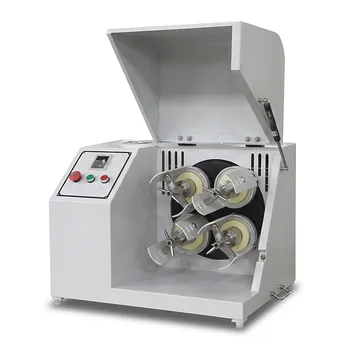
Horizontal Light Duty Planetary Ball Mill for Laboratory Sample Preparation

8L Planetary Ball Mill for Laboratory Grinding and Sample Preparation

Dual Station Planetary Ball Mill 24L
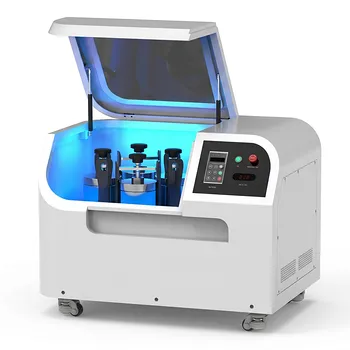
Planetary Ball Mill 12L

Nano High Energy Vibratory Ball Mill for Laboratory Sample Preparation
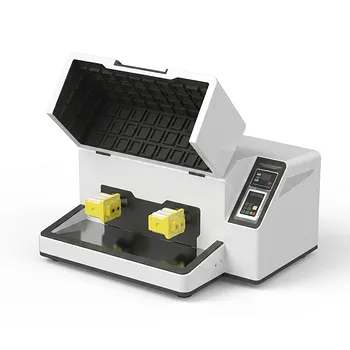
Multi-Platform Nanoscale High-Energy Vibratory Ball Mill
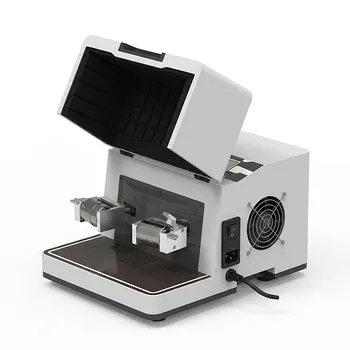
High Energy Hybrid Vibratory Ball Mill for Grinding Mixing and Cell Disruption