The Architecture of Soil Memory: How a Mechanical Sieve Shaker Reveals What Stabilization Has Changed
Aug 24, 2026
The Blind Spot in a Handful of Dirt
In a humid laboratory on the outskirts of Accra, a young geotechnical engineer named Efua stared at a pile of lateritic soil. The sample had been treated with banana leaf ash, a local stabilizer that promised to transform the brittle earth into a subgrade capable of supporting a new highway. The theory was elegant. But to prove it, she needed a number: the precise percentage of particles smaller than 0.075 millimeters before and after treatment. She shook a stack of sieves by hand for fifteen minutes, her shoulder aching, and recorded the weights. The results were inconsistent—every attempt produced a slightly different story. The soil seemed to have a memory her hands could not retrieve.
What Efua was confronting is a psychological quirk we often overlook in materials science: we trust our own effort more than we trust a machine’s consistency. We believe that feeling the resistance of the mesh conveys insight. But the stabilization of soil is not a qualitative texture; it is a physical transformation that happens at the scale of microns. To see it clearly, you must remove the human from the loop.
Your Hands Deceive You: The Case Against Manual Sieving
Manual sieving carries a hidden cognitive bias. When you shake a sieve by hand, you unconsciously adjust your rhythm based on how much material has passed. You might shake harder when you sense the sample is “almost done,” or ease up to avoid damaging delicate aggregates. This procedural drift is not sloppiness—it’s the brain’s attempt to optimize a chaotic process. But it destroys reproducibility.
A mechanical sieve shaker offers something no technician can: indifference. It does not care whether the sample is 90% complete or if the stabilizer appears to have worked. It applies a fixed frequency, a standardized amplitude, and a preset duration—typically 10 to 30 minutes—to every sieve stack. That indifference is the very thing that generates objective truth. When lime or banana leaf ash binds fine silts into coarser agglomerations, the shaker measures that shift with brutal honesty.
The Psychology of “Close Enough”
Human operators tend to conflate effort with accuracy. We assume that ten minutes of vigorous hand sieving must be equivalent to ten minutes of mechanical action. It is not. A mechanical shaker delivers high-frequency micro-impacts that keep particles in constant motion, preventing them from lodging into the apertures of a No. 200 sieve (0.075 mm). The hand simply cannot imitate that energy distribution. When Efua finally secured a vibratory sieve shaker, her coefficient of variation across five tests dropped from 17% to under 3%. The machine had exposed a pattern her own senses had masked.
The Grain Size Distribution Curve as a Language
Stabilized soils speak through their grain size distribution curve (GSDC). The curve is more than a plot; it is a fingerprint of the chemical reactions that have taken place. When a stabilizer such as lime or banana leaf ash reacts with clay minerals, it induces flocculation—the clustering of tiny platelets into sand-sized agglomerates. The GSDC shifts to the right, toward coarser fractions. That shift determines the soil’s permeability, its erodibility, and its load-bearing capacity. Without a reliable sieve analysis, you are designing a structure on a guess.
- Flocculation evidence: A reduction in the percentage passing the No. 200 sieve after stabilization indicates successful aggregation.
- Uniformity coefficient: Derived from the GSDC, this number tells you how well-graded the material is—critical for compaction behavior.
- Quality control baseline: A standard curve produced by a mechanical shaker becomes the reference that every truckload of material must match.
When the Machine Becomes an Engineer’s Microscope
Think of the sieve shaker as a time-lapse camera for soil genesis. It captures the moment when chemically treated particles stop acting as individuals and start behaving as a mass. One study on soil treated with 8% banana leaf ash showed that the fraction retained on the No. 40 sieve increased by 40% after 28 days of curing. That growth, invisible to the naked eye, becomes glaringly obvious once a mechanical sieve stack separates the sample into discrete weight fractions. The data is so clear it feels like someone turned on a light in a dark room.
The Paradox of Force: Avoiding Artificial Degradation
There is a delicate balance here. The same high-frequency energy that drives fines through a mesh can also shatter the agglomerates you are trying to measure. This is the stabilization paradox: the tool you use to verify aggregation may itself destroy it. I’ve seen engineers run a shaker for 45 minutes, only to watch their carefully nurtured flocs disintegrate into their original clay-sized particles. The GSDC then suggests the stabilizer failed—when in fact, the test protocol over-abraded the sample.
To navigate this paradox, you must tune the machine’s parameters to the material’s sensitivity:
| Shaking duration | Effect on stabilized soil | Recommended for |
|---|---|---|
| 5–10 minutes | Minimal aggregate breakdown; ideal for detecting fragile flocs. | High-clay soils with lime or BLA treatment. |
| 10–20 minutes | Balanced separation; standard for most specifications. | Routine quality control of subgrades. |
| >20 minutes | Risk of degradation; may underestimate flocculation benefit. | Only for very hard, granular materials. |
Moisture sensitivity compounds the problem. A sample that has not been properly dried will clump not because of stabilization chemistry but because of capillary adhesion. A mechanical shaker cannot distinguish between a true agglomerate and a blob of damp silt. The result is an overestimation of coarse fractions and a dangerously optimistic view of the soil’s engineering properties. Preparation matters.
The Ecosystem Behind a Single Sieve Stack
What Efua learned—and what I want to emphasize—is that a sieve shaker never works alone. To get soil ready for that graduated stack, you must first dry it without altering its chemistry, crush any naturally cemented lumps, and split the sample down to a representative mass. That requires a sample preparation ecosystem: drying ovens, jaw crushers or disc mills for breaking down hard aggregates, rotary sample splitters, and often a mortar grinder for homogenization.
In a high-throughput laboratory, the chain looks like this:
- Primary crushing: Jaw crushers reduce field chunks to manageable particles without generating excessive fines.
- Secondary grinding: A planetary ball mill or ring mill can further homogenize if elemental analysis (e.g., XRF) is required alongside particle sizing.
- Splitting and sampling: Riffle splitters ensure the sub-sample that enters the sieve shaker truly represents the bulk.
- Mechanical sieving: A vibratory sieve shaker with a calibrated stack of test sieves delivers the final grain size distribution.
If any link in this chain is weak, the GSDC you obtain is an artifact of your process, not a property of the soil. This is why laboratories that invest in a full suite of sample preparation instruments—from crushers and mills to mixers and hydraulic presses—produce data that civil engineers can stake their careers on.
Engineer’s Romance: The Beauty of a Repeatable Grain
There is something profound in the uniformity of a mechanical sieve. I have watched a lab technician remove twelve identical sieve fractions from a shaker after a ten-minute run, weigh them, and hand me a curve that describes the exact moment a pozzolanic reaction changed the face of a landscape. The hum of a shaker is not noise; it is the sound of thousands of micron-sized decisions being made without bias. It is the transfer of messy, living soil into a language that can build roads, bridges, and dams.
This is where I see what I can only call an engineer’s romance: the belief that a material can be understood so deeply that it becomes predictable. And the mechanical sieve shaker is one of the purest instruments of that belief. It does not amplify—it reveals. It does not embellish—it quantifies. In a world of subjective judgment and shifting site conditions, it gives you a number you can trust.
Making the Shift from Subjective to Systematic
If you’re still hand-sieving stabilized soils, you are leaving vital information on the table. The flocculation you worked to create may be invisible to your method. Worse, your quality control reports may show consistency where there is none, or variability that is just human artifact.
When you move to a mechanical sieve shaker, you are not just buying a piece of equipment. You are adopting a systematic mindset. You match the sample preparation workflow to the sensitivity of the test, you calibrate your sieves for mesh wear, and you log every shaking duration and amplitude. Over time, you accumulate a dataset that reveals seasonal trends, additive performance, and the long-term durability of your stabilization strategy.
A Checklist for Better Gradation Data
- Dry your sample thoroughly below 60°C to avoid altering clay mineral composition.
- Inspect sieve mesh under a microscope for elongation or clogging before each series.
- Set a standard shaking time (e.g., 10 minutes) and stick to it unless the material demands otherwise.
- Run a duplicate once per batch to catch random errors before they reach the design engineer.
- Link your sieving results to a broader material characterization — mixing, pelletizing, and compaction tests complete the story.
The Missing Piece: A Complete Sample Preparation Vision
At KINTEK, we have built our philosophy around a simple truth: instruments must match the rigor of the questions you ask. A sieve shaker yields its best data when the sample entering it has been prepared with the same care you give to the stabilization process itself. That is why we see the laboratory not as a collection of standalone machines, but as an integrated flow from raw earth to compacted pellet.
Our sieve shakers—both vibratory and air-jet—operate with the reliability and standardized force required to detect the subtle shifts stabilization produces. But they are just one node in a network that includes jaw crushers, liquid nitrogen cryogenic grinders for temperature-sensitive samples, planetary ball mills for ultrafine grinding, and hydraulic presses for creating XRF pellets or performing compaction studies. When a highway authority needs to verify that a lime-stabilized subgrade will survive a decade of monsoonal rain, the answer often begins in a jaw crusher, passes through a sieve shaker, and ends in a vacuum hot press that simulates deep-layer pressure.
To get that answer right, you need every stage to be defensible. The soil forgot its history when it was excavated. The instruments you choose must help it remember only what matters.
Quick Links
Suggested Products
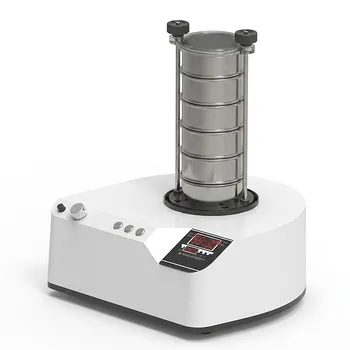
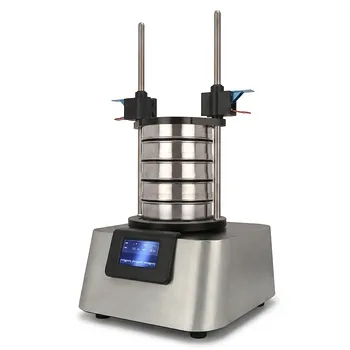
三维电磁微量振动筛分仪 Vibratory Sieve Shaker Electromagnetic 3D Motion Powder Particle Size Analyzer for Dry and Wet Sieving Laboratory Dry and Wet Three Dimensional Vibratory Sieve Shaker for Particle Analysis Small Laboratory Vibrating Sieve Shaker for Precise Particle Size Analysis Stainless Steel Laboratory Vibratory Test Sieve ShakerFurther Reading
The Quiet Gravity of a Perfect Mix: How Sieves and 3D Tumblers Engineer Certainty in Drug Formulation The Sieve and the Mind: Why Your Soil Test Results Depend on Replacing Human Fatigue with Engineered Consistency The 0.15 mm Question: Why Sieve Grading Is the Quiet Foundation of Reliable Lightweight Mortar The Hidden Geometry of Strength: Why 20 MPa Really Begins With a Sieve The Particle Whisperer: How a Vibratory Sieve Shaker Decodes Pine Bark into a Predictable Engineering Material
PowderPreparation
Last updated on May 14, 2026
Related Products
三维电磁微量振动筛分仪
Vibratory Sieve Shaker Electromagnetic 3D Motion Powder Particle Size Analyzer for Dry and Wet Sieving
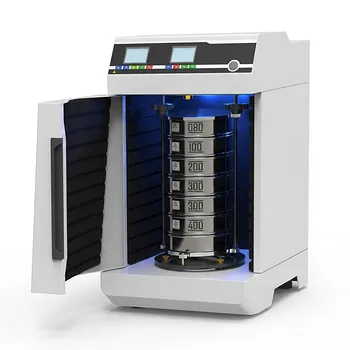
Laboratory Dry and Wet Three Dimensional Vibratory Sieve Shaker for Particle Analysis
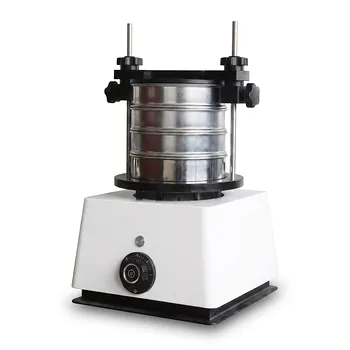
Small Laboratory Vibrating Sieve Shaker for Precise Particle Size Analysis
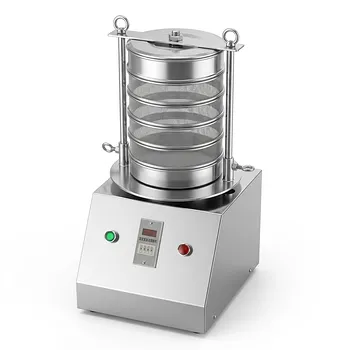
Stainless Steel Laboratory Vibratory Test Sieve Shaker

Heavy Duty Dry Three Dimensional Vibratory Sieve Shaker for Particle Separation

Dry Three Dimensional Vibratory Sieve Shaker
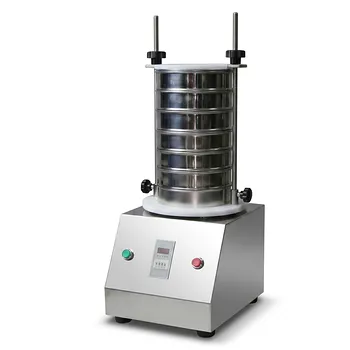
Small Laboratory Vibratory Sieve Shaker for Powder Gradation and Particle Size Analysis

Laboratory Vibratory Test Sieve Shaker for Precision Particle Size Analysis and Powder Grading
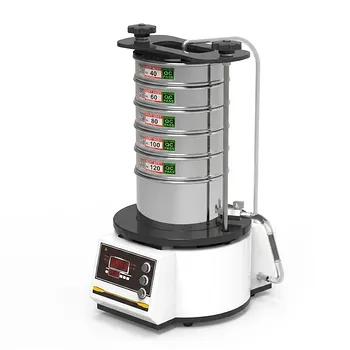
High Frequency Wet Three-Dimensional Vibrating Sieve Shaker for Dry and Wet Particle Size Analysis
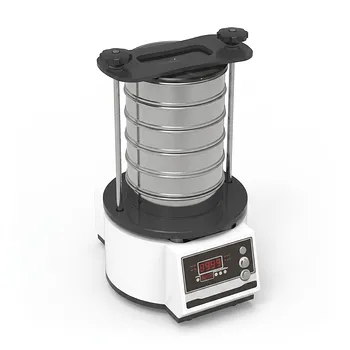
Tapping Oscillating Sieve Shaker for Dry and Wet Particle Size Analysis
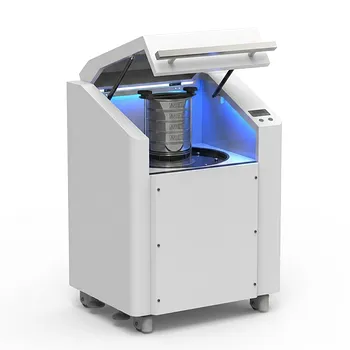
High Frequency Cabinet Type Three-Dimensional Rotary Vibrating Sieve Shaker for Dry Sieving and Particle Classification

Stainless Steel Rotary Vibrating Sieve High Precision Circular Vibratory Separator Industrial Powder Grading Machine Multi Layer Sifting Equipment
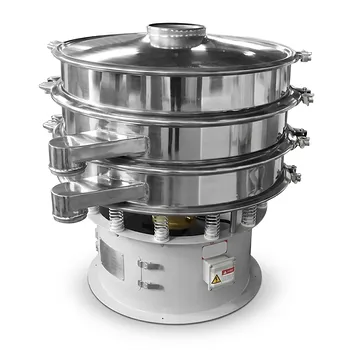
Three Dimensional Rotary Vibrating Sieve