Why must precision molds be used to shape (Ni0.5Zn0.5Fe2O4/CI/CB) powder? Achieve Accurate Microwave Absorption Data
Updated 4 months ago
Precision molds are mandatory because the electromagnetic performance of (Ni0.5Zn0.5Fe2O4/CI/CB) composites is inextricably linked to their physical dimensions. Specifically, these molds ensure the strictly defined geometry and thickness gradients required to calculate Reflection Loss (RL) with high accuracy. Without this precision, experimental data cannot reliably conform to the quarter-wavelength cancellation model, rendering microwave absorption evaluations invalid.
Precision molds transform a raw composite mixture into a high-fidelity test specimen by eliminating geometric variables. This standardization ensures that measured performance reflects the material's intrinsic electromagnetic properties rather than physical defects or dimensional inconsistencies.
The Critical Role of Dimensional Accuracy in Electromagnetic Testing
Validating the Quarter-Wavelength Cancellation Model
The quarter-wavelength cancellation model is the mathematical foundation for determining how a material absorbs microwaves. It requires the thickness of the sample to be precisely controlled to specific intervals, such as 2 mm, 4 mm, or 6 mm.
If the thickness deviates even slightly, the phase relationship between the incident and reflected waves changes. This leads to inaccurate readings that fail to align with theoretical performance models.
Eliminating Calculation Errors in Reflection Loss (RL)
In microwave absorption testing, thickness is a critical variable used in the equations to derive Reflection Loss. Precision molds provide the strictly defined geometric dimensions, such as a 50x50 mm surface area, necessary for standard test fixtures.
By using high-precision steel molds, researchers eliminate "physical dimension noise." This ensures that any change in absorption performance is due to the chemical composition of the composite rather than a variation in the sample's shape.
Enhancing Material Density and Structural Integrity
Minimizing Internal Voids and Porosity
The mixture of ferrite, Carbonyl Iron (CI), and Carbon Black (CB) with paraffin must be highly dense to yield accurate data. Precision molds, often used in conjunction with a precision hot press, apply directional pressure that forces the paraffin matrix to flow around the fillers.
This compression reduces internal voids and porosity within the composite. A dense, void-free sample is essential for consistent microwave interaction and reliable mechanical testing.
Facilitating Uniform Pressure Distribution
Precision molds are designed to transmit pressure uniformly throughout the "green body" or unsintered sample. This uniform distribution prevents anisotropic shrinkage, where the material contracts unevenly during cooling or further heat treatment.
Uniformity ensures that the fillers (CI and CB) are distributed evenly within the paraffin. This microscopic consistency is vital for achieving reproducible results across different batches.
Understanding the Trade-offs and Technical Challenges
Surface Friction and Demolding Risks
High-precision molds have extremely tight tolerances, which can lead to significant frictional resistance between the powder and the mold walls. This friction can cause surface micro-cracks during the demolding process, which compromises the sample's integrity.
To mitigate this, lubricants like paraffin or specialized coatings must be applied to the inner walls. This protects the surface finish and ensures that the pressure is transmitted to the material rather than lost to friction.
Material Sticking and Cleaning Requirements
The inclusion of paraffin in the mixture makes the composite prone to sticking to the mold surfaces, especially under heat. This requires rigorous cleaning protocols and highly polished mold surfaces to prevent cross-contamination between different nano-component ratios.
Strategic Implementation for Material Research
Making the Right Choice for Your Goal
- If your primary focus is microwave absorption accuracy: You must prioritize molds that offer sub-millimeter thickness control to satisfy the requirements of the quarter-wavelength cancellation model.
- If your primary focus is mechanical characterization (DMA): You must ensure the mold provides highly consistent geometric lengths and widths to avoid errors in storage and loss modulus calculations.
- If your primary focus is filler optimization: You must use precision sieving and ball milling prior to molding to ensure the powder is uniform enough to fill the precision mold without forming lumps.
The use of precision molds is the only way to ensure that the physical form of a composite specimen is a constant, allowing the underlying material science to be the only variable in your data.
Summary Table:
| Key Requirement | Impact on Research Accuracy |
|---|---|
| Dimensional Accuracy | Ensures valid Reflection Loss (RL) via quarter-wavelength cancellation model. |
| Thickness Control | Provides strictly defined 2mm/4mm/6mm intervals for theoretical alignment. |
| Density Optimization | Minimizes internal voids and porosity using uniform directional pressure. |
| Structural Integrity | Prevents anisotropic shrinkage and ensures even distribution of CI/CB fillers. |
| Surface Quality | High-polish finishes reduce demolding cracks and maintain sample fidelity. |
Elevate Your Material Research with Precision Compaction
To achieve reproducible results in microwave absorption and material science, the quality of your sample preparation is non-negotiable. At [Your Brand Name], we provide complete laboratory sample preparation solutions, specializing in advanced powder processing and high-precision compaction equipment.
Our extensive product line is designed to help researchers eliminate geometric variables and achieve maximum material density. Our offerings include:
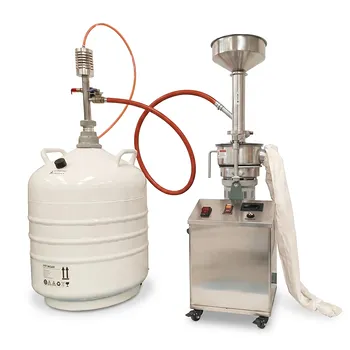
- Milling & Grinding: Planetary ball mills, jet mills, and liquid nitrogen cryogenic grinders for uniform powder size.
- Sieving & Mixing: Vibratory sieve shakers and high-efficiency powder/defoaming mixers.
- Advanced Compaction: A full spectrum of hydraulic presses, including Cold/Warm Isostatic Presses (CIP/WIP), vacuum hot presses, and standard lab presses for precise specimen shaping.
Eliminate dimensional noise and ensure your data reflects the true properties of your composites.
Contact our technical experts today to find the perfect equipment solution for your laboratory’s needs!
References
- anas houbi, Beibit Karibayev. Synthesis and Microwave Absorption Properties of (Ni0.5Zn0.5Fe2O4/CI/CB) Ternary Composites. DOI: 10.31489/2022ch4/4-22-9
Mentioned Products
- Laboratory Liquid Nitrogen Cryogenic Grinder Polymer Sample Preparation Pulverizer
- Universal Laboratory Pulverizer Grinder for Small Batch Powder Processing and Material Science Research
- Inclined Mixer for Homogeneous Powder Blending and Grinding
People Also Ask
- What is the role of a liquid nitrogen cryogenic grinder in biomass pretreatment? Optimize Your Activated Carbon Quality
- What role does liquid nitrogen cryogenic grinding play in the modification of CNTs? Optimize Nanomaterial Processing
- Why is a liquid nitrogen cryogenic grinder required before DSC? Ensure Accurate Thermal Analysis & Sample Integrity.
- Why is a liquid nitrogen cryogenic grinder necessary for plastic pre-processing? Achieve Precise Co-Pyrolysis Results
- What is the role of a liquid nitrogen cryogenic grinder in drug-polymer mixing? Achieve Superior Sample Homogeneity

Tech Team · PowderPreparation
Last updated on Jun 03, 2026