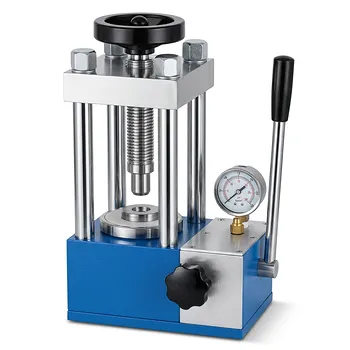
Why is it necessary to use a laboratory hydraulic press to compact Al-Ni composite powders before DTA? Ensure Data Precision
Updated 4 months ago
Compacting Al-Ni composite powders with a laboratory hydraulic press is essential for ensuring thermal data accuracy and repeatability. This process transforms loose particles into a dense, standardized cylindrical sample, typically at a specific relative density such as 85%. By doing so, you eliminate the unpredictable variables of particle shape and air-filled voids that would otherwise distort heat conduction during Differential Thermal Analysis (DTA).
Core Takeaway: Compaction standardizes the physical environment of the powder, ensuring that the exothermic reaction data captured during DTA reflects the material's intrinsic properties rather than the random arrangement of loose particles.
Eliminating Thermal Interferences
Minimizing Heat Conduction Barriers
Loose powders contain significant "packing voids" filled with air, which acts as an insulator. Compaction expels this trapped air, creating a continuous path for heat to flow through the sample. Without this, the DTA sensors would record staggered or delayed thermal signals that do not reflect the actual reaction kinetics of the Al-Ni composite.
Standardizing Particle Geometry
Individual powder particles vary in size and shape, which creates inconsistent contact points in a loose state. A hydraulic press uses high axial pressure to force these particles to rearrange and undergo plastic deformation. This results in a uniform sample where particle geometry no longer dictates the rate of heat transfer.
Ensuring Data Accuracy and Representativeness
Simulating Bulk Reaction Environments
Al-Ni composites are often used in structural or reactive applications where they exist in a dense, solid form. Testing loose powder provides data that is irrelevant to these real-world conditions. Precise pressure molding creates a sample that mimics the bulk reaction environment, providing more stable and representative exothermic data.
Optimizing Physical Contact for Exothermic Reactions
The reaction between Aluminum and Nickel is highly dependent on the "intimate contact" between the two species. Compaction ensures that the particles are mechanically interlocked and tightly pressed together. This physical proximity is vital for the diffusion mechanisms that trigger the exothermic response during heating.
Achieving Structural and Compositional Consistency
Maintaining Uniform Density
A hydraulic press allows for the creation of samples with a consistent green density. Using specific pressures, such as 30 MPa to 200 MPa, ensures that every sample tested in the DTA has the same internal structure. This uniformity is the only way to compare different powder batches or compositions reliably.
Preventing Component Segregation
In loose form, different ingredients like Al and Ni may settle or shift due to differing densities and sizes. The high-pressure compaction process pre-binds different components together. This ensures that the composition ratio remains consistent throughout the entire sample during the thermal test.
Understanding the Trade-offs
The Risk of Internal Stress
While high pressure is necessary for density, excessive force can introduce internal stress concentrations or micro-cracks within the sample. These defects can lead to structural failure during the heating phase of the DTA, potentially causing "noisy" data or sample disintegration.
Pressure-Induced Phase Changes
Applying extreme pressure can sometimes trigger localized deformation or heat that may slightly alter the surface chemistry of the powders. It is critical to find the optimum pressure-holding duration to achieve density without unintentionally initiating the Al-Ni reaction before the DTA test begins.
Making the Right Choice for Your Research
To achieve the best results with your Al-Ni composite samples, tailor your pressing parameters to your specific research goals:
- If your primary focus is analytical precision: Use a high-precision mold and a hydraulic press with a digital pressure gauge to ensure every sample reaches the exact same relative density.
- If your primary focus is simulating end-use performance: Select a compaction pressure that matches the density the material will experience in its final industrial application.
- If your primary focus is studying sintering behavior: Monitor the "green density" of the compact carefully, as this will directly influence the shrinkage and densification rates observed during thermal analysis.
By precisely controlling the compaction of Al-Ni powders, you move from measuring the characteristics of a random pile of dust to measuring the fundamental thermal properties of a sophisticated composite material.
Summary Table:
| Key Benefit | Impact on DTA Analysis | Scientific Importance |
|---|---|---|
| Eliminates Air Voids | Improves heat conduction paths | Prevents staggered or delayed thermal signals |
| Standardizes Geometry | Ensures uniform contact points | Removes variables related to particle shape |
| Mechanical Interlocking | Facilitates diffusion mechanisms | Triggers stable & representative exothermic reactions |
| Uniform Density | Creates consistent green density | Allows for reliable comparison between batches |
Elevate Your Material Analysis Precision
High-quality Differential Thermal Analysis (DTA) starts with impeccable sample preparation. We provide complete laboratory sample preparation solutions for material science, specializing in high-precision powder processing and compaction equipment.
Whether you need standard lab presses, XRF pellet presses, or advanced Cold/Warm Isostatic Presses (CIP/WIP), our hydraulic press spectrum is engineered to deliver the consistent green density required for accurate research. Beyond pressing, our extensive line includes planetary ball mills, cryogenic grinders, vacuum hot presses, and sieve shakers to support your entire workflow.
Don't let inconsistent sample preparation compromise your research data. Contact us today to find the perfect compaction solution for your laboratory and ensure your thermal analysis reflects the true intrinsic properties of your materials.
References
- Minseok Oh, Byungmin Ahn. Exothermic Reaction Kinetics in High Energy Density Al-Ni with Nanoscale Multilayers Synthesized by Cryomilling. DOI: 10.3390/met8020121
Mentioned Products
- Enhanced 9 Punch Rotary Tablet Press for Powder Compaction
- 6-Ton Small Single-Punch Tablet Press — Laboratory Powder & Granule Tableting Equipment / Tablet Forming Machine
- 6 Ton Variable Frequency Single Punch Tablet Press
- Manual Tablet Press with Dual Scale Pressure Gauge for Pharmaceutical Food Chemical Laboratory Sample Preparation
People Also Ask
- What is the purpose of adding lubricants like zinc stearate during Al-Al2O3 powder pressing? Achieve Superior Density
- Why is a laboratory hydraulic press required for FT-IR KBr pellets? Achieve Precise Sample Clarity for ZrC–SiC Analysis
- What role does a high-strength stainless steel mold kit play in the uniaxial die compaction process? Ensuring Precision
- Why is a laboratory hydraulic press required to compress oyster shell powder before XRF analysis? Improve Data Accuracy.
- Why is vacuum sealing and flexible packaging necessary for Aluminum Titanate powders during CIP? Ensure Peak Density

Tech Team · PowderPreparation
Last updated on May 14, 2026
Related Products
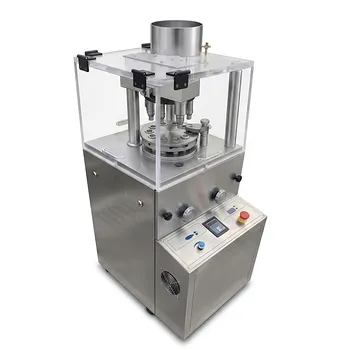
Enhanced 9 Punch Rotary Tablet Press for Powder Compaction
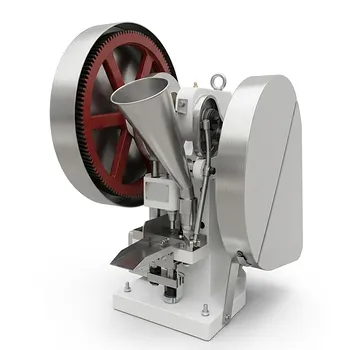
6-Ton Small Single-Punch Tablet Press — Laboratory Powder & Granule Tableting Equipment / Tablet Forming Machine
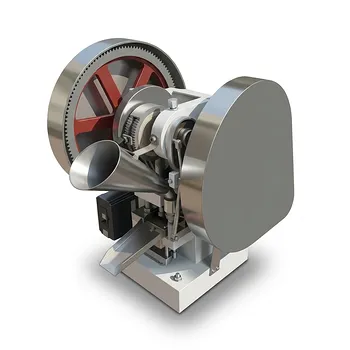
6 Ton Variable Frequency Single Punch Tablet Press