Why is it necessary to use a 63 μm standard test sieve when preparing ceramic materials for adsorption studies? Expert Guide
Updated 5 months ago
The use of a 63 μm standard test sieve is a critical step in standardizing the physical state of ceramic powders. By filtering materials through this specific mesh, researchers ensure a uniform particle size distribution that maximizes the specific surface area available for chemical interaction. This consistency is vital for obtaining repeatable adsorption kinetics data, ensuring that the results accurately reflect the material's chemical potential rather than physical inconsistencies.
Using a 63 μm sieve transforms bulk ceramic waste into a high-surface-area powder, eliminating the "dilution effect" caused by inert coarse particles. This standardization is the foundation for reliable adsorption studies, improved mechanical integrity, and enhanced chemical reactivity during material processing.
Maximizing Adsorption Efficiency and Data Reliability
The Role of Specific Surface Area
Adsorption is fundamentally a surface-controlled phenomenon where molecules adhere to the exterior of a solid material. A 63 μm sieve produces a fine-grained fraction that significantly increases the specific surface area per unit of mass. This increase in area provides more active sites for pollutants, such as methyl orange, to bind to the ceramic surface.
Ensuring Repeatability in Kinetic Studies
In adsorption experiments, data must be highly representative and repeatable to be scientifically valid. Using a standardized particle size ensures that every test sample behaves identically under experimental conditions. This allows for an accurate assessment of the material’s adsorption potential without the interference of varying grain sizes.
Eliminating the Dilution Effect
Coarse sand and gravel particles often lack the porous structure or mineralogical characteristics required for effective adsorption. By excluding particles larger than 63 μm, researchers remove this dilution effect, focusing the study on the most chemically active and bioavailable portion of the sediment or ceramic.
Structural and Chemical Advantages of Fine Particles
Enhancing Chemical Reactivity and Sintering
Powders that pass through a 63 μm mesh possess a high degree of fineness, which significantly enhances chemical reactivity during the sintering process. This fine particle size facilitates faster diffusion and more efficient heat transfer. In processes like Spark Plasma Sintering (SPS), this leads to a more consistent densification rate and higher-quality composite materials.
Eliminating Structural Defects
Large impurity particles can act as "weak points" or stress concentrators within a ceramic or cementitious system. Using a high-precision sieve allows for the removal of coarse agglomerates and unground impurities. This ensures a more homogeneous mixture, which improves the mechanical strength, airtightness, and durability of the final ceramic joint or refractory material.
Improving Packing Density
A controlled particle size distribution improves the filling performance and packing density during the pressing phase. When particles are uniform and fine, they settle more efficiently into the mold. This results in a higher green body density, which is essential for achieving a defect-free microstructure after firing.
Understanding the Trade-offs and Limitations
The Risk of Particle Agglomeration
Extremely fine powders have a high surface energy, which can lead to coarse agglomerates forming after the sieving process. These clusters can behave like large particles, effectively hiding their internal surface area and skewing adsorption results. It is often necessary to use ultrasonic dispersion to ensure the particles remain individual units during testing.
Material Loss and Processing Time
Sieving to a 63 μm threshold is a labor-intensive process that can result in significant material loss if the initial grinding was inefficient. Researchers must balance the need for high-precision fineness with the time and energy costs of milling bulk materials down to the micron level.
Limitations of Instrumental Verification
While laser particle size analyzers are common, they can sometimes overlook a small number of oversized particles. Standard sieve tests are required to quantify these residues that might act as structural flaws. Relying solely on automated instruments without physical sieving can lead to an incomplete understanding of the material's true granulometry.
How to Apply This to Your Project
Recommendations Based on Research Goals
- If your primary focus is Adsorption Kinetics: Strictly utilize the 63 μm fraction to ensure your data reflects true surface chemistry rather than physical grain size variation across different samples.
- If your primary focus is Mechanical Strength: Use the sieve to remove all particles above 63 μm that could serve as structural weak points or trigger cracks in the final ceramic body.
- If your primary focus is Environmental Assessment: Prioritize the fine fraction (< 63 μm) for testing, as this is where heavy metals and organic pollutants are most likely to be enriched.
- If your primary focus is Sintering Efficiency: Use the 63 μm sieve to ensure heat transfer consistency and to prevent coarse particles from slowing down the densification process.
Standardizing your ceramic powder through a 63 μm sieve is the most effective way to ensure that your experimental results are a true reflection of the material's chemical and structural properties.
Summary Table:
| Key Factor | Impact of 63 μm Sieving | Research Benefit |
|---|---|---|
| Surface Area | Increases specific surface area | More active binding sites for adsorption |
| Data Quality | Ensures uniform particle size | Repeatable and representative results |
| Purity | Removes inert coarse particles | Eliminates the 'dilution effect' |
| Reactivity | Enhances particle fineness | Faster diffusion and sintering efficiency |
| Structure | Removes oversized agglomerates | Higher mechanical strength and density |
Elevate Your Material Research with Precision Sample Preparation
Achieving accurate and repeatable adsorption data starts with the right particle size. At [Company Name], we provide complete laboratory sample preparation solutions for material science, specializing in high-performance powder processing and compaction equipment.
Our extensive product line is designed to help you achieve the perfect 63 μm fraction and beyond:
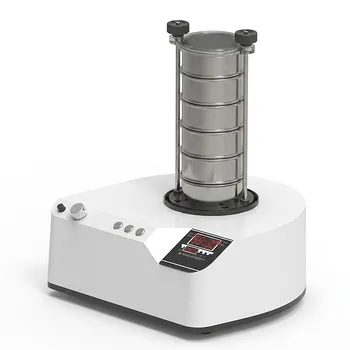
- Sieving Excellence: Vibratory and air-jet sieve shakers with high-precision test sieves and meshes for reliable particle sizing.
- Advanced Milling: Planetary ball mills, jet mills, and liquid nitrogen cryogenic grinders for efficient material reduction.
- Homogeneous Mixing: Specialized powder and defoaming mixers to ensure sample consistency.
- Precision Compaction: A full spectrum of hydraulic presses, including Cold/Warm Isostatic Presses (CIP/WIP), XRF pellet presses, and vacuum hot presses for superior green body density.
Maximize your lab's efficiency and ensure the integrity of your research results. Contact our experts today to find the perfect equipment solution!
References
- OLALEYE TIMILEHIN F., Jemkur Maurice. ASSESSMENT OF THE EFFICIENCY OF CRUSHED CERAMICS IN ADSORBING METHYL ORANGE DYE FROM WASTEWATER. DOI: 10.22159/ijcr.2023v7i4.225
Mentioned Products
- Laboratory Vibratory Test Sieve Shaker for Precision Particle Size Analysis and Powder Grading
- Small Laboratory Vibrating Sieve Shaker for Precise Particle Size Analysis
- 三维电磁微量振动筛分仪
People Also Ask
- What role does a laboratory sieve shaker play in determining PDI? Achieve Precision in Biomass Quality Testing
- What are the functions of sieve shakers for coconut shell powder? Achieve Precise Particle Size & Quality Control.
- What function does a laboratory sieve shaker perform in the PSD analysis of residual soil? Ensure Precise Grading
- What is the role of a laboratory sieve shaker in the preparation of plantain peel adsorbents? Standardize Particle Size
- What is the function of a laboratory vibratory sieve shaker? Enhance Coal Particle Size Distribution (PSD) Analysis

Tech Team · PowderPreparation
Last updated on May 14, 2026