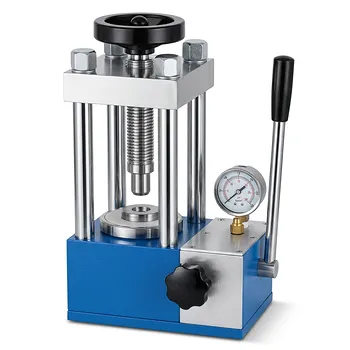
Why is an XRF pellet press required for filter cake sample preparation? Ensure maximum XRF quantitative accuracy.
Updated 5 months ago
Precision analysis begins with sample preparation. An XRF pellet press is required for secondary sample preparation because filter cakes, in their raw state, possess irregular surfaces and internal voids that distort X-ray measurements. By compressing crushed filter cakes and binders under high pressure (typically 25 tons), the press creates a dense, standardized pellet with a perfectly flat surface. This process is essential to eliminate grain size effects and minimize matrix interference, ensuring the quantitative accuracy required for Wavelength Dispersive X-ray Fluorescence (WDXRF) and Energy Dispersive X-ray Fluorescence (ED-XRF) analysis.
Core Takeaway: The pellet press transforms heterogeneous filter cakes into standardized, high-density discs to eliminate physical variables—such as particle size and air gaps—that would otherwise degrade the precision of elemental quantification.
Overcoming Physical Interference in X-ray Paths
Eliminating the Grain Size Effect
Raw filter cakes consist of particles with varying shapes and sizes that scatter X-rays inconsistently. This variability, known as the grain size effect, causes fluctuations in signal intensity that do not reflect the actual elemental concentration.
A pellet press applies extreme force to crush these particles into a uniform matrix. This ensures that the X-ray beam interacts with a consistent physical structure, leading to stable and repeatable excitation.
Minimizing Voids and Air Gaps
Loose powder or poorly compacted filter cakes contain microscopic air pockets (voids) between particles. These voids attenuate low-energy fluorescence lines, leading to an underestimation of light elements.
High-pressure densification removes these internal pores. By creating a continuous solid phase, the press allows for a more accurate assessment of oxide concentrations and major elements.
The Role of Standardization in Quantitative Results
Creating a Reproducible Detection Surface
For quantitative analysis to be valid, the geometry of every sample must be identical. A pellet press ensures that the surface presented to the X-ray beam is perfectly flat and smooth.
Any surface irregularity or "shadowing" caused by a rough texture can interfere with the path of the X-ray. A standardized pellet ensures that the distance between the source, the sample surface, and the detector remains constant.
Ensuring Mechanical Stability
Filter cakes are often brittle or crumbly after the initial drying process. Mixing the sample with a binder, such as wax powder, and using a hydraulic press creates a disc with sufficient mechanical strength.
This stability prevents the sample from disintegrating inside the XRF instrument. It also ensures the sample can be handled and archived without losing its structural integrity.
Understanding the Trade-offs and Limitations
The Impact of Binder Dilution
Adding a binder is necessary for structural integrity, but it introduces a dilution factor into the analysis. Expert technicians must precisely calculate the binder-to-sample ratio to maintain the integrity of the quantitative data.
Furthermore, the binder itself must be ultra-pure. Any contaminants in the wax powder will appear as false positives in the final spectral analysis.
Risks of Improper Pressure Application
Applying insufficient pressure (below 20-25 tons) may result in a pellet that is not dense enough, leading to "sample creep" or cracking during analysis. Conversely, excessive pressure can cause certain mineral structures to deform or the pellet to shatter upon release from the die.
Optimizing Your Sample Preparation Strategy
Selecting the right preparation method depends on your specific analytical requirements and the nature of the filter cake material.
- If your primary focus is Maximum Quantitative Accuracy: Utilize a high-pressure press (25+ tons) with a high-quality binder to ensure a perfectly homogeneous surface for WDXRF analysis.
- If your primary focus is Detecting Light Elements: Ensure the sample is ground to an extremely fine powder before pressing to minimize the attenuation caused by even the smallest remaining voids.
- If your primary focus is High-Throughput Screening: Implement a standardized pressing protocol with automated dies to ensure consistency across hundreds of samples without manual variability.
The transformation of a filter cake into a high-density pellet is the single most critical step in ensuring your XRF data is both reliable and scientifically defensible.
Summary Table:
| Key Feature | Impact on XRF Analysis |
|---|---|
| High-Pressure Compaction | Eliminates grain size effects and ensures consistent X-ray scattering. |
| Surface Standardization | Creates a perfectly flat, reproducible surface for stable excitation. |
| Void Removal | Minimizes air gaps to prevent the attenuation of light element signals. |
| Mechanical Stability | Prevents sample crumbling and ensures safe handling inside the instrument. |
| Binder Integration | Provides structural integrity for brittle materials like dried filter cakes. |
Elevate Your Material Analysis with Precision Sample Prep
Achieving defensible XRF data begins long before the sensor scans the sample. At our core, we provide complete laboratory sample preparation solutions for material science, specializing in high-performance powder processing and compaction equipment designed to eliminate variables and maximize accuracy.
Our extensive product lines are engineered for excellence, including:
- Size Reduction: Jaw/roll crushers and liquid nitrogen cryogenic grinders.
- Advanced Milling: Planetary ball, jet, sand/bead, disc, and rotor mills.
- Classification & Mixing: Vibratory/air-jet sieve shakers and high-efficiency powder/defoaming mixers.
- Compaction Excellence: A full spectrum of hydraulic presses, including XRF pellet presses, Cold/Warm Isostatic Presses (CIP/WIP), standard lab presses, and vacuum hot presses.
Whether you are a researcher or a high-throughput laboratory, we bring the expertise and equipment needed to standardize your workflow and protect your results.
Ready to optimize your sample preparation? Contact us today to find the perfect solution for your lab!
References
- Mustapha Chabane, B. Dahmani. Synthesis and Evaluation of Polyacrylamide Based Filter Pellets Incorporating GAC, Iron Oxide, Zinc Oxide, and Kaolin for Chromium and Nickel Water Remediation. DOI: 10.18280/rcma.340212
Mentioned Products
- 实验室旋转式压片机 多冲模单压式自动连续压片
- 6 Ton Variable Frequency Single Punch Tablet Press
- Ordinary Type Rotary Tablet Press for Pharmaceutical Chemical Food Electronic Industries
- Enhanced 9 Punch Rotary Tablet Press for Powder Compaction
- 6-Ton Small Single-Punch Tablet Press — Laboratory Powder & Granule Tableting Equipment / Tablet Forming Machine
People Also Ask
- What is the role of a laboratory uniaxial hydraulic press in the preparation of alumina ceramic samples? Key Benefits
- What are the advantages of double-action pressing equipment? Master Uniform Density in High-Aspect-Ratio Ceramics
- What is the function of a laboratory hydraulic forming press in CRSS rubber prep? Ensure Superior Material Integrity
- What role does a laboratory hydraulic press play in the forming of Ce-TZP/Al2O3 green bodies? Maximize Density & Strength
- How does a laboratory hydraulic press ensure the quality of high-entropy cathode H-SOFC single cells? Optimize Performance

Tech Team · PowderPreparation
Last updated on May 14, 2026
Related Products
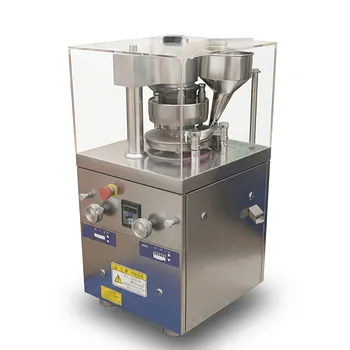
实验室旋转式压片机 多冲模单压式自动连续压片
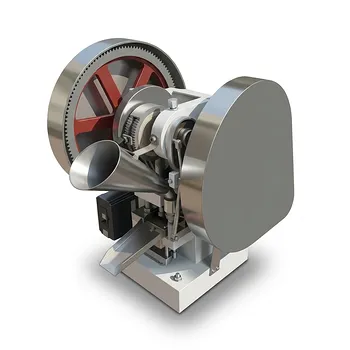
6 Ton Variable Frequency Single Punch Tablet Press
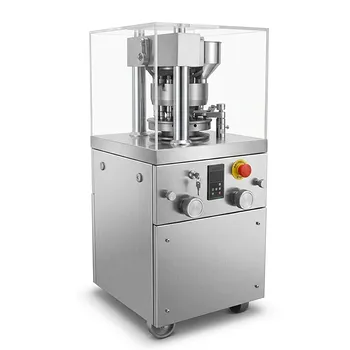
Ordinary Type Rotary Tablet Press for Pharmaceutical Chemical Food Electronic Industries
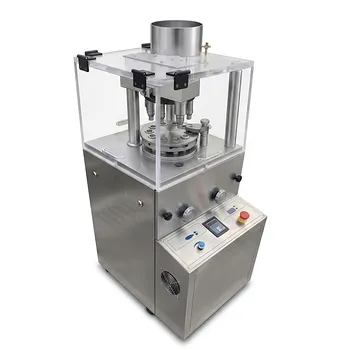
Enhanced 9 Punch Rotary Tablet Press for Powder Compaction
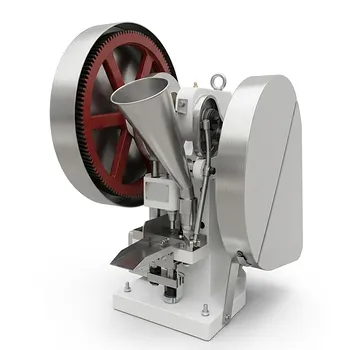
6-Ton Small Single-Punch Tablet Press — Laboratory Powder & Granule Tableting Equipment / Tablet Forming Machine