What is the role of a laboratory uniaxial hydraulic press in the preparation of alumina ceramic samples? Key Benefits
Updated 4 months ago
The laboratory uniaxial hydraulic press is the critical tool for transforming loose alumina powder into a cohesive "green body" ready for sintering. It applies controlled axial pressure—typically ranging from 30 to 150 MPa—to a powder-binder mixture within a precision mold. This mechanical force drives particle rearrangement and compaction, establishing the sample's geometric shape, initial density, and the mechanical strength required for handling and subsequent thermal processing.
The primary role of the hydraulic press is to establish the structural and densified foundation of the alumina sample. By achieving uniform particle packing and reducing internal porosity under high pressure, the press ensures the green body can withstand the stresses of sintering without cracking or excessive deformation.
Particle Rearrangement and Initial Densification
Overcoming Inter-particle Friction
The hydraulic press provides the necessary force to overcome friction between alumina particles. This allows the powder to flow and rearrange into a more efficient packing configuration within the mold.
Reducing Internal Porosity
As pressure is applied, the air gaps between particles are minimized. This reduction in internal porosity is vital for achieving a high relative density, which often needs to exceed 85% after the final sintering stage.
Facilitating Plastic Deformation
Under higher pressures, the alumina particles and binders undergo plastic deformation. This increases the contact area between particles, creating a more stable and tightly packed internal structure.
Defining Geometric Shape and Green Strength
Precision Molding for Structural Foundation
The press works in tandem with precision molds to give the alumina powder its preliminary geometric shape. Whether forming discs, prisms, or custom geometries, the press ensures the sample meets specific dimensional requirements.
Developing Sufficient Green Strength
"Green strength" refers to the mechanical integrity of the sample before it is fired. The stable pressure provided by the hydraulic press ensures that the particles bond tightly enough to be handled or machined without crumbling.
Ensuring Uniform Density
Precise control over the axial load ensures that the initial density is consistent throughout the sample. Uniformity at this stage is the most significant factor in preventing warping during high-temperature treatments.
Influence on the Sintering Process
Controlling Shrinkage and Cracking
A well-pressed green body has a predictable shrinkage rate during sintering. By ensuring a uniform distribution of particles and binders, the press prevents the uneven internal stresses that lead to macro-cracks.
Enabling Final Densification
The hydraulic press sets the stage for final densification in the furnace. Without the high-pressure compaction provided by the press, the alumina would remain too porous to achieve the hardness and durability required for technical ceramics.
Understanding the Trade-offs
Pressure Gradients and Friction
One limitation of uniaxial pressing is the non-uniform pressure distribution caused by friction between the powder and the mold walls. This can lead to density gradients, where the top of the sample is denser than the center or bottom.
The Risk of Laminar Cracks
If the pressure is released too quickly, or if the binder content is incorrect, the sample may experience "springback" or elastic recovery. This can result in horizontal cracks, known as laminations, which ruin the structural integrity of the ceramic.
Tooling Wear and Maintenance
The high pressures required for alumina—often exceeding 100 MPa—place significant mechanical stress on the molds. Over time, this wear can lead to dimensional inaccuracies and requires regular inspection of the die surfaces.
Making the Right Choice for Your Goal
To achieve the best results with your alumina ceramic samples, tailor your pressing strategy to your specific research or production requirements.
- If your primary focus is maximizing green strength: Prioritize the use of organic binders and higher pressures (above 80 MPa) to ensure the sample can withstand complex handling.
- If your primary focus is minimizing sintering deformation: Focus on achieving a uniform fill of the mold and using a slower pressure release cycle to prevent internal micro-cracking.
- If your primary focus is high-throughput sampling: Utilize industrial-grade presses with automated pressure dwelling to ensure consistency across multiple batches.
By masterfully controlling the uniaxial compression of alumina powder, you create the essential foundation for high-performance ceramic materials.
Summary Table:
| Function | Key Benefit | Critical Parameter |
|---|---|---|
| Compaction | Overcomes inter-particle friction for dense packing | 30 - 150 MPa Pressure |
| Densification | Minimizes internal porosity and air gaps | Relative density > 85% |
| Shaping | Provides precise geometric structural foundation | Mold & Die Accuracy |
| Green Strength | Enables handling and machining before firing | Binder & Plastic Deformation |
| Sintering Control | Prevents warping and ensures uniform shrinkage | Pressure Dwelling & Release |
Elevate Your Ceramic Research with Precision Compaction
Achieving the perfect green body is the foundation of high-performance technical ceramics. We provide complete laboratory sample preparation solutions for material science, specializing in high-quality powder processing and compaction equipment.
Whether you are working with alumina, zirconia, or advanced composites, our extensive product line is designed to meet the rigorous demands of your lab:
- Hydraulic Presses: Standard lab presses, XRF pellet presses, Hot Presses, and Vacuum Hot Presses.
- Isostatic Pressing: Cold (CIP) and Warm Isostatic Presses (WIP) for uniform density.
- Powder Processing: Planetary ball mills, jet mills, and cryogenic grinders for ideal particle size.
- Mixing & Sizing: Powder mixers, defoaming mixers, and vibratory sieve shakers.
Ensure uniform density, eliminate laminar cracks, and optimize your sintering results with our industry-leading tools.
Contact our experts today to find the right solution for your lab!
References
- Gabriel A. Acevedo, Paola Villegas. COMPARACIÓN DE LA BIOCOMPATIBILIDAD IN VITRO Y RESISTENCIA A LA FLEXIÓN DE - ALÚMINA NANO Y MICROMÉTRICA COMO MATERIAL POTENCIAL PARA RECONSTRUCCIÓN DE TEJIDO ÓSEO. DOI: 10.17533/udea.rcm.19390
Mentioned Products
- 实验室旋转式压片机 多冲模单压式自动连续压片
- 6-Ton Small Single-Punch Tablet Press — Laboratory Powder & Granule Tableting Equipment / Tablet Forming Machine
- 5 Ton Single Punch Tablet Press Laboratory Small Batch Production
- Manual Tablet Press with Dual Scale Pressure Gauge for Pharmaceutical Food Chemical Laboratory Sample Preparation
- 6 Ton Variable Frequency Single Punch Tablet Press
People Also Ask
- What are the advantages of double-action pressing equipment? Master Uniform Density in High-Aspect-Ratio Ceramics
- What is the function of a laboratory hydraulic forming press in CRSS rubber prep? Ensure Superior Material Integrity
- What role does a laboratory hydraulic press play in the forming of Ce-TZP/Al2O3 green bodies? Maximize Density & Strength
- How does a laboratory hydraulic press ensure the quality of high-entropy cathode H-SOFC single cells? Optimize Performance
- What is the function of an industrial uniaxial hydraulic press for red clay TiO2 substrates? Achieve Precision Density

Tech Team · PowderPreparation
Last updated on Jun 03, 2026
Related Products
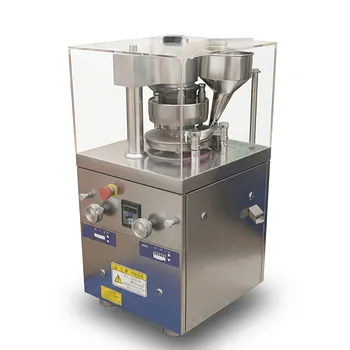
实验室旋转式压片机 多冲模单压式自动连续压片
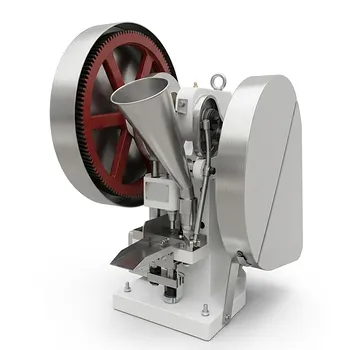
6-Ton Small Single-Punch Tablet Press — Laboratory Powder & Granule Tableting Equipment / Tablet Forming Machine
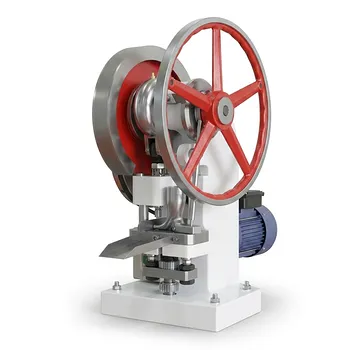
5 Ton Single Punch Tablet Press Laboratory Small Batch Production
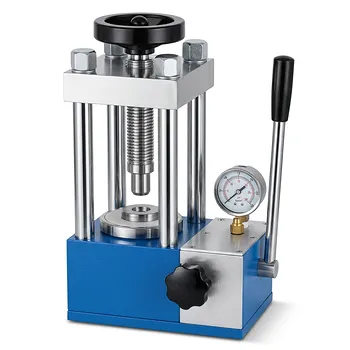
Manual Tablet Press with Dual Scale Pressure Gauge for Pharmaceutical Food Chemical Laboratory Sample Preparation