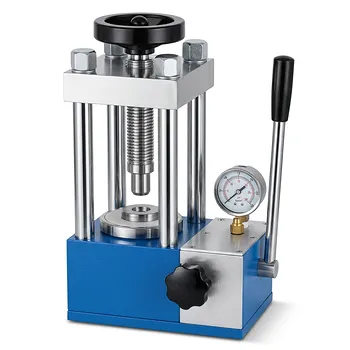
Why is an industrial-grade uniaxial hydraulic press used in SSRS? Ensure Uniform Pellets for Precise Material Analysis
Updated 5 months ago
The use of an industrial-grade uniaxial hydraulic press is essential for establishing a standardized physical baseline. It compresses mixed powders into green pellets with a consistent starting density and sufficient mechanical strength. This uniformity allows researchers to isolate the effects of the sintering process itself when comparing Solid-State Reaction Sintering (SSRS) with alternative methods like cold sintering.
The hydraulic press acts as a critical control mechanism, transforming loose powder into a uniform green body to ensure that variations in final microstructure and electrical properties are the result of the sintering method rather than inconsistent initial conditions.
Establishing an Experimental Baseline
Eliminating Loose Powder Inconsistencies
Mixed mineral powders in a loose state possess inherent inconsistencies in volume and air distribution. The hydraulic press applies a specific force, such as 50 MPa or 100 MPa, to mold these powders into cylindrical specimens with standardized dimensions.
Ensuring Uniform Green Density
By applying uniaxial pressure, the press ensures a uniform initial green density across all samples. This standardization is vital for gradient furnace experiments, as it allows researchers to accurately measure linear shrinkage and open porosity without interference from molding variations.
Optimizing Particle Contact and Densification
Enhancing Initial Particle Contact
The hydraulic press forces powder particles into immediate contact, which is necessary for the diffusion mechanisms of high-temperature sintering. This process pre-excludes air from between the particles, significantly increasing the effective contact area.
Accelerating the Sintering Rate
A higher filling density, achieved through precise hydraulic pressing, contributes to a faster densification rate during the subsequent heating stages. This preparation reduces the risk of non-uniform deformation as the material shrinks at temperatures reaching 1600 °C.
Facilitating Comparative Analysis
Benchmarking Against Cold Sintering
To validly compare Solid-State Reaction Sintering (SSRS) with the Cold Sintering Process (CSP), both must begin with samples of similar mechanical integrity. The press provides the necessary starting point to evaluate differences in microstructure and electrical properties between the two methods.
Providing Mechanical Strength for Handling
The resulting green pellets must have sufficient mechanical strength to be handled and placed into high-temperature furnaces. Without this initial compaction, the samples would be too fragile to survive the transition from the mixing stage to the final sintering environment.
Understanding the Trade-offs
Pressure Distribution Limits
In uniaxial pressing, friction between the powder and the die walls can lead to pressure gradients within the pellet. This can result in slight density variations from the top to the bottom of the sample, potentially affecting the uniformity of the final sintered body.
Risk of Entrapped Air
If pressure is applied too rapidly, air may become trapped in the center of the pellet, leading to internal cracks or lamination. Careful control of the pressing speed and the use of binders are often required to mitigate these physical defects.
How to Apply This to Your Project
Selecting the Right Pressing Parameters
When designing a comparative experiment, the choice of pressure directly influences the reliability of your data.
- If your primary focus is electrical property benchmarking: Use a consistent pressure (e.g., 50 MPa) to ensure that grain boundary contact is uniform across all comparative samples.
- If your primary focus is maximizing sintered density: Opt for higher uniaxial pressures (e.g., 100 MPa) to minimize initial porosity and accelerate the subsequent densification phase.
- If your primary focus is preventing sample deformation: Ensure the die is properly lubricated and the pressure is released slowly to avoid internal stresses in the green body.
By treating the hydraulic pressing stage as a rigorous control variable, you ensure that your experimental conclusions are based on the sintering science rather than specimen preparation errors.
Summary Table:
| Key Function | Experimental Benefit | Impact on Results |
|---|---|---|
| Standardized Compaction | Eliminates loose powder air pockets | Ensures consistent starting density and volume |
| Enhanced Particle Contact | Facilitates diffusion mechanisms | Accelerates densification and sintering rates |
| Mechanical Strengthening | Creates durable green pellets | Allows safe handling and high-temp furnace loading |
| Baseline Control | Isolates sintering variables | Enables valid comparisons with Cold Sintering (CSP) |
Elevate Your Material Research with Precision Sample Preparation
Reliable experimental results in material science start with consistent sample preparation. At [Brand Name], we provide complete laboratory solutions tailored for powder processing and compaction. Our equipment ensures your green bodies meet the most rigorous standards, allowing you to focus on the science of sintering rather than specimen preparation errors.
Our extensive product lines specialize in every stage of the workflow:
- Powder Processing: Jaw/roll crushers, liquid nitrogen cryogenic grinders, and advanced mills (planetary ball, jet, sand, disc, and rotor).
- Classification & Mixing: Vibratory/air-jet sieve shakers and high-performance powder or defoaming mixers.
- Advanced Pressing Solutions: A full spectrum of hydraulic presses, including standard lab presses, XRF pellet presses, Cold/Warm Isostatic Presses (CIP/WIP), and vacuum hot presses.
Whether you are conducting comparative SSRS studies or developing new ceramic composites, our precision-engineered tools help you eliminate variables and achieve repeatable data.
Ready to standardize your laboratory workflow?
Contact our technical experts today to find the perfect solution for your project!
References
- Moritz Kindelmann, Olivier Guillon. Highly conductive grain boundaries in cold-sintered barium zirconate-based proton conductors. DOI: 10.1039/d3ta07076j
Mentioned Products
- Ordinary Type Rotary Tablet Press for Pharmaceutical Chemical Food Electronic Industries
- 6-Ton Small Single-Punch Tablet Press — Laboratory Powder & Granule Tableting Equipment / Tablet Forming Machine
- Enhanced 9 Punch Rotary Tablet Press for Powder Compaction
- 6 Ton Variable Frequency Single Punch Tablet Press
- Manual Tablet Press with Dual Scale Pressure Gauge for Pharmaceutical Food Chemical Laboratory Sample Preparation
People Also Ask
- Why is a laboratory hydraulic press required for FT-IR KBr pellets? Achieve Precise Sample Clarity for ZrC–SiC Analysis
- Why is a laboratory hydraulic press required to compress oyster shell powder before XRF analysis? Improve Data Accuracy.
- Why is vacuum sealing and flexible packaging necessary for Aluminum Titanate powders during CIP? Ensure Peak Density
- What are the advantages of using hardened steel molds and graphite spray for titanium powder? Ensure structural integrity
- What role does a high-strength stainless steel mold kit play in the uniaxial die compaction process? Ensuring Precision

Tech Team · PowderPreparation
Last updated on May 14, 2026
Related Products
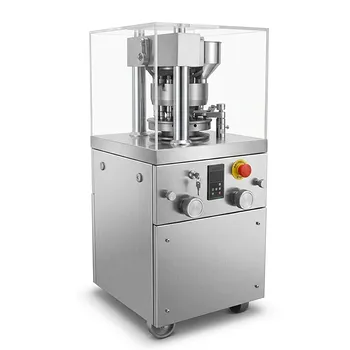
Ordinary Type Rotary Tablet Press for Pharmaceutical Chemical Food Electronic Industries
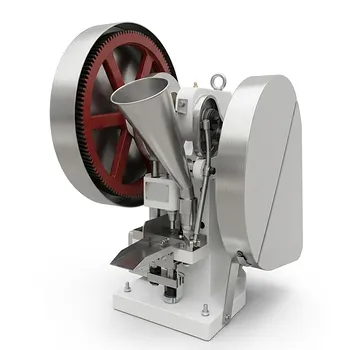
6-Ton Small Single-Punch Tablet Press — Laboratory Powder & Granule Tableting Equipment / Tablet Forming Machine
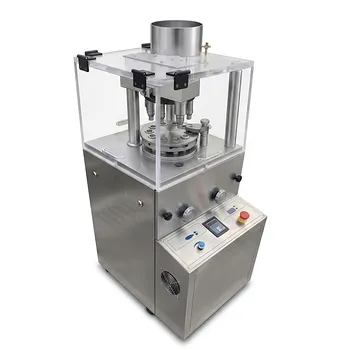
Enhanced 9 Punch Rotary Tablet Press for Powder Compaction
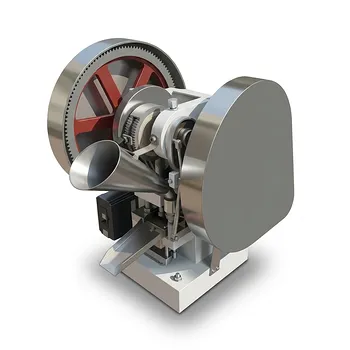
6 Ton Variable Frequency Single Punch Tablet Press