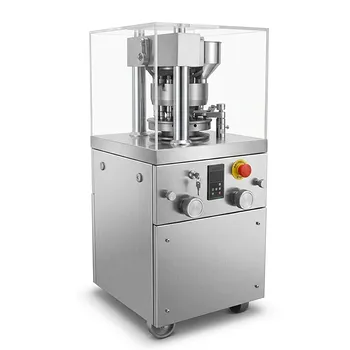
Why is a manual hydraulic pellet press necessary for graphite/graphene Raman testing? Enhance Your Spectral Accuracy
Updated 5 months ago
A manual hydraulic pellet press is essential for Raman spectroscopy because it transforms loose graphite or graphene powders into a dense, flat, and uniform surface. By applying high tonnage, the press eliminates air voids and surface irregularities that would otherwise scatter the laser light. This ensures the resulting data accurately reflects the material's intrinsic properties, specifically the defect density and crystallinity.
Preparation via a hydraulic press creates a stable reflection plane that suppresses background noise and minimizes signal interference. This standardized sample state is a prerequisite for obtaining the high-resolution spectra required to quantify a material’s structural integrity.
Overcoming Physical Obstacles to Optical Accuracy
Eliminating Voids and Porosity
Loose graphite and graphene powders are naturally porous, containing significant air gaps between particles. These internal voids cause the Raman laser to refract and scatter unpredictably, leading to weak signal intensity and "fuzzy" data.
A hydraulic press applies extreme pressure to collapse these voids, creating a solid, continuous mass. This density ensures that the laser interacts directly with the carbon structure rather than the air trapped between flakes.
Creating a Uniform Reflection Plane
Raman spectroscopy relies on a precise focal point; if the sample surface is uneven, the laser cannot maintain a consistent focus across the testing area. Manual pressing forces the powder into a specialized die, resulting in a disk-shaped pellet with a mirror-like flatness.
This flat surface acts as a stable reflection plane. It allows for uniform laser excitation and ensures that the reflected light is captured efficiently by the spectrometer’s detector.
Maximizing Data Integrity and Signal Quality
Suppressing Background Noise
In their loose state, powder samples produce significant background noise caused by diffuse scattering. This noise can mask subtle spectral features, making it difficult to distinguish the material's true signature from ambient interference.
The pelletizing process effectively suppresses this noise by streamlining the optical path. By reducing surface roughness, the press ensures that the Raman signals have higher resolution and a much stronger signal-to-noise ratio.
Ensuring Accurate D-band and G-band Metrics
The primary goal of testing graphite and graphene is often to measure the D-band (defect density) and G-band (crystallinity). Inaccurate sample preparation can lead to artificial broadening of these peaks or incorrect intensity ratios.
Using a hydraulic press ensures that the peak intensities accurately represent the molecular vibrations of the carbon atoms. This allows researchers to reliably calculate the ratio between the D and G bands, which is the industry standard for assessing material quality.
Understanding the Trade-offs and Pitfalls
The Risk of Pressure-Induced Defects
While high pressure is necessary to form a pellet, excessive tonnage can inadvertently alter the sample. Applying too much force may introduce mechanical strain or "amorphization," where the crystalline structure of the graphene is damaged by the preparation itself.
Surface Contamination
The dies used in manual presses must be meticulously cleaned between samples. Because Raman spectroscopy is highly sensitive, even microscopic residues from a previous test or oils from the operator's hands can contaminate the pellet and produce misleading spectral peaks.
Manual Consistency Challenges
Unlike automated systems, a manual press relies on the operator to apply consistent pressure for a specific duration. Variations in "dwell time" or the speed of pumping can lead to slight differences in pellet density, which may affect the repeatability of quantitative analyses across different batches.
How to Optimize Your Sample Preparation
To achieve the most accurate Raman spectroscopy results, the preparation method must align with your specific analytical objectives.
- If your primary focus is quantifying defect density: Use a moderate, consistent pressure to form a pellet without over-compressing, which helps avoid introducing mechanical artifacts into the D-band.
- If your primary focus is high-throughput screening: Ensure you use a standardized "dwell time" (the duration the pressure is held) to maintain consistency across dozens of samples.
- If your primary focus is maximizing signal-to-noise ratio: Focus on the polish and cleanliness of the die surfaces to ensure the resulting pellet has the highest possible degree of flatness.
Properly utilized, a manual hydraulic pellet press transforms a chaotic powder into a structured specimen, turning inconsistent raw data into definitive scientific evidence.
Summary Table:
| Feature | Benefit for Raman Spectroscopy | Critical Consideration |
|---|---|---|
| Void Removal | Eliminates air gaps to prevent laser scattering and refraction. | Moderate pressure is required to avoid structural amorphization. |
| Surface Flatness | Creates a stable reflection plane for consistent laser focus. | Dies must be meticulously cleaned to prevent cross-contamination. |
| High Density | Suppresses background noise and maximizes signal intensity. | Standardized dwell times ensure repeatability across batches. |
| Data Integrity | Ensures accurate D-band (defect) and G-band (crystallinity) metrics. | Excessive tonnage can introduce mechanical strain artifacts. |
Precision Sample Preparation for Material Science
Achieving high-resolution Raman spectra starts with flawless sample preparation. We provide complete laboratory sample preparation solutions specialized for material science, focusing on high-performance powder processing and compaction equipment.
Our extensive range of hydraulic presses—including Manual Lab Presses, XRF Pellet Presses, Hot Presses, and Cold/Warm Isostatic Presses (CIP/WIP)—is engineered to produce the dense, uniform pellets essential for accurate graphite and graphene analysis. To support your entire workflow, we also offer:
- Advanced Milling: Planetary ball, jet, sand/bead, and rotor mills for precise particle size control.
- Crushing & Grinding: Jaw/roll crushers and liquid nitrogen cryogenic grinders.
- Powder Handling: Powder mixers, vacuum defoaming mixers, and vibratory/air-jet sieve shakers.
Ready to eliminate signal noise and improve your laboratory's data integrity?
Contact our experts today to find your ideal solution!
References
- Ali A. El‐Samak, Tony McNally. Graphite precursor processing controlled performance of graphene nanoplatelet (GNP)–filled SBR. DOI: 10.1007/s42114-025-01502-y
Mentioned Products
- Manual Tablet Press with Dual Scale Pressure Gauge for Pharmaceutical Food Chemical Laboratory Sample Preparation
- 6-Ton Small Single-Punch Tablet Press — Laboratory Powder & Granule Tableting Equipment / Tablet Forming Machine
- 5 Ton Single Punch Tablet Press Laboratory Small Batch Production
- Enhanced 9 Punch Rotary Tablet Press for Powder Compaction
- 6 Ton Variable Frequency Single Punch Tablet Press
People Also Ask
- What is the function of a laboratory press in Cr-Ti alloy evaluation? Quantify Fracture Stress & Strength
- What is the function of a laboratory press in assessing the hydrophobic performance of modified vermiculite fillers?
- What is the core function of a laboratory press in the forming of ceramic filter element green bodies? Maximize Density.
- What is the function of a laboratory press in the preparation of ceramic feed rods? Master Density and Precision
- Why is vacuum sealing and flexible packaging necessary for Aluminum Titanate powders during CIP? Ensure Peak Density

Tech Team · PowderPreparation
Last updated on May 14, 2026
Related Products
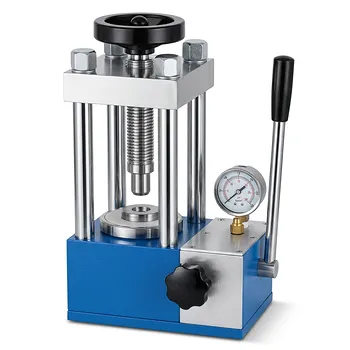
Manual Tablet Press with Dual Scale Pressure Gauge for Pharmaceutical Food Chemical Laboratory Sample Preparation
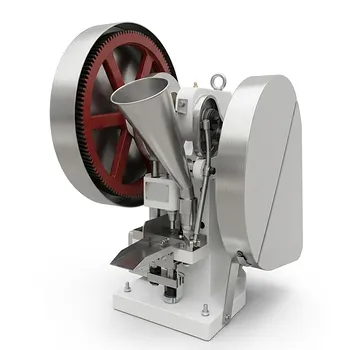
6-Ton Small Single-Punch Tablet Press — Laboratory Powder & Granule Tableting Equipment / Tablet Forming Machine
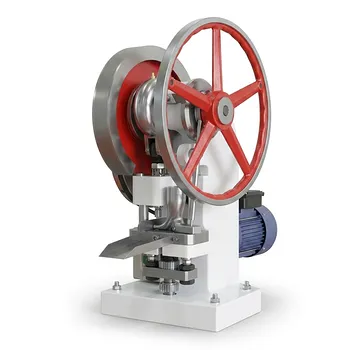
5 Ton Single Punch Tablet Press Laboratory Small Batch Production
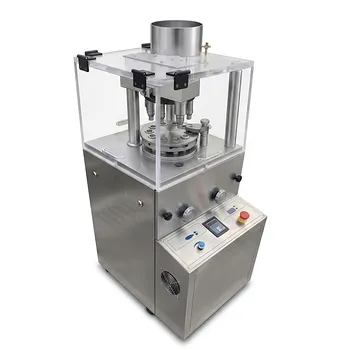
Enhanced 9 Punch Rotary Tablet Press for Powder Compaction
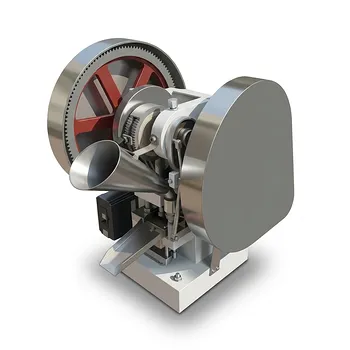
6 Ton Variable Frequency Single Punch Tablet Press