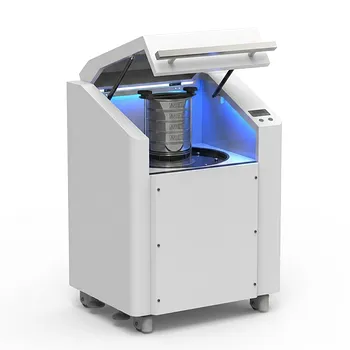
Why are precision sieves and shakers essential for BWI? Accurate Particle Analysis for Grinding Energy
Updated 4 months ago
Precision test sieves and vibratory sieve shakers are the foundational tools for calculating the Bond Ball Mill Work Index (BWI) because they define the particle size distribution of both the feed and the product. These instruments allow technicians to accurately identify the $F_{80}$ and $P_{80}$ values—the specific aperture sizes through which 80% of the material passes—which are the primary variables required to determine the energy consumption necessary for ore grinding.
The accuracy of the Bond Work Index depends entirely on the precision of particle classification; without standardized sieving, it is impossible to calculate the grinding energy efficiency or maintain the 250% circulating load required for a valid test.
Defining the Energy Variables: $F_{80}$ and $P_{80}$
The Foundation of the Bond Equation
To calculate the BWI, one must know the exact size of the material entering the mill (Feed) and the material leaving it (Product). Precision test sieves are used to perform a complete analysis across a standard Tyler mesh series to plot a passage percentage curve.
Identifying the 80% Passing Point
The $F_{80}$ and $P_{80}$ values are not measured directly but are interpolated from the sieve analysis data. High-precision meshes, often ranging from 63 $\mu$m to 365 $\mu$m, ensure that the resulting curve is mathematically sound and the energy efficiency calculation is reliable.
Quantifying Fineness Changes
By comparing the feed and product distributions, researchers can quantitatively analyze how the material responds to grinding. This data provides the scientific basis for determining how much electrical energy is required to reduce a specific ore to a desired target size.
Maintaining the Equilibrium: The 250% Circulating Load
Simulating Closed-Circuit Grinding
The Bond test is a "locked-cycle" test designed to simulate a continuous industrial grinding circuit. High-precision sieves, particularly the 106 $\mu$m mesh, are used at the end of each cycle to separate the undersize product from the oversize "circulating load."
Adjusting Mill Revolutions
The mass of the material that passes through the sieve determines the "grindability" of the ore for that specific cycle. This measurement is used to calculate the number of mill revolutions required for the next cycle to maintain a steady 250% circulating load.
Impact on Calculation Accuracy
If the sieving process is imprecise, the circulating load will drift, leading to an unstable test. Inaccurate screening directly compromises the grindability values, which can result in significant errors in the final Work Index and subsequent mill sizing.
The Role of the Vibratory Sieve Shaker in Reliability
Ensuring Repeatable Mechanical Force
Vibratory sieve shakers provide a standardized, high-frequency mechanical force that manual shaking cannot replicate. This consistency ensures that every particle has an equal opportunity to pass through the mesh apertures during the set vibration time.
Preventing Sieve Blinding
Fine ore particles often become trapped in the mesh, a phenomenon known as blinding. The specific vibration amplitudes of a shaker help clear the mesh, ensuring a thorough separation of fine and coarse aggregates across diameters ranging from 0.15 mm to 19 mm.
Standardizing the Analytical Process
Using a mechanical shaker removes human error from the particle size analysis phase. This standardization is critical for generating repeatable passage percentage curves, which are essential when comparing different ore samples or verifying metallurgical reports.
Understanding the Trade-offs and Pitfalls
Mesh Wear and Calibration
Even the highest quality sieves degrade over time due to the abrasive nature of crushed ore. Worn apertures will lead to an overestimation of the passing percentage, which artificially lowers the calculated Work Index and could lead to under-sized industrial equipment.
Overloading the Sieve Stack
Placing too much material on a sieve can "cushion" smaller particles, preventing them from reaching the mesh surface. This results in an inaccurate $P_{80}$ value, emphasizing the need for strict adherence to sample mass limits during the BWI test.
Vibration Amplitude Settings
If the vibratory shaker's amplitude is too low, the material will not stratify correctly; if it is too high, particles may bounce off the mesh rather than passing through. Optimization of shaker settings is required for different material densities to ensure the classification is truly representative.
How to Apply This to Your Project
To ensure the highest accuracy in your Bond Ball Mill Work Index determinations, follow these recommendations based on your specific goals:
- If your primary focus is industrial mill sizing: Use certified, high-precision sieves to ensure $F_{80}$ and $P_{80}$ data is accurate to within 1%, as small errors here lead to massive discrepancies in plant-scale power requirements.
- If your primary focus is process stability: Implement a strict vibratory shaker protocol, including fixed vibration times and amplitudes, to ensure the 250% circulating load is reached quickly and maintained consistently across cycles.
- If your primary focus is quality control of functional materials: Utilize ultra-fine precision meshes (down to 63 $\mu$m) to monitor enrichment patterns and ensure the feed entering subsequent processes meets strict physical specifications.
Precision sieving is the bridge between laboratory-scale grinding data and the successful design of energy-efficient industrial processing plants.
Summary Table:
| Key Component | Role in BWI Determination | Impact on Accuracy |
|---|---|---|
| Precision Test Sieves | Define $F_{80}$ & $P_{80}$ particle distributions | Prevents energy calculation errors and mill mis-sizing |
| Vibratory Sieve Shaker | Provides standardized mechanical force | Eliminates human error; ensures repeatable stratification |
| Standard Mesh Series | Separates material at 106 $\mu$m (or target) | Maintains the critical 250% circulating load equilibrium |
| Amplitude Control | Prevents sieve blinding & mesh clogging | Ensures all particles have an equal opportunity to pass |
Optimize Your Grinding Analysis with Precision Equipment
Achieving an accurate Bond Ball Mill Work Index (BWI) requires more than just a calculation—it demands high-precision laboratory tools. At [Insert Brand Name], we provide complete laboratory sample preparation solutions for material science, specializing in the powder processing and compaction equipment necessary for reliable results.
Our extensive product line supports every stage of the BWI workflow:
- Classification: Precision vibratory and air-jet sieve shakers with certified test sieves for exact $F_{80}$ and $P_{80}$ measurement.
- Size Reduction: Heavy-duty jaw/roll crushers and high-efficiency planetary ball mills, jet mills, and disc mills.
- Compaction & Preparation: A full spectrum of hydraulic presses, including Cold/Warm Isostatic Presses (CIP/WIP) and XRF pellet presses.
Whether you are sizing industrial mills or performing metallurgical QC, our equipment ensures your data is repeatable and mathematically sound. Contact us today to discuss your laboratory needs and see how our expertise can enhance your material processing efficiency.
References
- Wladmir José Gomes Florêncio, Vládia Cristina Gonçalves de Souza. The Effect of Particle Size Distribution on the BWI and Energy Consumption of Harder Ores. DOI: 10.4236/jmmce.2025.135015
Mentioned Products
- Laboratory Vibratory Test Sieve Shaker for Precision Particle Size Analysis and Powder Grading
- Small Laboratory Vibrating Sieve Shaker for Precise Particle Size Analysis
- 三维电磁微量振动筛分仪
- Laboratory Air Jet Sieving Machine for Fine Powder Particle Size Analysis and Deagglomeration
- High Frequency Wet Three-Dimensional Vibrating Sieve Shaker for Dry and Wet Particle Size Analysis
People Also Ask
- What role does a laboratory sieve shaker play in determining PDI? Achieve Precision in Biomass Quality Testing
- What are the functions of sieve shakers for coconut shell powder? Achieve Precise Particle Size & Quality Control.
- What function does a laboratory sieve shaker perform in the PSD analysis of residual soil? Ensure Precise Grading
- What is the role of a laboratory sieve shaker in the preparation of plantain peel adsorbents? Standardize Particle Size
- What is the function of a laboratory vibratory sieve shaker? Enhance Coal Particle Size Distribution (PSD) Analysis

Tech Team · PowderPreparation
Last updated on Jun 03, 2026
Related Products
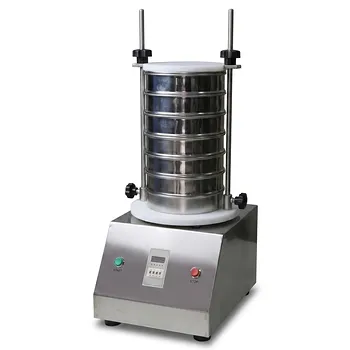
Laboratory Vibratory Test Sieve Shaker for Precision Particle Size Analysis and Powder Grading
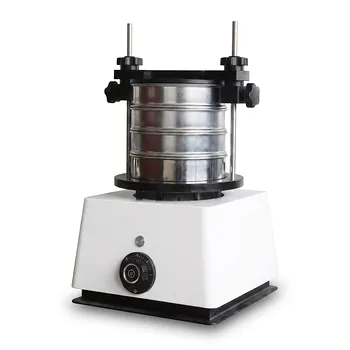
Small Laboratory Vibrating Sieve Shaker for Precise Particle Size Analysis
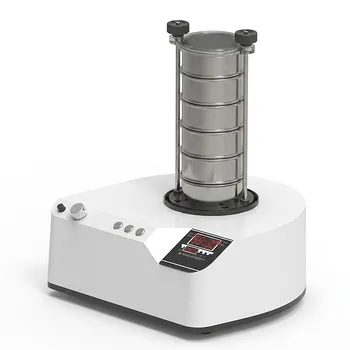
三维电磁微量振动筛分仪
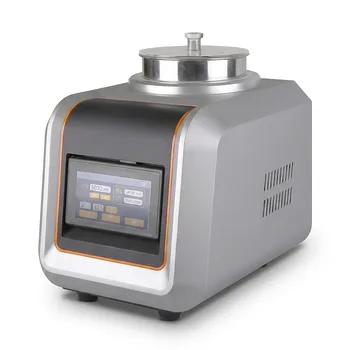
Laboratory Air Jet Sieving Machine for Fine Powder Particle Size Analysis and Deagglomeration
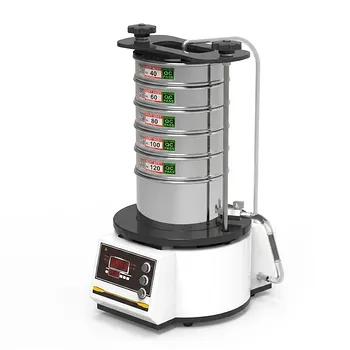
High Frequency Wet Three-Dimensional Vibrating Sieve Shaker for Dry and Wet Particle Size Analysis
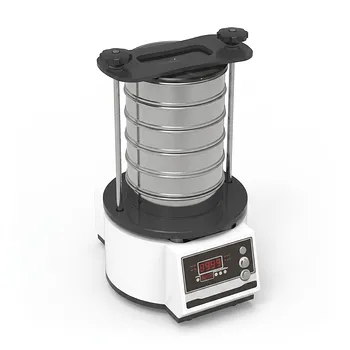
Tapping Oscillating Sieve Shaker for Dry and Wet Particle Size Analysis
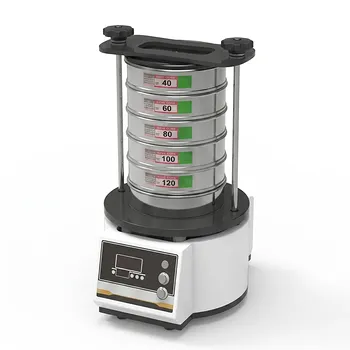
Dry Three Dimensional Vibratory Sieve Shaker
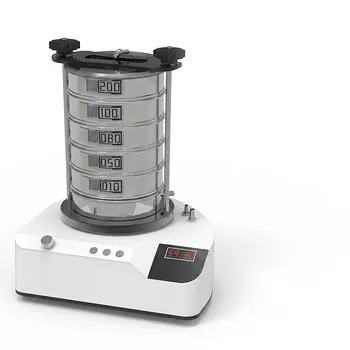
Heavy Duty Dry Three Dimensional Vibratory Sieve Shaker for Particle Separation
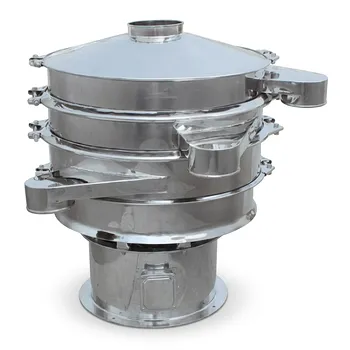
Stainless Steel Rotary Vibrating Sieve High Precision Circular Vibratory Separator Industrial Powder Grading Machine Multi Layer Sifting Equipment
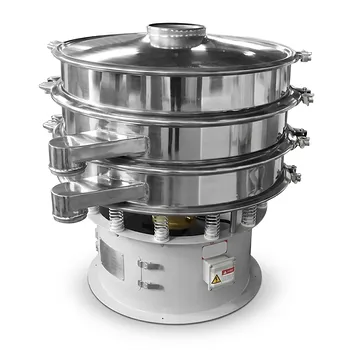
Three Dimensional Rotary Vibrating Sieve