What role does a laboratory hydraulic press play in the compaction of mullite-based ceramic green bodies? Expert Guide
Updated 4 months ago
The laboratory hydraulic press serves as the fundamental tool for transforming loose mullite precursor powders into cohesive, high-density "green bodies" via uniaxial compaction. By applying a constant, high-pressure load—typically ranging from 75 MPa to 140 MPa—the press forces particle rearrangement and mechanical interlocking. This process establishes the essential geometric and structural foundation required to survive the stresses of high-temperature sintering.
The core role of the hydraulic press is to maximize particle contact and eliminate internal voids, creating a stable ceramic compact. Precise pressure control is vital to ensure a uniform density distribution, which directly prevents cracking and irregular shrinkage during the final densification process.
The Mechanism of Uniaxial Compaction
Overcoming Particle Friction and Rearrangement
The primary function of the hydraulic press is to apply axial force to powder contained within a precision steel mold. This pressure allows the mullite precursor particles to overcome internal friction, causing them to slide and shift into a more efficient packing arrangement.
Elimination of Entrapped Gases and Voids
As the hydraulic ram descends, it effectively excludes entrapped gases from the powder bed. By reducing the volume of large pores and voids, the press ensures that the resulting green body has the high initial density necessary for successful solid-phase reactions.
Mechanical Interlocking and Bonding
Under high-pressure loads, such as 400 bar, particles undergo localized deformation and mechanical interlocking. This creates sufficient mechanical strength for the green body to be handled and measured without crumbling before it ever enters the furnace.
Impact on the Sintering Lifecycle
Establishing Uniform Phase Transformation Kinetics
For mullite-based ceramics, the uniformity of the green body is critical for consistent phase transformation kinetics. A hydraulic press provides the precise control needed to ensure that the chemical reactions occurring at high temperatures happen evenly throughout the entire volume of the material.
Minimizing Sintering Shrinkage and Deformation
A high-density compact produced by a press provides a stable foundation for sintering shrinkage. By minimizing initial porosity, the press reduces the total volume change that occurs during heating, which prevents the ceramic from warping or losing its intended geometric shape.
Improving Final Dielectric and Breakdown Strength
In specialized applications, the press's ability to minimize internal defects directly correlates to the final performance. Reducing internal porosity through high-precision compaction significantly improves the breakdown strength and final density of the finished ceramic component.
Understanding the Trade-offs and Pitfalls
The Challenge of Density Gradients
While uniaxial pressing is efficient, it is susceptible to wall friction between the powder and the mold. This can lead to density gradients, where the top of the pellet is denser than the middle, potentially causing "hourglassing" or bowing during sintering.
Pressure-Induced Cracking (Capping)
Applying excessive pressure can lead to elastic recovery, or "springback," once the load is released. If the pressure is too high for the specific mullite mixture, the stored elastic energy can cause the green body to delaminate or "cap," resulting in horizontal cracks.
Limitations of Uniaxial Geometry
Uniaxial pressing is generally limited to simple geometric shapes, such as cylindrical discs or rectangular blocks. For complex components, the hydraulic press serves as a primary compaction tool, but it may require subsequent machining or alternative forming methods to achieve intricate details.
How to Apply This to Your Project
Recommendations for Success
- If your primary focus is maximizing final density: Utilize higher pressure loads (near 140 MPa) and ensure the powder is finely milled to increase particle contact points.
- If your primary focus is preventing sintering cracks: Use the hydraulic press to maintain a lower, consistent pressure (around 75 MPa) and implement a slow pressure-release cycle to minimize elastic springback.
- If your primary focus is Field-Assisted Sintering (FAST): Use the press to establish stable conductive pathways by ensuring the green body has a high, uniform density to reduce initial contact resistance.
By mastering the precise application of pressure, you ensure that your mullite-based ceramics transition from loose powder to high-performance technical components with structural integrity and predictable shrinkage.
Summary Table:
| Process Stage | Mechanism of Action | Key Benefit to Green Body |
|---|---|---|
| Loading (75-140 MPa) | Particle sliding & rearrangement | High initial packing density |
| Compression | Elimination of entrapped gases | Reduced porosity & void volume |
| Compaction | Mechanical interlocking | Enhanced strength for handling |
| Pressure Release | Controlled elastic recovery | Prevention of capping & cracks |
Elevate Your Ceramic Research with Precision Compaction Solutions
Achieving structural integrity in mullite-based ceramics starts with superior powder preparation and compaction. We provide complete laboratory sample preparation solutions tailored for material science, specializing in high-performance powder processing and compaction equipment.
Our extensive product line supports your entire workflow:
- Powder Processing: Crushers (jaw/roll), liquid nitrogen cryogenic grinders, and advanced mills (planetary ball, jet, sand/bead, disc, rotor).
- Sizing & Mixing: Vibratory/air-jet sieve shakers and high-efficiency powder/defoaming mixers.
- Advanced Compaction: A full spectrum of hydraulic presses, including Standard Lab Presses, XRF Pellet Presses, Cold/Warm Isostatic Presses (CIP/WIP), and Vacuum Hot Presses.
From eliminating density gradients to preventing pressure-induced cracking, our equipment is designed to ensure predictable, high-quality sintering results.
Transform your loose powders into high-performance technical components.
Contact Our Experts Today to discuss your specific application and find the perfect press for your laboratory.
References
- Grace Olufunke Matthew, Seun Samuel Owoeye. Effects of alumina slag (Valoxy) and rice husk ash as substitute resources on mechanical properties of mullite based ceramics. DOI: 10.5281/zenodo.6962179
Mentioned Products
- Enhanced 9 Punch Rotary Tablet Press for Powder Compaction
- Manual Tablet Press with Dual Scale Pressure Gauge for Pharmaceutical Food Chemical Laboratory Sample Preparation
- 6-Ton Small Single-Punch Tablet Press — Laboratory Powder & Granule Tableting Equipment / Tablet Forming Machine
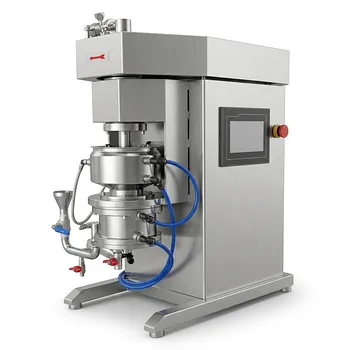
- Small Ceramic Structure Laboratory Sand Mill Nanoscale Grinding Dispersion Equipment Seal-less Screen-less Design
People Also Ask
- What is the purpose of adding lubricants like zinc stearate during Al-Al2O3 powder pressing? Achieve Superior Density
- Why is a laboratory hydraulic press required for FT-IR KBr pellets? Achieve Precise Sample Clarity for ZrC–SiC Analysis
- What role does a high-strength stainless steel mold kit play in the uniaxial die compaction process? Ensuring Precision
- Why is a laboratory hydraulic press required to compress oyster shell powder before XRF analysis? Improve Data Accuracy.
- Why is vacuum sealing and flexible packaging necessary for Aluminum Titanate powders during CIP? Ensure Peak Density

Tech Team · PowderPreparation
Last updated on Jun 03, 2026
Related Products
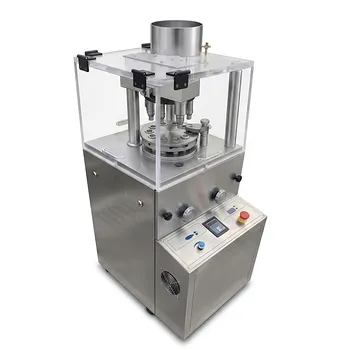
Enhanced 9 Punch Rotary Tablet Press for Powder Compaction
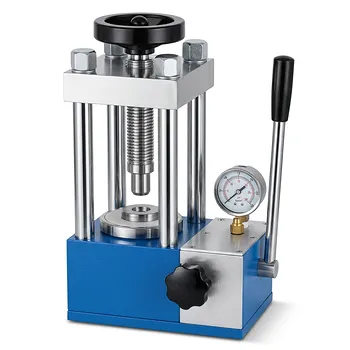
Manual Tablet Press with Dual Scale Pressure Gauge for Pharmaceutical Food Chemical Laboratory Sample Preparation
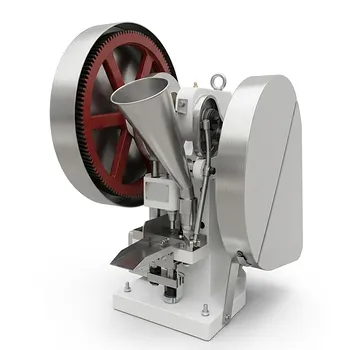
6-Ton Small Single-Punch Tablet Press — Laboratory Powder & Granule Tableting Equipment / Tablet Forming Machine