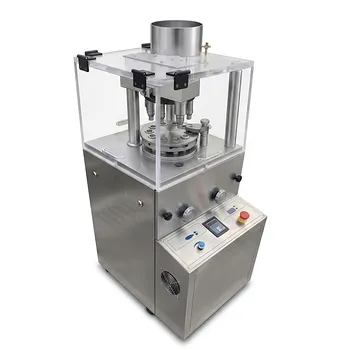
What role do industrial hydraulic presses play in ceramic waste forming? Maximize Material Densification and Strength
Updated 5 months ago
Industrial hydraulic presses are the mechanical catalyst for material densification.
In the forming stage of ceramic mixtures incorporating granite or gypsum residues, industrial hydraulic presses apply high uniaxial pressure to force out internal air and achieve high material densification. This process creates tight mechanical contact between the waste powders and the clay matrix, establishing a "green body" with the structural integrity and particle proximity required for effective solid-phase reactions during sintering.
Core Takeaway: The hydraulic press serves as the critical bridge between loose powder and a solid ceramic, using precise pressure to eliminate density gradients and ensure the material can withstand the stresses of high-temperature densification.
Transforming Waste into Structural Foundations
Achieving High Material Densification
Industrial hydraulic presses provide the controlled axial pressure—typically ranging from 60 MPa to 120 MPa—necessary to drive the rearrangement and plastic deformation of particles. This mechanical compaction is essential for forcing granite and gypsum residues into the clay matrix, significantly increasing the packing density of the mixture.
Eliminating Internal Porosity
By applying constant pressure, the press effectively evacuates internal air and eliminates large pores that would otherwise weaken the final product. This reduction in porosity is the primary mechanism for transforming loose, synthesized powders into a cohesive green body with specific geometric dimensions.
Ensuring Dimensional Accuracy
The use of precision molds during the pressing stage ensures that the resulting green bodies possess the necessary dimensional accuracy. This initial shaping is vital because it directly influences the shrinkage rate during the subsequent sintering process, allowing for predictable final product sizes.
Facilitating Solid-Phase Reactions
Maximizing Inter-particle Contact
For solid-phase reactions to occur during sintering, particles must be in extreme proximity. The hydraulic press creates this tight contact between waste powders and the clay, establishing the physical foundation required for atomic diffusion and grain rearrangement.
Developing Necessary Green Strength
The compaction process provides the green body with sufficient mechanical strength to undergo handling, turnover, and transport to the kiln. Without this high-pressure molding, the mixture would lack the structural foundation needed to maintain its shape during the early stages of high-temperature processing.
Controlling Density Distribution
Precise pressure loading ensures a consistent internal density across the entire green body. Maintaining a uniform density distribution is critical for preventing warping, as it ensures that the material shrinks at a uniform rate when exposed to heat.
Understanding the Trade-offs and Pitfalls
The Risk of Residual Stress
While high pressure is necessary for densification, excessive pressure can introduce residual stress within the green body. If these stresses are not managed, they can lead to "spring-back" effects or micro-cracking once the pressure is released from the mold.
Limitations of Uniaxial Pressing
In industrial settings, the friction between the powder and the mold walls can lead to pressure gradients. These gradients may result in slight variations in density between the top and center of the ceramic body, which can impact the uniformity of the final sintered product.
Material Deformation and Tool Wear
Applying extreme pressures, sometimes up to 1200 MPa for specialized oxides, increases the rate of tool and mold wear. Operators must balance the need for high green strength with the economic reality of maintaining precision molding equipment.
Optimizing the Pressing Stage for Your Material
To achieve the best results when integrating granite or gypsum residues into ceramic bodies, consider the following strategic focuses:
- If your primary focus is maximizing waste utilization: Use higher pressure ranges (near 120 MPa) to ensure irregular granite particles are fully embedded within the clay matrix to prevent structural voids.
- If your primary focus is minimizing post-sintering defects: Prioritize precise pressure control and air evacuation to eliminate density gradients, which are the leading cause of warping and cracking during the kiln phase.
- If your primary focus is high-volume production efficiency: Focus on a pressing cycle that optimizes green strength for rapid handling, reducing the risk of breakage during the turnover process.
Mastering the hydraulic forming stage is the definitive step in successfully transforming industrial residues into high-performance, durable ceramic products.
Summary Table:
| Key Function | Impact on Ceramic Material | Technical Parameter/Benefit |
|---|---|---|
| High Densification | Increases packing density and particle contact | 60 - 120 MPa typical pressure |
| Air Evacuation | Eliminates internal porosity and voids | Prevents structural failure |
| Dimensional Control | Ensures accuracy and predictable shrinkage | Reduces warping during sintering |
| Green Strength | Provides mechanical integrity for handling | Vital for high-volume production |
| Stress Management | Mitigates density gradients | Ensures uniform material performance |
Optimize Your Material Densification with Precision Pressing Solutions
Transforming industrial residues like granite or gypsum into high-performance ceramics requires extreme precision and reliable pressure control. At our facility, we provide complete laboratory sample preparation solutions tailored for material science and powder processing.
Whether you are focusing on waste utilization or advanced material synthesis, our extensive equipment line includes:
- Hydraulic Presses: A full spectrum featuring standard lab presses, Cold/Warm Isostatic Presses (CIP/WIP), XRF pellet presses, and vacuum hot presses.
- Powder Processing: High-efficiency crushers (jaw/roll), liquid nitrogen cryogenic grinders, and advanced mills (planetary, jet, and disc).
- Material Refinement: Sieve shakers, powder mixers, and defoaming mixers to ensure a perfect mixture before compaction.
Ready to enhance your green body quality and sintering results? Contact our experts today to find the ideal compaction solution for your research or production needs!
References
- Kelson Silva de Almeida, José Milton Elias de Matos. Efeito de resíduos de gesso e de granito em produtos da indústria de cerâmica vermelha: revisão bibliográfica. DOI: 10.1590/s1517-707620200001.0893
Mentioned Products
People Also Ask
- What is the purpose of adding lubricants like zinc stearate during Al-Al2O3 powder pressing? Achieve Superior Density
- Why is a laboratory hydraulic press required for FT-IR KBr pellets? Achieve Precise Sample Clarity for ZrC–SiC Analysis
- What role does a high-strength stainless steel mold kit play in the uniaxial die compaction process? Ensuring Precision
- Why is a laboratory hydraulic press required to compress oyster shell powder before XRF analysis? Improve Data Accuracy.
- Why is vacuum sealing and flexible packaging necessary for Aluminum Titanate powders during CIP? Ensure Peak Density

Tech Team · PowderPreparation
Last updated on May 14, 2026