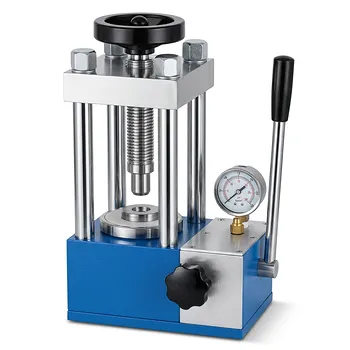
What is the necessity of a high-pressure hydraulic press for mullite ceramics? Optimize Density & Sintering Success
Updated 5 months ago
High-pressure hydraulic pressing is the essential first step in transforming loose mullite precursors into a viable structural ceramic. By applying precise uniaxial loads—often reaching 140 MPa—the press forces kaolin and additive powders (such as sawdust or binders) into a dense "green body." This process eliminates trapped air and maximizes particle contact, creating the physical foundation required for successful high-temperature sintering.
The necessity of the hydraulic press lies in its ability to achieve high green density through mechanical compaction. This "pre-densification" ensures the green body has the structural integrity to be handled and the microscopic proximity required for solid-phase reactions during firing.
Driving Particle Rearrangement and Deformation
Overcoming Internal Frictional Forces
Loose ceramic powders naturally resist compaction due to inter-particle friction and irregular shapes. High-pressure hydraulic systems provide the constant, unidirectional force needed to overcome these forces, sliding particles into a more efficient packing arrangement.
Facilitating Plastic Deformation and Crushing
Under pressures like 80 to 140 MPa, individual powder particles may undergo plastic deformation or even localized crushing. This breakdown of granulated particles fills smaller voids, significantly increasing the contact points between the kaolin and other mixture components.
Eliminating Macro-Porosity and Trapped Air
The hydraulic press effectively "squeezes" out air trapped between particles that would otherwise remain as large internal voids. By removing these large pores at the forming stage, the press prevents the formation of structural flaws that cannot be easily fixed during sintering.
Preparing the Green Body for Sintering
Promoting Solid-Phase Reactions
Mullite formation relies on diffusion and solid-phase reactions between aluminum and silicon-bearing minerals. The high-pressure environment ensures particles are in such close proximity that atomic diffusion can occur efficiently once the material reaches sintering temperatures.
Controlling Sintering Shrinkage
A dense green body experiences much more predictable and uniform shrinkage rates during the cooling and firing phases. By maximizing initial density, the hydraulic press reduces the risk of severe dimensional deformation or "warping" in the final ceramic component.
Minimizing the Density Gradient
Precision-controlled hydraulic systems help maintain a uniform pressure distribution throughout the mold. This minimizes the density gradient, ensuring that one part of the ceramic does not shrink or densify faster than another, which is a leading cause of internal stress.
Ensuring Mechanical Handling and Geometric Accuracy
Developing Necessary Green Strength
Before they are fired, ceramic bodies must be moved, measured, and placed into kilns. High-pressure forming provides the mechanical bonding force required for the green body to support its own weight and survive handling without crumbling.
Defining Precise Geometric Shapes
Using precision molds and axial pressure allows for the creation of specific dimensions, such as cylindrical pellets or 4x4x60 mm bars. This accuracy is critical for industrial applications where the finished mullite part must meet strict tolerances.
Understanding Technical Trade-offs and Pitfalls
The Risk of Lamination and Cracking
If pressure is released too quickly or if the powder is too dry, "spring-back" can occur, leading to lamination cracks. The hydraulic press must be operated with controlled loading and unloading cycles to prevent these structural failures.
Tooling Wear and Friction
Applying 140 MPa of pressure generates significant wear on precision molds. Without proper lubrication or high-quality tool steel, the friction between the powder and the mold walls can lead to uneven density or "die-sticking."
How to Apply High-Pressure Forming to Your Project
Making the Right Choice for Your Goal
- If your primary focus is maximizing final material density: Utilize the highest recommended pressure (e.g., 140 MPa) to maximize particle contact and reduce initial porosity.
- If your primary focus is preventing dimensional warping: Focus on achieving a uniform pressure distribution and using granulated powders to ensure the green density is consistent throughout the mold.
- If your primary focus is industrial handling and turnover: Ensure the molding pressure is sufficient to create high "green strength," allowing the samples to be handled without edge chipping or breakage.
High-pressure hydraulic compaction is the indispensable bridge between a loose powder mixture and a high-performance, dense mullite ceramic.
Summary Table:
| Process Mechanism | Impact on Mullite Green Body | Key Benefit |
|---|---|---|
| High-Pressure Load (up to 140 MPa) | Overcomes inter-particle friction & drives rearrangement | Maximum green density |
| Macro-Porosity Removal | Squeezes out trapped air and internal voids | Prevents structural flaws in firing |
| Mechanical Compaction | Promotes plastic deformation and particle contact | Faster solid-phase reactions |
| Structural Bonding | Develops necessary "green strength" | Safe handling & geometric accuracy |
| Uniform Pressure Distribution | Minimizes density gradients | Predictable shrinkage & less warping |
Elevate Your Ceramic Research with Precision Compaction Solutions
At [Company Name], we provide complete laboratory sample preparation solutions tailored for material science and advanced ceramics. Achieving the perfect mullite green body requires precise control over pressure and uniformity.
Our extensive line of equipment is designed to help you achieve superior material density and structural integrity:
- Advanced Compaction: A full spectrum of hydraulic presses, including Cold/Warm Isostatic Presses (CIP/WIP), standard lab presses, XRF pellet presses, and high-temperature vacuum hot presses.
- Powder Processing: High-efficiency crushers (jaw/roll), liquid nitrogen cryogenic grinders, and specialized mills (planetary ball, jet, and disc).
- Sizing & Mixing: Sieve shakers (vibratory/air-jet) and high-performance powder or defoaming mixers.
Whether you are a researcher optimizing sintering parameters or a distributor seeking reliable OEM/ODM support, we bring the expertise and equipment needed for professional-grade powder processing.
Ready to optimize your ceramic forming process? Contact our experts today to find the ideal hydraulic press for your laboratory!
References
- Emese Kurovics, László A. Gömze. EXAMINATION OF THE CARBONIZATION PROCESS USING KAOLIN AND SAWDUST. DOI: 10.2495/mc190021
Mentioned Products
- Hydraulic Double Shaft Disperser for High Viscosity Liquid Mixing and Dispersion
- 6 Ton Variable Frequency Single Punch Tablet Press
- Enhanced 9 Punch Rotary Tablet Press for Powder Compaction
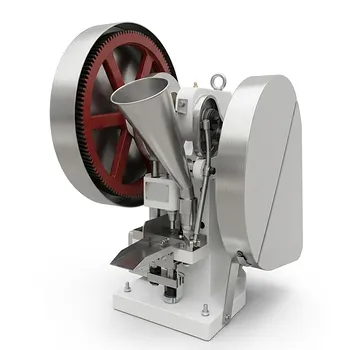
- 6-Ton Small Single-Punch Tablet Press — Laboratory Powder & Granule Tableting Equipment / Tablet Forming Machine
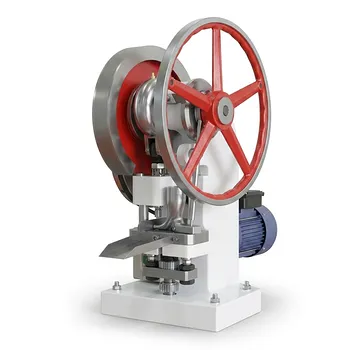
- 5 Ton Single Punch Tablet Press Laboratory Small Batch Production
People Also Ask
- Why is it necessary for an industrial hydraulic press to provide high unit pressure when preparing MMC green bodies? Optimize Densification
- What role does high-speed mixing play in photoanode slurry prep? Optimize Nanoparticle Dispersion for Solar Efficiency
- What are the advantages of a customized dual-blade mixer? High-Shear Mixing for High-Viscosity Pastes
- How does high-precision mixing ensure phase stability in BaO–MgO–ZrO2 ceramics? Achieve Pure Dielectric Performance
- What is the function of high-efficiency mixing and defoaming equipment in catalyst systems? Achieve Molecular Uniformity

Tech Team · PowderPreparation
Last updated on May 14, 2026
Related Products
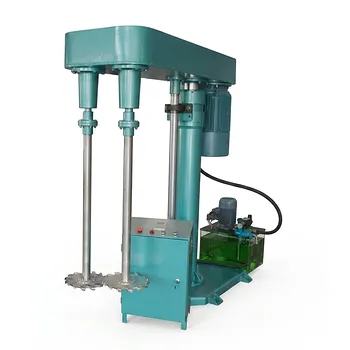
Hydraulic Double Shaft Disperser for High Viscosity Liquid Mixing and Dispersion
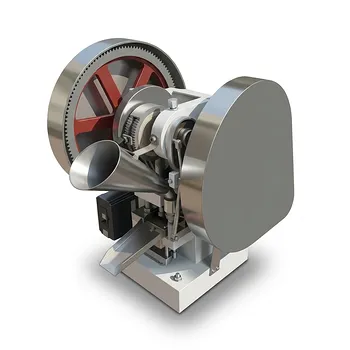
6 Ton Variable Frequency Single Punch Tablet Press
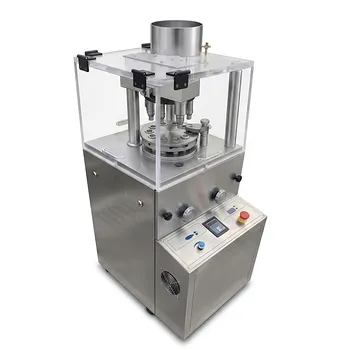
Enhanced 9 Punch Rotary Tablet Press for Powder Compaction
6-Ton Small Single-Punch Tablet Press — Laboratory Powder & Granule Tableting Equipment / Tablet Forming Machine
5 Ton Single Punch Tablet Press Laboratory Small Batch Production
Ordinary Type Rotary Tablet Press for Pharmaceutical Chemical Food Electronic Industries