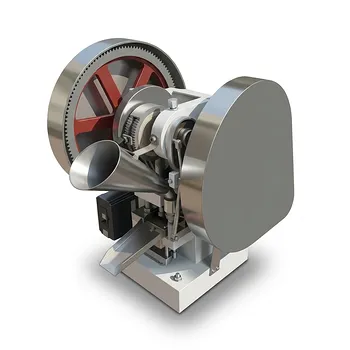
What is the function of an industrial uniaxial hydraulic press for red clay TiO2 substrates? Achieve Precision Density
Updated 5 months ago
In the production of red clay substrates, an industrial uniaxial hydraulic press serves as the primary mechanical consolidation tool. It applies constant, precise pressure to transform atomized red clay powder into dense, prismatic "green bodies." This process creates the stable structural foundation essential for the uniform application of titanium dioxide ($TiO_2$) coatings and successful subsequent sintering.
The uniaxial hydraulic press ensures the structural integrity of red clay substrates by achieving high-density particle packing. This mechanical pre-treatment is vital to prevent structural defects and provides the dimensional stability required for high-performance $TiO_2$ functional coatings.
Mechanical Consolidation and Shaping
Transforming Loose Powder into Green Bodies
The press uses high tonnage to apply axial pressure to atomized red clay powder within a mold. This force overcomes internal friction, inducing particle rearrangement and plastic deformation to create a solid form.
Establishing Geometric Precision
By using a fixed die, the press creates prismatic green bodies with exact dimensions. This standardized geometry is necessary for automated $TiO_2$ coating processes and ensures consistent heat distribution during the firing stage.
Enhancing Material Density and Performance
The Role of Relative Density
High-pressure compaction targets a high-density foundation before sintering occurs. Achieving a high relative density (often exceeding 80%) minimizes the volume of internal pores that could otherwise compromise the coating’s adhesion or the substrate's strength.
Shortening Atomic Diffusion Paths
Densely packing the particles shortens the diffusion paths between atoms. This facilitates more efficient mass transport during heating, which is a critical prerequisite for achieving full densification and preventing structural failure.
Facilitating Phase Transformations
A well-compacted substrate provides the physical environment necessary for the $TiO_2$ coating to undergo critical changes. Proper compaction supports the transformation from the anatase phase to the rutile phase during subsequent heat treatments.
Structural Stability and Defect Prevention
Controlling Sintering Shrinkage
The tight arrangement of powder particles prevents significant shrinkage during the firing process. Without uniform compaction, the substrate may warp or crack, which would lead to the delamination of the $TiO_2$ layer.
Ensuring Surface Uniformity
The press creates a flat, high-density surface that allows the titanium dioxide coating to be applied evenly. Consistent surface geometry is critical for obtaining reliable data if the final samples are analyzed via X-ray fluorescence or other spectroscopic methods.
Understanding the Trade-offs
Pressure Gradient Challenges
Uniaxial pressing can lead to internal pressure gradients, where the density is slightly higher near the punch and lower in the center of the body. If these gradients are too steep, they can cause "spring-back" effects or non-uniform shrinkage during sintering.
Geometric Limitations
This method is primarily optimized for simple prismatic or cylindrical shapes. Complex geometries are difficult to press uniaxially because the pressure does not always distribute evenly to every corner of a complex mold.
Optimizing Substrate Preparation for Your Goal
To achieve the best results for $TiO_2$ coatings, the pressing parameters must be aligned with your specific technical requirements.
- If your primary focus is coating adhesion: Prioritize high-pressure compaction to maximize surface density and minimize the surface porosity that can cause coating flakes.
- If your primary focus is dimensional accuracy: Utilize precise hydraulic control systems to ensure consistent green body dimensions across large production batches.
- If your primary focus is sintering efficiency: Ensure the red clay powder is finely atomized to facilitate better particle packing under the uniaxial force.
Mastering the uniaxial pressing stage is the most critical step in ensuring the long-term durability and functionality of red clay-based $TiO_2$ materials.
Summary Table:
| Key Function | Technical Benefit | Impact on TiO2 Coating |
|---|---|---|
| Powder Consolidation | Transforms loose powder into "green bodies" | Provides a stable structural foundation |
| High-Pressure Compaction | Achieves >80% relative density | Minimizes porosity to prevent coating delamination |
| Geometric Precision | Standardizes prismatic/cylindrical shapes | Ensures uniform coating thickness and heat distribution |
| Structural Alignment | Shortens atomic diffusion paths | Facilitates phase transformation (Anatase to Rutile) |
| Shrinkage Control | Reduces volume loss during firing | Prevents substrate warping and coating cracks |
Optimize Your Material Preparation with Precision Engineering
To achieve superior $TiO_2$ coating performance, high-quality substrate preparation is non-negotiable. We provide complete laboratory sample preparation solutions for material science, specializing in advanced powder processing and compaction equipment.
Our extensive product line includes:
- Compaction Excellence: Industrial & Lab Hydraulic Presses, Cold/Warm Isostatic Presses (CIP/WIP), XRF Pellet Presses, and Vacuum Hot Presses.
- Powder Processing: Planetary ball mills, jet mills, jaw/roll crushers, and cryogenic grinders.
- Refinement & Mixing: Sieve shakers (vibratory/air-jet), powder mixers, and high-efficiency defoaming mixers.
Whether you are scaling up production or conducting precise lab research, our equipment ensures the dimensional stability and density required for high-performance functional materials.
Contact our experts today to find the perfect solution for your red clay and ceramic processing needs!
References
- Gabriel S. Pena, Vargas, Fabio. RECUBRIMIENTOS DE TiO2 SOBRE SUSTRATOS DE ARCILLA ROJA USANDO PROYECION TÉRMICA OXIACETILENICA. DOI: 10.5281/zenodo.7796305
Mentioned Products
- 实验室旋转式压片机 多冲模单压式自动连续压片
- Ordinary Type Rotary Tablet Press for Pharmaceutical Chemical Food Electronic Industries
- 6-Ton Small Single-Punch Tablet Press — Laboratory Powder & Granule Tableting Equipment / Tablet Forming Machine
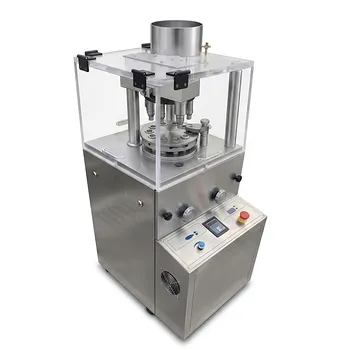
- Enhanced 9 Punch Rotary Tablet Press for Powder Compaction
- 6 Ton Variable Frequency Single Punch Tablet Press
People Also Ask
- What is the role of a laboratory uniaxial hydraulic press in the preparation of alumina ceramic samples? Key Benefits
- What are the advantages of double-action pressing equipment? Master Uniform Density in High-Aspect-Ratio Ceramics
- What is the function of a laboratory hydraulic forming press in CRSS rubber prep? Ensure Superior Material Integrity
- What role does a laboratory hydraulic press play in the forming of Ce-TZP/Al2O3 green bodies? Maximize Density & Strength
- How does a laboratory hydraulic press ensure the quality of high-entropy cathode H-SOFC single cells? Optimize Performance

Tech Team · PowderPreparation
Last updated on May 14, 2026
Related Products
实验室旋转式压片机 多冲模单压式自动连续压片
Ordinary Type Rotary Tablet Press for Pharmaceutical Chemical Food Electronic Industries
6-Ton Small Single-Punch Tablet Press — Laboratory Powder & Granule Tableting Equipment / Tablet Forming Machine
Enhanced 9 Punch Rotary Tablet Press for Powder Compaction