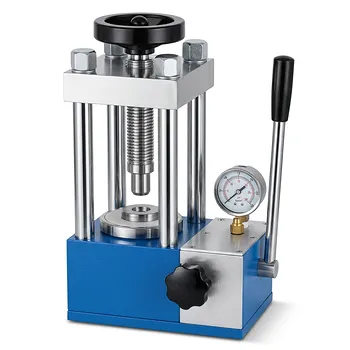
What is the critical function of uniaxial pressure in forming aluminum matrix composites? Optimize Density and Strength
Updated 5 months ago
The critical function of uniaxial pressure in forming aluminum matrix composites is to achieve powder particle densification. By applying high-magnitude force, the hydraulic press expels air from between particles and induces plastic deformation, transforming loose, mechanically alloyed powder into a "green body" with a defined geometric shape and mechanical strength.
Uniaxial pressure acts as the foundational mechanism for physical consolidation, overcoming particle resistance to create a dense compact. This process is essential for establishing the particle contact and initial density required for successful sintering and final component performance.
Mechanisms of Powder Densification
Elimination of Internal Voids
The primary role of the hydraulic press is to force out air trapped between powder particles. By reducing these gaps, the press minimizes porosity and establishes a high initial density within the green body.
Inducing Plastic Deformation
Under high pressure—often reaching between 450 MPa and 700 MPa—the individual powder particles undergo intense plastic deformation. This deformation allows particles to interlock tightly, creating a cohesive solid from loose material.
Overcoming Material Resistance
Mechanically milled composite powders often possess high hardness and complex geometries. The powerful mechanical force of an industrial hydraulic press is required to overcome this resistance and achieve physical densification.
Impact on Sintering and Final Quality
Foundation for Atomic Diffusion
High-pressure compaction expands the contact area between particles. This increased contact is a necessary prerequisite for atomic diffusion and neck growth during the subsequent high-temperature sintering stage.
Controlling Shrinkage and Porosity
A well-pressed green body significantly reduces volume shrinkage during the sintering process. This control is critical for maintaining dimensional accuracy and achieving the desired final porosity in the aluminum matrix.
Uniformity and Defect Prevention
The stability of the hydraulic press determines the uniformity of the compact's internal density. Precise control over the pressure gradient is essential to prevent micro-cracks and density variations that could lead to structural failure.
Understanding the Trade-offs
Pressure Magnitude vs. Tooling Wear
While higher pressures (e.g., 700 MPa) result in greater density, they also increase the mechanical stress on the molds and dies. Excessive pressure can lead to premature tooling failure or the creation of internal stresses that cause the green body to crack upon ejection.
Holding Time and Density Gradients
The duration for which pressure is held is as critical as the magnitude itself. Insufficient holding time may result in elastic recovery (spring-back), leading to a green body with an inconsistent internal density gradient and poor structural integrity.
Material Hardness Challenges
For composites with high-hardness reinforcements, even extreme uniaxial pressure may not achieve theoretical density. In these cases, the limit of plastic deformation is reached quickly, making the management of the powder-to-binder ratio or milling time vital.
How to Apply This to Your Process
Recommendations Based on Project Goals
- If your primary focus is maximizing final relative density: Utilize higher pressures (500-700 MPa) and extended holding times to ensure maximum plastic deformation and particle contact.
- If your primary focus is dimensional precision: Focus on the stability of the hydraulic press to ensure a uniform density gradient, which minimizes uneven shrinkage during sintering.
- If your primary focus is processing hard-milled powders: Prioritize high-tonnage industrial presses capable of overcoming particle resistance to achieve basic mechanical strength in the green compact.
- If your primary focus is reducing sintering defects: Ensure the pressure is high enough to eliminate large voids, as these gaps are difficult to close during low-temperature sintering stages.
By mastering the application of uniaxial pressure, you establish the structural foundation necessary to transform raw composite powders into high-performance industrial components.
Summary Table:
| Key Aspect | Role of Uniaxial Pressure | Impact on Material Quality |
|---|---|---|
| Densification | Expels air and reduces internal voids | Increases initial green body density |
| Deformation | Induces plastic deformation (450-700 MPa) | Interlocks particles for mechanical strength |
| Sintering Prep | Expands particle contact area | Facilitates atomic diffusion and neck growth |
| Precision | Controls volume shrinkage | Ensures dimensional accuracy and prevents cracks |
Elevate Your Material Research with Precision Compaction
Achieving the perfect green body density requires equipment that balances raw power with extreme stability. At KINTEK SOLUTION, we provide complete laboratory sample preparation solutions for material science, specializing in high-performance powder processing and compaction equipment.
Our extensive range includes:
- Advanced Milling: Planetary ball mills, jet mills, and cryogenic grinders for superior powder refinement.
- Sieving & Mixing: Vibratory sieve shakers and high-efficiency powder/defoaming mixers.
- Precision Pressing: A full spectrum of hydraulic presses, including Cold/Warm Isostatic Presses (CIP/WIP), standard lab presses, XRF pellet presses, and advanced vacuum hot presses.
Whether you are developing aluminum matrix composites or advanced ceramics, our solutions are designed to overcome material resistance and ensure uniform density gradients. Contact us today to optimize your laboratory workflow!
References
- Dawit Mekonen, Habtamu Tsegaye. Investigation of the effect of SiC, TiC and TiB2 particles on the microstructure and mechanical properties of aluminum under the local laser melting influence. DOI: 10.56975/ijsdr.v10i7.303893
Mentioned Products
- Ordinary Type Rotary Tablet Press for Pharmaceutical Chemical Food Electronic Industries
- 6-Ton Small Single-Punch Tablet Press — Laboratory Powder & Granule Tableting Equipment / Tablet Forming Machine
- Enhanced 9 Punch Rotary Tablet Press for Powder Compaction
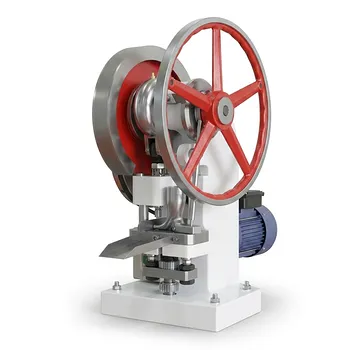
- 5 Ton Single Punch Tablet Press Laboratory Small Batch Production
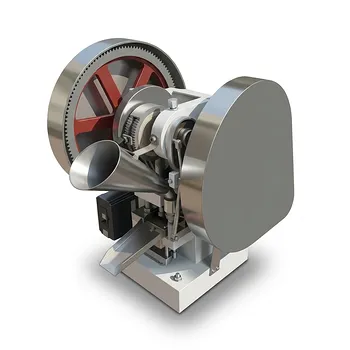
- 6 Ton Variable Frequency Single Punch Tablet Press
People Also Ask
- Why is a laboratory hydraulic press required for FT-IR KBr pellets? Achieve Precise Sample Clarity for ZrC–SiC Analysis
- Why is a laboratory hydraulic press required to compress oyster shell powder before XRF analysis? Improve Data Accuracy.
- Why is vacuum sealing and flexible packaging necessary for Aluminum Titanate powders during CIP? Ensure Peak Density
- What are the advantages of using hardened steel molds and graphite spray for titanium powder? Ensure structural integrity
- What role does a high-strength stainless steel mold kit play in the uniaxial die compaction process? Ensuring Precision

Tech Team · PowderPreparation
Last updated on May 14, 2026
Related Products
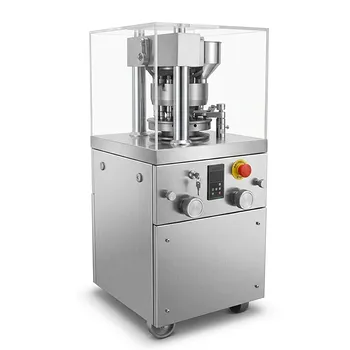
Ordinary Type Rotary Tablet Press for Pharmaceutical Chemical Food Electronic Industries
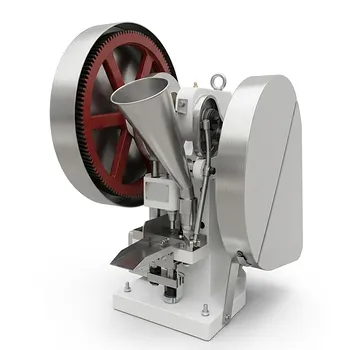
6-Ton Small Single-Punch Tablet Press — Laboratory Powder & Granule Tableting Equipment / Tablet Forming Machine
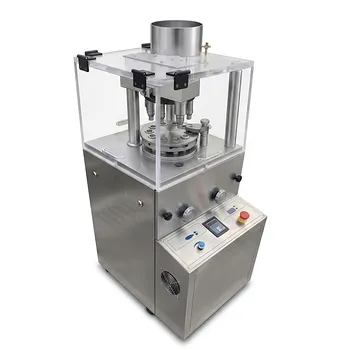
Enhanced 9 Punch Rotary Tablet Press for Powder Compaction
5 Ton Single Punch Tablet Press Laboratory Small Batch Production
6 Ton Variable Frequency Single Punch Tablet Press
Hydraulic Double Shaft Disperser for High Viscosity Liquid Mixing and Dispersion