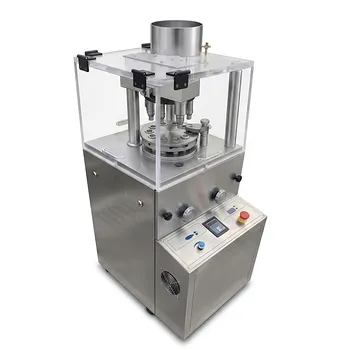
What function does an industrial-grade hydraulic press serve in the production of porous HEA green compacts?
Updated 4 months ago
The industrial-grade hydraulic press serves as the mechanical engine for cold press molding, transforming loose powder mixtures into structural precursors. By applying high unidirectional pressure—often reaching levels such as 160 MPa—the press compresses high-entropy alloy (HEA) powders into cylindrical green compacts. This process is fundamental to establishing the initial density, shape, and particle-to-particle contact required for all subsequent metallurgical stages.
The primary role of the hydraulic press is to induce plastic deformation and mechanical interlocking between alloy particles. This creates a stable green body that possesses the necessary physical integrity for handling and provides the high-surface-area contact required for atomic diffusion during sintering.
Mechanisms of Powder Transformation
Inducing Plastic Deformation
The application of massive axial force compels individual powder particles to undergo plastic deformation. This deformation flattens the contact points between particles, effectively compressing the pores and eliminating air gaps within the mixture.
Establishing Mechanical Interlocking
As particles deform under pressure, they create a stable mechanical interlock that holds the green compact together without the need for chemical binders. This results in a green body with sufficient initial strength to be moved, measured, and placed into a sintering furnace without cracking or crumbling.
Creating the Foundation for Diffusion
By forcing particles into intimate contact, the hydraulic press sets the stage for element diffusion. This close proximity is a prerequisite for the atomic migration and grain growth that occur during the high-temperature sintering process.
Ensuring Structural and Dimensional Integrity
Precise Geometric Shaping
Industrial hydraulic presses use precision steel molds to ensure the green compact achieves specific dimensions and a consistent geometric shape. This precision is vital for reducing dimensional deviations after the final sintering process, ensuring the part meets engineering tolerances.
Controlled Density Distribution
The ability to provide a stable, preset pressing force allows for a more consistent density distribution throughout the compact. Precise control over the dwell time and pressure levels helps minimize internal stresses that could lead to structural failure during heating.
Overcoming Spatial Resistance
The high-pressure environment (reaching levels as high as 1150 MPa in specialized applications) is necessary to overcome the Coulombic forces and spatial resistance of alloy powders. This ensures that the reinforcement phases are tightly embedded within the matrix for a stable final structure.
Understanding the Trade-offs and Pitfalls
The Challenge of Density Gradients
Because industrial presses typically apply uniaxial pressure, the friction between the powder and the mold walls can lead to uneven density. This often results in a "density gradient" where the center of the compact is less dense than the ends, potentially causing warping during sintering.
Balancing Pressure with Target Porosity
In the production of porous high-entropy alloys, applying excessive pressure can be counterproductive. If the pressure is too high, it may eliminate the very pores intended for the final application, while pressure that is too low will result in a fragile compact that cannot survive handling.
Risk of Micro-cracking
Rapid decompression after the pressing cycle can lead to elastic recovery of the particles, which may cause micro-cracks in the green body. Careful control of the pressure release phase is essential to maintain the structural integrity of the alloy.
Applying Compaction Parameters to Your Project
Recommendations Based on Production Goals
- If your primary focus is Maximum Final Density: Utilize higher pressures (exceeding 160 MPa) and longer dwell times to maximize plastic deformation and eliminate internal voids before sintering.
- If your primary focus is Controlled Porosity: Precisely calibrate the hydraulic pressure to the lower end of the effective range to ensure mechanical stability while preserving the interconnected pore networks.
- If your primary focus is Dimensional Precision: Employ high-strength precision molds in conjunction with the press to ensure uniform axial force and minimize post-sintering shrinkage.
The strategic application of hydraulic pressure is the defining step in translating theoretical alloy compositions into viable, high-performance structural materials.
Summary Table:
| Key Mechanism | Action During Compaction | Primary Production Benefit |
|---|---|---|
| Plastic Deformation | Flattens contact points & eliminates air gaps | Enhances atomic diffusion for sintering |
| Mechanical Interlocking | Binds particles without chemical additives | Increases green strength for handling |
| Geometric Shaping | Precision steel molding under axial force | Ensures strict dimensional tolerances |
| Density Control | Regulated pressure and dwell time | Minimizes warping and structural failure |
Optimize Your Material Synthesis with KINTEK
Achieving the perfect balance of porosity and structural integrity in high-entropy alloys requires precision and the right equipment. KINTEK provides complete laboratory sample preparation solutions specifically designed for advanced material science.
Our specialized range includes everything from jaw and roll crushers and cryogenic grinders to high-energy planetary ball and jet mills for superior powder processing. To ensure the highest quality green bodies, we manufacture a full spectrum of hydraulic presses, including:
- Cold/Warm Isostatic Presses (CIP/WIP) for uniform density.
- Manual and Automatic Lab Presses for standard compaction.
- XRF Pellet Presses and Vacuum Hot Presses for specialized thermal processing.
Whether you are a researcher or an industrial distributor, our equipment is built to deliver reliability, precision, and high performance. Contact KINTEK today to find your compaction solution and take your HEA production to the next level!
References
- Ying Wang, Ming Ma. Effect of Porosity on the Corrosion Behavior of FeCoNiMnCrx Porous High-Entropy Alloy in 3.5 Wt.% NaCl Solution. DOI: 10.3390/met15020210
Mentioned Products
People Also Ask
- What is the purpose of adding lubricants like zinc stearate during Al-Al2O3 powder pressing? Achieve Superior Density
- Why is a laboratory hydraulic press required for FT-IR KBr pellets? Achieve Precise Sample Clarity for ZrC–SiC Analysis
- What role does a high-strength stainless steel mold kit play in the uniaxial die compaction process? Ensuring Precision
- Why is a laboratory hydraulic press required to compress oyster shell powder before XRF analysis? Improve Data Accuracy.
- Why is vacuum sealing and flexible packaging necessary for Aluminum Titanate powders during CIP? Ensure Peak Density

Tech Team · PowderPreparation
Last updated on Jun 03, 2026