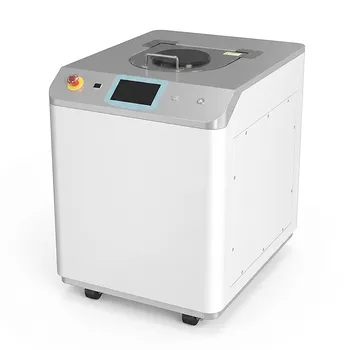
What processing conditions does a vacuum hot press provide for PEEK-NH2/GN? Master Your Thermoforming Success
Updated 4 months ago
To achieve high-performance PEEK-NH2/GN nanocomposites, a high-precision vacuum hot press provides a high-temperature environment of 360°C, a continuous pressure of 3 MPa, and a sustained vacuum atmosphere. These parameters are precisely coupled to ensure the PEEK matrix reaches its melting point and densifies without undergoing thermal-oxidative degradation, which would otherwise compromise the material’s structural integrity.
The core function of a high-precision vacuum hot press is to create a controlled environment where simultaneous thermal and mechanical actions drive the formation of a continuous three-dimensional conductive network. By balancing heat, pressure, and air removal, the system transforms discrete core-shell particles into a dense, functional composite.
The Pillars of the Thermoforming Environment
Precision Temperature Control at 360°C
The PEEK-NH2 matrix requires a high-temperature environment of exactly 360°C to initiate melt flow. At this specific temperature, the polymer moves from a solid to a viscous state, allowing the encapsulated graphene to move and reorient within the matrix.
Continuous Pressure of 3 MPa
A steady axial pressure of 3 MPa is applied to drive the densification process and eliminate internal air gaps. This mechanical force is critical for forcing the polymer melt to fill voids and for pressing the surface-coated graphene layers together to ensure physical contact.
The Role of the Vacuum Atmosphere
The vacuum environment is essential to prevent the thermal-oxidative degradation of the PEEK matrix at elevated temperatures. By removing oxygen, the system protects the chemical structure of the polymer and ensures the final composite retains its intended mechanical and electrical properties.
Microstructural Development and Network Formation
Induction of Melt Flow
Under the combined influence of 360°C heat and 3 MPa pressure, the core-shell structured PEEK-NH2@Gr particles undergo melt flow. This fluid state is the prerequisite for reorganizing the internal components of the nanocomposite.
Formation of the 3D Conductive Network
As the particles melt and flow, the surface-coated graphene begins to overlap. This process creates a continuous three-dimensional conductive network throughout the polymer matrix, which is vital for electrical and thermal conductivity.
Densification and Pore Elimination
Simultaneous heating and pressing drive the rearrangement and diffusion of the material, effectively eliminating closed pores. This results in a high-density matrix with strong interfacial bonding between the graphene fillers and the PEEK-NH2 resin.
Understanding the Trade-offs
Balancing Temperature and Degradation
While 360°C is necessary for melt flow, exceeding this temperature or failing to maintain a vacuum can lead to rapid polymer breakdown. Precision control is mandatory to avoid "scorching" the matrix, which would result in brittle, low-quality parts.
Pressure Sensitivity and Geometric Accuracy
While 3 MPa is required for densification, the pressure must be held constant to achieve a precise geometric thickness. Fluctuations in pressure during the cooling phase can introduce internal stresses or thickness variations that lead to warping in the final sheet.
How to Apply These Conditions to Your Project
Recommendations for Material Success
- If your primary focus is electrical conductivity: Ensure the 3 MPa pressure is held long enough for the graphene layers to fully overlap and form a stable 3D network.
- If your primary focus is structural durability: Prioritize the vacuum integrity to prevent oxidative defects and focus on eliminating porosity through precise axial pressure.
- If your primary focus is geometric precision: Utilize a controlled three-stage cycle (preheating, pressing, and cooling) to manage the cooling rate and prevent internal stress accumulation.
Mastering the interplay between high heat and vacuum-protected pressure is the only way to unlock the full performance potential of advanced PEEK nanocomposites.
Summary Table:
| Processing Parameter | Required Specification | Core Function in Thermoforming |
|---|---|---|
| Temperature | 360°C | Initiates melt flow and enables polymer reorganization. |
| Pressure | 3 MPa (Axial) | Drives densification, eliminates pores, and forms 3D networks. |
| Atmosphere | High Vacuum | Prevents thermal-oxidative degradation of the PEEK matrix. |
| Material State | Melt Flow | Transforms discrete particles into a continuous composite. |
| Final Goal | Dense Nanocomposite | Ensures strong interfacial bonding and high conductivity. |
Elevate Your Material Research with Precision Engineering
Unlock the full performance potential of advanced PEEK nanocomposites and technical ceramics with our high-precision laboratory solutions. At [Company Name], we provide complete laboratory sample preparation solutions for material science, specializing in high-performance powder processing and compaction equipment.
Whether you require a Vacuum Hot Press to master the interplay of heat and atmosphere, or a Cold/Warm Isostatic Press (CIP/WIP) for superior densification, our extensive product line—including planetary ball mills, jet mills, and specialized hydraulic presses—is engineered to meet the most rigorous research standards.
Ready to optimize your thermoforming cycle? Contact our technical experts today for a tailored solution that ensures the structural integrity and functional excellence of your materials.
References
- Huizhi Liu, Zhixiong Huang. Preparation of PEEK-NH <sub>2</sub> /graphene network structured nanocomposites with high electrical conductivity. DOI: 10.1515/epoly-2022-0067
Mentioned Products
- 非介入式材料均质机真空脱泡行星搅拌高粘度混合设备
- Industrial Vacuum Kneader for High-Viscosity Silicone, Rubber, and Compound Mixing
- Dual Cup Vacuum Centrifugal Mixer Planetary Paste Defoaming Machine Industrial Material Processor
- High Efficiency Vacuum Planetary Centrifugal Mixer and Defoaming Machine for Industrial Material Research and Precise Laboratory Powder Dispersion
- High Speed Vacuum Planetary Centrifugal Mixer and Defoamer for Industrial Paste Processing
People Also Ask
- How does a planetary vacuum defoaming mixer help magnesium calcium phosphate slurries? Achieve Flawless 3D Printed Bone
- Why is vacuum defoaming necessary for PDMS mixtures before microwave irradiation curing? Key to Structural Integrity
- What role does a vacuum defoaming mixer play in BNT MLCC slurry? Ensure High Dielectric Strength & Pinhole-Free Prep
- Why is a vacuum defoaming mixer essential for DLP 3D printing ceramic slurries? Key to Structural Integrity
- What is the purpose of using a high-vacuum defoaming mixer for SiC/Cf composites? Optimize Density and Strength

Tech Team · PowderPreparation
Last updated on Jun 03, 2026
Related Products
非介入式材料均质机真空脱泡行星搅拌高粘度混合设备
Industrial Vacuum Kneader for High-Viscosity Silicone, Rubber, and Compound Mixing
Dual Cup Vacuum Centrifugal Mixer Planetary Paste Defoaming Machine Industrial Material Processor
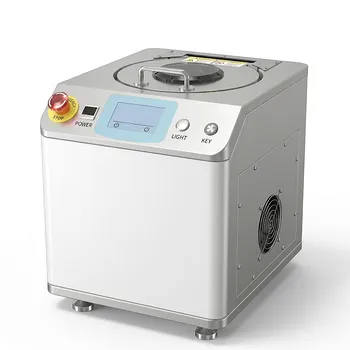
High Efficiency Vacuum Planetary Centrifugal Mixer and Defoaming Machine for Industrial Material Research and Precise Laboratory Powder Dispersion
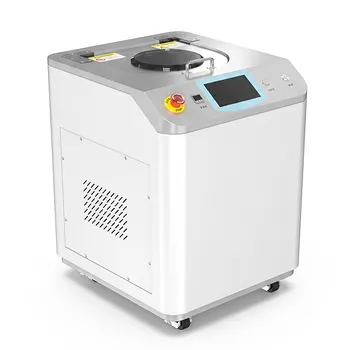
High Speed Vacuum Planetary Centrifugal Mixer and Defoamer for Industrial Paste Processing
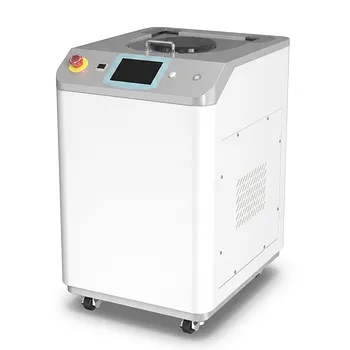
High Viscosity Planetary Centrifugal Mixing and Vacuum Defoaming Machine for Laboratory Material Preparation
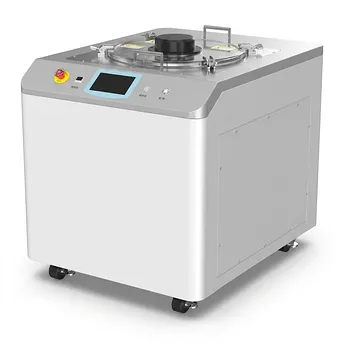
Industrial Planetary Centrifugal Vacuum Defoaming Mixer for High Viscosity Paste and Powder Homogenization
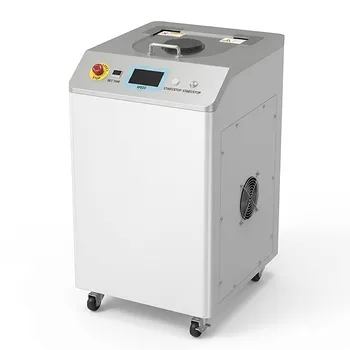
High Viscosity Planetary Centrifugal Vacuum Mixer for Material Defoaming and Uniform Mixing