What are the benefits of using a vacuum Hot Press for NbC cermets? Achieve Superior Density and Purity
Updated 4 months ago
Vacuum Hot Pressing (HP) provides a dual-force advantage for Niobium Carbide (NbC) cermets. By simultaneously applying uniaxial pressure and high heat in an oxygen-free environment, it accelerates densification through plastic flow and diffusion creep at lower temperatures than conventional sintering. This synergy produces high-density materials with a fine-grained microstructure, resulting in an optimal balance of extreme hardness and fracture toughness.
The core benefit of using a vacuum Hot Press for NbC cermets is the ability to achieve near-theoretical density while suppressing grain growth. This process ensures chemical purity and superior mechanical properties by combining mechanical force with precise atmospheric control.
Accelerated Densification and Microstructural Control
Enhancing Diffusion Kinetics at Lower Temperatures
The simultaneous application of uniaxial pressure and heat triggers plastic flow and diffusion creep in NbC powders. This mechanical assistance allows the material to reach full density at temperatures significantly lower than those required by pressureless sintering.
Inhibiting Grain Coarsening
By lowering the required sintering temperature and reducing high-temperature dwell times, the vacuum hot press effectively prevents the grains from growing too large. A fine-grained microstructure is critical for NbC cermets, as it directly translates to higher hardness without sacrificing toughness.
Achieving Near-Theoretical Density
The vacuum HP process is capable of eliminating closed pores that are often trapped during standard sintering. This allows the cermet to approach a density exceeding 99% of its theoretical limit, significantly improving compressive strength and mechanical reliability.
Atmospheric Protection and Chemical Purity
Preventing Oxidation of Carbide Phases
Niobium Carbide and other non-oxide ceramics are highly susceptible to oxidation when exposed to oxygen at high temperatures. The high-vacuum environment isolates the material from oxygen, ensuring the chemical integrity and purity of the carbide phases.
Volatilization of Impurities
The vacuum environment does more than just protect; it actively cleanses the material by accelerating the volatilization of impurities. This results in a higher-purity final product, which is vital for studying the intrinsic properties of the NbC system.
Regulating Internal Pore Distribution
By accurately controlling the pressure load throughout the heating cycle, researchers can regulate the distribution of internal pores. This level of control ensures stable quality across different samples, which is essential for consistent laboratory study and material characterization.
Understanding the Trade-offs and Limitations
Geometry and Complexity Constraints
Because a vacuum Hot Press utilizes uniaxial pressure within a precision mold, it is generally limited to relatively simple shapes like discs or blocks. It lacks the ability of a Cold Isostatic Press (CIP) to produce large-sized or complex-structured parts with uniform pressure from all directions.
Pressure Gradients and Distortion
The friction between the powder and the mold walls during uniaxial pressing can create pressure gradients within the material. This can lead to minor variations in density distribution, which may cause shrinkage distortion if not carefully managed during the cooling phase.
Equipment and Operational Costs
A vacuum Hot Press is a sophisticated piece of equipment that requires significant investment and specialized maintenance. The process is typically more time-consuming on a per-unit basis than continuous sintering furnaces, making it better suited for high-performance applications and research than mass production of low-cost components.
Making the Right Choice for Your Goal
Achieving the best results with NbC cermets depends on aligning your equipment choice with your specific research or production requirements.
- If your primary focus is maximum hardness and toughness: Use a vacuum Hot Press to ensure a fine-grained microstructure and near-theoretical density.
- If your primary focus is chemical purity and oxidation resistance: The high-vacuum environment of a Hot Press is essential to prevent contamination of the carbide phases.
- If your primary focus is manufacturing complex, near-net shapes: Consider using Cold Isostatic Pressing (CIP) to create a uniform green body followed by separate vacuum sintering.
The vacuum Hot Press remains the definitive tool for researchers seeking to push the mechanical limits of Niobium Carbide through precise microstructural engineering.
Summary Table:
| Key Feature | Advantage for NbC Cermets | Impact on Material Quality |
|---|---|---|
| Uniaxial Pressure | Accelerates densification at lower temperatures | Near-theoretical density (>99%) |
| Vacuum Environment | Prevents carbide oxidation and removes impurities | Exceptional chemical purity |
| Thermal Control | Reduces dwell time and prevents grain growth | Fine-grained, high-hardness structure |
| Simultaneous Force | Triggers plastic flow and diffusion creep | Improved fracture toughness & reliability |
Elevate Your Material Research with Expert Compaction Solutions
Achieving the perfect balance of hardness and toughness in Niobium Carbide cermets requires precision equipment. At [Brand Name], we provide complete laboratory sample preparation solutions for material science, specializing in advanced powder processing and compaction technology.
Whether you are refining raw materials with our crushers (jaw/roll) and mills (planetary ball, jet, rotor), or seeking the ultimate densification through our Cold/Warm Isostatic Presses (CIP/WIP) and Vacuum Hot Presses, we have the tools to ensure your research success. Our equipment is designed to help you achieve superior microstructural control and chemical purity for high-performance ceramics.
Ready to optimize your lab's capabilities? Contact our experts today to discuss how our hot presses and powder processing lines can transform your NbC cermet production.
References
- Daniela Hübler, Thomas Gradt. Effect of different binders and secondary carbides on NbC cermets. DOI: 10.1007/s10010-022-00583-1
Mentioned Products
- 非介入式材料均质机真空脱泡行星搅拌高粘度混合设备
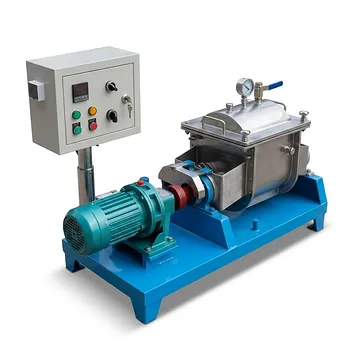
- Industrial Vacuum Kneader for High-Viscosity Silicone, Rubber, and Compound Mixing
- Dual Cup Vacuum Centrifugal Mixer Planetary Paste Defoaming Machine Industrial Material Processor
- High Efficiency Vacuum Planetary Centrifugal Mixer and Defoaming Machine for Industrial Material Research and Precise Laboratory Powder Dispersion
- High Speed Vacuum Planetary Centrifugal Mixer and Defoamer for Industrial Paste Processing
People Also Ask
- How does a planetary vacuum defoaming mixer help magnesium calcium phosphate slurries? Achieve Flawless 3D Printed Bone
- Why is vacuum defoaming necessary for PDMS mixtures before microwave irradiation curing? Key to Structural Integrity
- What role does a vacuum defoaming mixer play in BNT MLCC slurry? Ensure High Dielectric Strength & Pinhole-Free Prep
- Why is a vacuum defoaming mixer essential for DLP 3D printing ceramic slurries? Key to Structural Integrity
- What is the purpose of using a high-vacuum defoaming mixer for SiC/Cf composites? Optimize Density and Strength

Tech Team · PowderPreparation
Last updated on Jun 03, 2026
Related Products

非介入式材料均质机真空脱泡行星搅拌高粘度混合设备
Industrial Vacuum Kneader for High-Viscosity Silicone, Rubber, and Compound Mixing

Dual Cup Vacuum Centrifugal Mixer Planetary Paste Defoaming Machine Industrial Material Processor

High Efficiency Vacuum Planetary Centrifugal Mixer and Defoaming Machine for Industrial Material Research and Precise Laboratory Powder Dispersion

High Speed Vacuum Planetary Centrifugal Mixer and Defoamer for Industrial Paste Processing

High Viscosity Planetary Centrifugal Mixing and Vacuum Defoaming Machine for Laboratory Material Preparation

High Viscosity Planetary Centrifugal Vacuum Mixer for Material Defoaming and Uniform Mixing

Industrial Planetary Centrifugal Vacuum Defoaming Mixer for High Viscosity Paste and Powder Homogenization