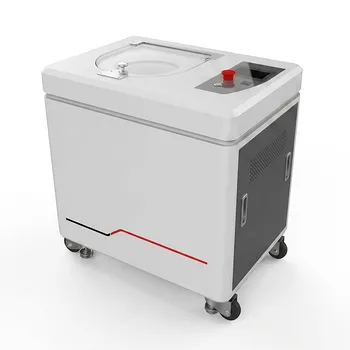
What are the advantages of a vacuum hot pressing furnace? Maximize density and strength in Al2O3-SiC nanocomposites.
Updated 4 months ago
The vacuum hot pressing furnace provides a decisive advantage by simultaneously applying high temperature and uniaxial pressure to force the consolidation of materials that are otherwise resistant to sintering. In Al2O3-SiC nanocomposites, this method achieves near-theoretical density at significantly lower temperatures than conventional sintering by using mechanical force to overcome the pinning effect of nano-SiC particles.
Core Takeaway: Vacuum hot pressing transcends the limits of pressureless sintering by using thermo-mechanical coupling to eliminate residual porosity and inhibit grain growth, resulting in ultra-fine grain nanocomposites with superior mechanical integrity.
The Mechanics of Pressure-Assisted Densification
Overcoming Grain Boundary Resistance
In Al2O3-SiC systems, nano-SiC particles reside at the grain boundaries of the alumina matrix, creating significant resistance to grain boundary movement. While this prevents grain growth, it also makes traditional sintering difficult because the material resists the shrinkage required for densification.
A vacuum hot press overcomes this by applying vertical pressure (typically around 35 MPa), which provides the driving force necessary to move atoms and close pores despite the presence of SiC.
Accelerating Plastic Flow and Rearrangement
The simultaneous application of heat and pressure triggers plastic flow and particle rearrangement within the powder compact. This allows the alumina matrix to flow around the rigid SiC nanoparticles, filling voids that would remain open in a conventional furnace.
This mechanism enables the material to reach a relative density exceeding 99.5%, effectively approaching the material's theoretical maximum.
Microstructural Control and Grain Refinement
Lowering the Required Densification Temperature
Because mechanical pressure assists the sintering process, the absolute temperature required to reach full density is significantly reduced. Conventional sintering often requires extreme heat that can lead to undesirable secondary reactions or energy inefficiency.
By operating at lower temperatures, the vacuum hot press minimizes the energy budget while maintaining tighter control over the material's internal phases.
Suppressing Abnormal Grain Growth
High temperatures in conventional sintering often lead to abnormal grain growth, where a few large grains consume smaller ones, weakening the final ceramic. Vacuum hot pressing achieves densification so rapidly and at such low temperatures that the alumina grains do not have the thermal energy to grow excessively.
The result is an ultra-fine grain structure that preserves the strengthening and toughening effects of the SiC reinforcements.
The Role of the Controlled Vacuum Environment
Preventing Oxidative Degradation
Silicon Carbide (SiC) is susceptible to oxidation at high temperatures, which can form a brittle silica layer that weakens the bond between the matrix and the reinforcement. The vacuum environment inhibits this oxidation, ensuring the chemical purity of the SiC phase remains intact.
This preservation of the reinforcement phase is critical for maintaining the high hardness and wear resistance expected from nanocomposites.
Improving Interfacial Bonding
The vacuum system effectively removes adsorbed gases and moisture from the surface of the powder particles before consolidation begins. This leads to a cleaner interface between the Al2O3 and SiC, which promotes stronger atomic bonding.
Strong interfacial bonding is the primary factor that allows the composite to effectively transfer loads from the matrix to the nano-reinforcements.
Understanding the Trade-offs
Geometric Limitations
Unlike conventional sintering, which can handle complex "near-net" shapes in a batch environment, hot pressing is generally restricted to simple geometries. Because the pressure is applied uniaxially (vertically) via graphite dies, the process is best suited for producing discs, plates, or cylinders.
Throughput and Cost Considerations
The requirement for high-strength graphite tooling and the specialized nature of vacuum-pressure cycles make hot pressing more capital intensive than pressureless sintering. Each cycle typically produces fewer parts, making it a "quality-over-quantity" solution for high-performance applications.
Making the Right Choice for Your Goal
- If your primary focus is Maximum Mechanical Strength: Utilize vacuum hot pressing to ensure near-zero porosity and an ultra-fine grain size that maximizes fracture toughness.
- If your primary focus is Cost-Effective Mass Production: Consider conventional sintering for simpler Al2O3 components where the performance requirements do not justify the tooling costs of hot pressing.
- If your primary focus is Chemical Purity and Phase Integrity: Select the vacuum hot press to prevent the oxidation of SiC and ensure a clean, high-strength bond between the matrix and reinforcements.
Vacuum hot pressing stands as the definitive solution for engineering Al2O3-SiC nanocomposites that require the highest possible density and refined microstructures.
Summary Table:
| Feature | Conventional Sintering | Vacuum Hot Pressing |
|---|---|---|
| Densification Force | Thermal energy only | Thermo-mechanical coupling |
| Relative Density | Often lower due to SiC pinning | Near-theoretical (>99.5%) |
| Grain Structure | Risk of abnormal grain growth | Ultra-fine, refined grains |
| Sintering Temp. | Higher temperatures required | Significantly lower temperatures |
| Atmosphere | Ambient or inert | High vacuum (prevents oxidation) |
| Geometry | Complex near-net shapes | Simple shapes (discs, cylinders) |
Elevate Your Material Research with Precision Engineering
Achieving theoretical density and superior mechanical properties in advanced ceramics requires more than just heat—it requires precise control over pressure and environment. At [Brand Name], we provide complete laboratory sample preparation solutions tailored for material science.
Whether you are refining powders with our planetary ball mills, jet mills, and disc mills, or consolidating high-performance composites, our equipment ensures reliability and excellence. Our extensive lineup includes:
- Powder Processing: Jaw/roll crushers, liquid nitrogen cryogenic grinders, and high-efficiency sieve shakers.
- Advanced Mixing: Precision powder mixers and specialized defoaming mixers.
- Compaction & Sintering: A full spectrum of hydraulic presses, including Cold/Warm Isostatic Presses (CIP/WIP), XRF pellet presses, and state-of-the-art Vacuum Hot Presses.
Ready to optimize your Al2O3-SiC nanocomposite production? Contact our technical experts today to find the perfect solution for your lab’s specific needs.
References
- Alireza Moradkhani, Ali Naserifar. Effect of Sintering Temperature on the Grain Size and Mechanical Properties of Al2O3-SiC Nanocomposites. DOI: 10.4191/kcers.2019.56.3.01
Mentioned Products
People Also Ask
- How does a planetary vacuum defoaming mixer help magnesium calcium phosphate slurries? Achieve Flawless 3D Printed Bone
- Why is vacuum defoaming necessary for PDMS mixtures before microwave irradiation curing? Key to Structural Integrity
- What role does a vacuum defoaming mixer play in BNT MLCC slurry? Ensure High Dielectric Strength & Pinhole-Free Prep
- Why is a vacuum defoaming mixer essential for DLP 3D printing ceramic slurries? Key to Structural Integrity
- What is the purpose of using a high-vacuum defoaming mixer for SiC/Cf composites? Optimize Density and Strength

Tech Team · PowderPreparation
Last updated on Jun 03, 2026